A coffee-machine manufacturer sells 40 machines through an online campaign. Each sale brings in ₹20,000, excluding tax. The campaign spends ₹2 lakh on advertising and reports ₹8 lakh in revenue: a 4x return on ad spend.
Then the order costs are added up. After making, packing, delivering and supporting each machine, the manufacturer has ₹4,000 left per sale. Advertising costs ₹5,000 per sale. The campaign is ₹1,000 short on every machine, or ₹40,000 across the 40 orders, before fixed overheads.
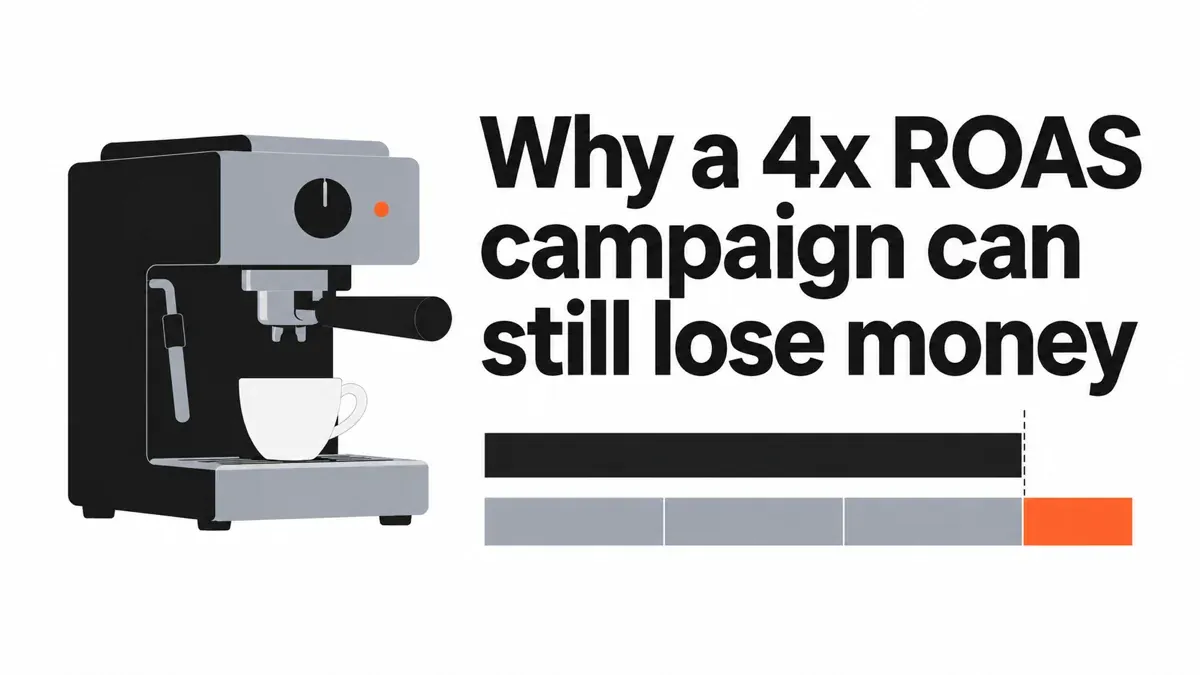
A 4x ROAS campaign can still lose money when the contribution available before advertising is less than 25% of revenue. At 4x ROAS, advertising alone consumes that 25%.
About this example: this is a hypothetical coffee-machine manufacturer, not a disclosed client case or an industry benchmark. All prices, costs and sales volumes below are explicit teaching assumptions. The editorial perspective draws on an anonymous contributor’s observations; the numerical scenario is independently constructed.
What 4x ROAS measures and what it leaves out
For this article, ROAS means revenue attributed to advertising divided by media spend. ₹8,00,000 divided by ₹2,00,000 equals 4x, or 400%. It means ₹4 in attributed revenue for every ₹1 spent on media. It does not establish how much profit the manufacturer keeps. ROAS measures attributed revenue against advertising cost; profitability requires a wider cost calculation.
Here, agency fees and creative production are outside media spend and must be considered separately. Keep that definition consistent across reports. You can check the multiple and contribution after ads using the ROAS calculator.
The coffee-machine example: follow one order first
Assume one machine per order, 40 completed sales, and a net selling price of ₹20,000 per machine after discounts and excluding sales tax. For simplicity, all 40 orders are credited to this campaign and there are no refunded sales in the measured period. These assumptions make the arithmetic transparent; they do not prove that advertising caused every sale.
Item | Per machine | 40 machines |
|---|---|---|
Net sales | ₹20,000 | ₹8,00,000 |
Variable manufacturing cost | −₹14,000 | −₹5,60,000 |
Protective packaging and order handling | −₹500 | −₹20,000 |
Outbound delivery paid by the seller | −₹500 | −₹20,000 |
Payment-processing cost: assumed 3% of net sales | −₹600 | −₹24,000 |
Expected after-sales cost allowance | −₹400 | −₹16,000 |
Contribution before advertising | ₹4,000 | ₹1,60,000 |
Media spend allocated across orders | −₹5,000 | −₹2,00,000 |
Modelled contribution after advertising | −₹1,000 | −₹40,000 |
The ₹14,000 manufacturing assumption covers variable components, assembly and testing. It excludes fixed factory overheads. Packaging is listed separately, so it must not also sit inside manufacturing cost. The 3% processing charge is a simplified modelling assumption, not a quoted provider rate; actual fees and their calculation base should come from settlement records.
The ₹400 after-sales allowance estimates additional warranty parts, service labour and related transport attributable to these sales. It is an expected cost, not a claim that each buyer has already needed a ₹400 repair. Replace it with evidence from the manufacturer’s own warranty and service history.
This distinction matters: the ₹40,000 is a modelled contribution loss after allowing for expected after-sales costs, not a verified bank-account shortfall. Even before that ₹16,000 allowance, the scenario is ₹24,000 negative after advertising. Fixed factory costs, office costs, agency fees and other omitted expenses would still need to be covered.
A 30% product margin is not a 30% advertising budget
Looking only at ₹20,000 revenue and ₹14,000 variable manufacturing cost leaves ₹6,000, or 30% of revenue. It is tempting to treat that entire amount as available for advertising.
But packaging, delivery, processing and the after-sales allowance consume another ₹2,000. The amount available before ads is ₹4,000, or 20%. Calling the initial 30% a complete margin would overstate what the campaign can afford.
For machinery, the sale does not end when the checkout payment arrives. Depending on the product and sales model, installation, replacement parts, technical support and warranty transport can matter. Include the costs the manufacturer actually bears, using a consistent method and without counting them twice.
Editorial perspective: agree on the cost before judging the campaign
An anonymous contributor describing their experience with an e-commerce campaign emphasised that the business must understand the actual product cost, overheads and money retained from a sale before deciding whether advertising is working. This is a paraphrase of their perspective, not a verbatim quotation or a verified financial case study.
For a coffee-machine manufacturer, that means the campaign team and the finance or operations team need an agreed cost per completed order. A revenue target without that cost sheet can reward sales that leave too little to fund the business.
Calculate the break-even ROAS for this manufacturer
Contribution margin before advertising = ₹4,000 ÷ ₹20,000 = 20%. For a positive contribution margin, advertising break-even ROAS = 1 ÷ contribution margin expressed as a decimal. Here, 1 ÷ 0.20 = 5x.
At the same ₹8 lakh in sales, the maximum media spend that would leave zero contribution after ads is ₹1.6 lakh. The actual ₹2 lakh spend exceeds that limit by ₹40,000. A 5x result would cover the modelled variable costs and media spend, while leaving nothing for fixed overheads or profit.
ROAS on the same ₹8 lakh net sales | Media spend | Contribution after ads |
|---|---|---|
4x | ₹2,00,000 | −₹40,000 |
5x | ₹1,60,000 | ₹0 |
6.25x | ₹1,28,000 | ₹32,000 |
These are comparisons at a fixed sales volume and cost structure, not predictions that reducing spend will preserve all 40 sales. Even the ₹32,000 at 6.25x is contribution toward overheads and profit, not net profit.
Use the break-even ROAS calculator with costs that match its field definitions. Keep net revenue consistent with the revenue used for ROAS. If the calculator does not separately capture a cost such as warranty service, calculate the complete contribution margin first and use it in the ROAS calculator, or maintain a separate cost sheet. Do not silently leave the expense out.
Reconcile revenue before celebrating the result
Match the campaign’s purchase reporting to completed orders and payment records for the same cohort and period. Check purchase values, currency, discounts, cancellations, refunds and taxes. A dashboard may retain the initial purchase value even when an order is later cancelled or partly refunded.