
Advora.media
Language

Opens Google Translate in a new tab. Automatic translations may contain errors.

Performance Marketing/ Insights

How to plan an advertising budget from a sales target

Work backwards from the sales target to the enquiries and media spend required, then plan for awareness, conversion and delivery. A practical approach for real estate, manufacturing and e-commerce.

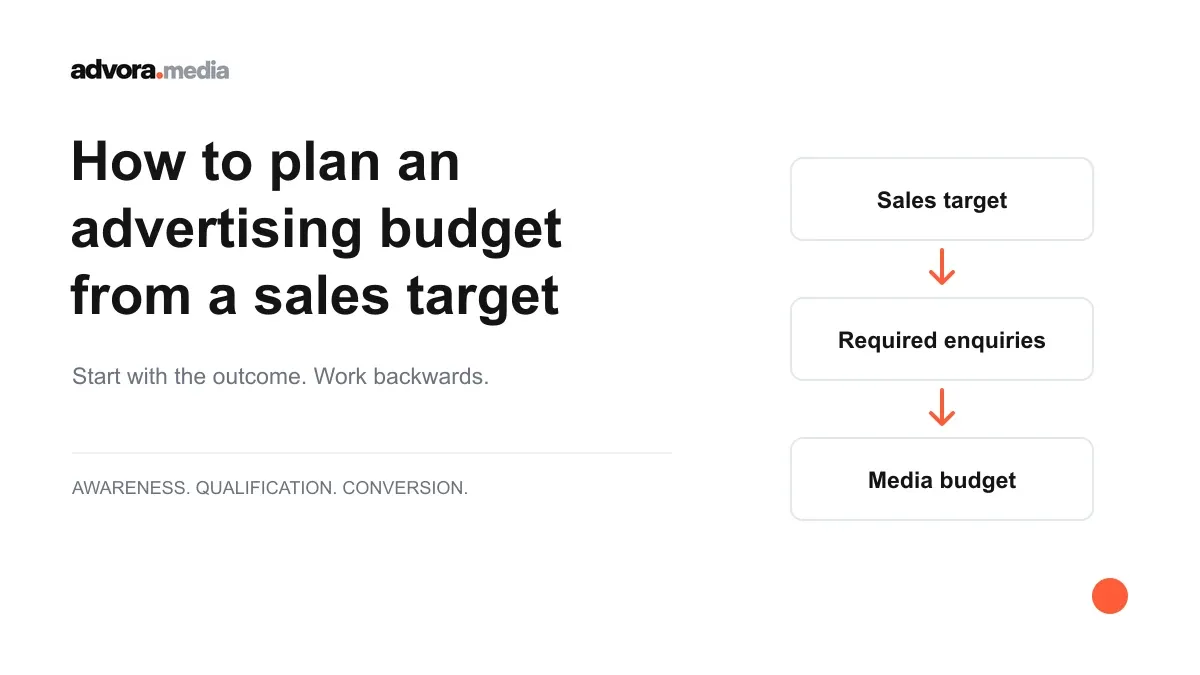
How to plan an advertising budget from a sales target: a sequence connects the sales target, required enquiries and media budget.
Plan backwards from sales through the required enquiries to media spend. Conceptual illustration. Credit: Advora Editorial Team

A sales target tells you what the business wants. It does not, by itself, tell you how much advertising will be needed to achieve it. The missing link is the path from first exposure to qualified interest and, eventually, a completed sale.

To plan an advertising budget from a sales target, work backwards through that path. Estimate the conversions required at each stage, apply a defensible acquisition-cost range, and then account for the awareness, creative, sales support and measurement needed to make the plan work. Check the resulting budget against margins, cash availability and delivery capacity before committing it.

Real estate makes this process easy to see: sales require suitable site visits, visits require qualified prospects, and qualified prospects come from a larger pool of enquiries. The same reasoning works for a manufacturer selling through demonstrations and quotations, or an e-commerce business selling directly online.

Editorial perspective: define the funnel before dividing the budget

An anonymous contributor described a planning approach that starts with the purpose of each stage. In their real estate example, the top of the funnel builds awareness and relevant reach; the middle generates qualified enquiries and moves them toward site visits; the bottom turns suitable visits into closures. The message should change with the decision the buyer is making.

Their central point was to reverse the calculation: start with the sales required, then estimate the site visits, qualified leads and total enquiries needed to support them. Use an observed lead-cost range to translate that requirement into a media estimate. Without historical data, begin with testing and review what the campaign and sales process actually produce.

This is a paraphrase of a contributed perspective, not a verbatim quotation or a documented client case. No client identity or project performance figures are used. The examples below explain planning methods rather than promise campaign results.

Start with a sales target that the business can actually use

Specify the outcome, deadline and commercial value. In real estate, a reservation, a retained booking and a completed transaction are different milestones. In manufacturing, a quotation is different from a purchase order. In e-commerce, orders placed differ from orders retained after cancellations and returns.

Also separate the total business target from the part advertising is expected to support. Review the existing pipeline, repeat customers, referrals and other sources before asking new campaigns to supply every sale. Use realistic expectations for that pipeline rather than treating all open opportunities as guaranteed revenue.

Allow enough time for new enquiries to mature. A campaign launched this month may contribute to later sales, while this month’s closures may come from earlier campaigns. A target that ignores the sales cycle can make a reasonable campaign look ineffective or credit it for customers acquired before it started.

Work backwards from closures to enquiries

For a simple real estate funnel, calculate required attended site visits as target closures divided by the attended-visit-to-closure rate. Then calculate required qualified leads as required attended visits divided by the qualified-lead-to-attended-visit rate. Finally, divide qualified leads by the enquiry-to-qualified rate to estimate the enquiries needed.

Each percentage must refer to the preceding stage, and each stage needs the same definition across the data you use. A scheduled visit is not an attended visit. If some customers purchase without visiting, model that route separately rather than forcing all sales through a stage they never completed.

Use conversion rates from comparable, sufficiently mature groups of leads wherever possible. Separate projects, price bands and channels when their outcomes differ materially. An average assembled from unrelated campaigns can make the calculation precise on paper and unreliable in practice.

The Lead Funnel & CAC calculator helps test whether your planned spend, CPL and stage conversion rates support the intended outcome. Check its stage labels: the real estate preset ends at bookings, which should not silently become completed transactions in your report. Its CAC calculation uses media spend, not every sales and marketing expense.

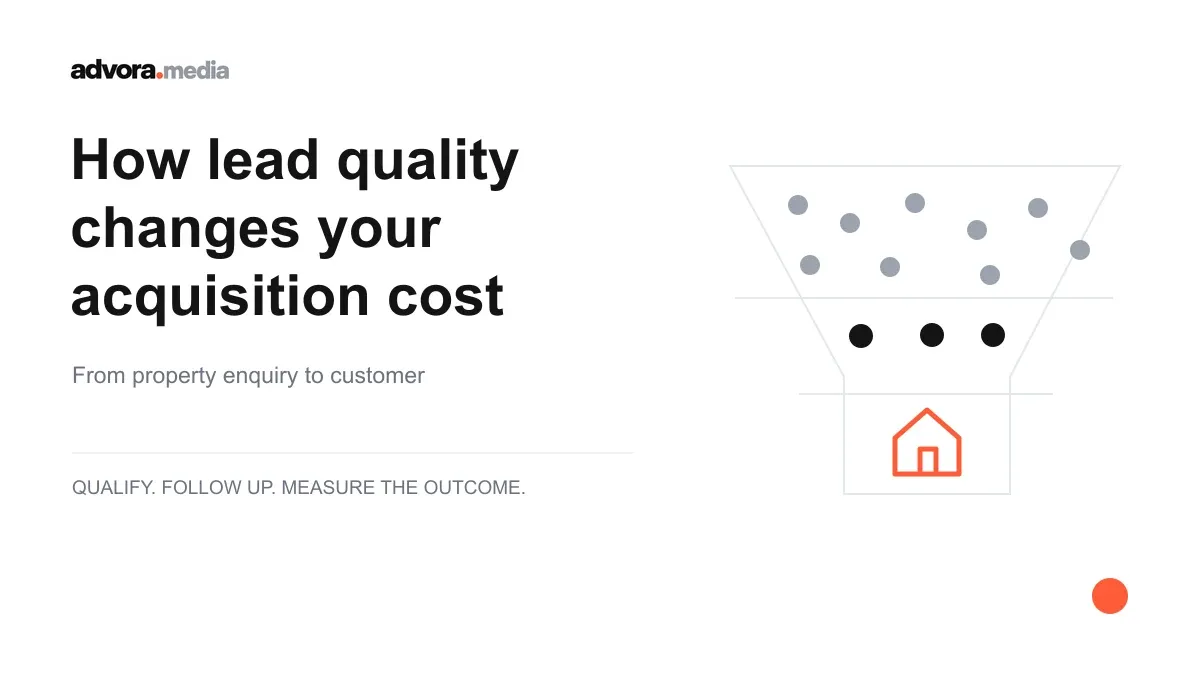
If the qualification rate is uncertain, our guide to how lead quality changes your acquisition cost explains why a cheaper enquiry can still cost more to turn into a customer.

Turn the lead requirement into a budget range

Once the enquiry requirement is established, the basic calculation is: lead-generation media budget = required enquiries × expected cost per enquiry. Use a low and high cost assumption, and document where each comes from. A recent observed range is usually more relevant than a generic industry average.

In the Ad Budget Planner, choose Target leads and Your assumptions, enter the lead requirement for the planning month, and add your low and high CPL estimates. Its planning buffer applies to the upper estimate only. That buffer is a contingency you choose, not a statistical confidence interval.

Keep the time periods aligned. If the sales objective spans a longer cycle, phase the lead requirement across the months when enquiries must enter the pipeline. Do not place a quarterly requirement into a monthly field and then interpret the result as the total quarterly budget.

The planner estimates media spend and excludes creative, agency fees and taxes. Its daily pacing divides the monthly amount across 30 days; adapt your operational pacing to the actual calendar and sales schedule. Higher spend does not guarantee proportionately more enquiries.

Run a weaker-conversion scenario as well as a higher-CPL scenario. A contingency on lead price alone does not cover a deterioration in qualification or closing rates. If the cautious scenario is unaffordable, reconsider the target, timing, offer or conversion process before approving the plan.

Give each funnel stage a job and a message

Top of funnel: establish relevance and familiarity

For a property project, awareness creative can introduce the location, property type, starting price and reasons the project may suit the buyer. For a manufacturer, it might demonstrate a problem the equipment solves. For e-commerce, it might show the product in use and establish why someone would consider it.

Reach, frequency and engagement help describe delivery and response. They are not interchangeable with sales. Treat frequency as a measure to manage, not an outcome to maximise indefinitely: repeated exposure is useful only while the audience and message remain relevant.

Middle of funnel: help people evaluate and qualify

Real estate prospects may need floor plans, location details, price clarity and a suitable visit appointment. Industrial buyers may need specifications, compatibility information and a demonstration. Online shoppers may need sizing, delivery details, product comparisons and credible evidence of performance.

The budget here should support the next meaningful decision. Measure qualified conversations, relevant appointments or other useful progression rather than counting every interaction as equivalent. Keep qualification questions tied to information the sales team will use.

Bottom of funnel: remove barriers to a decision

After a property visit, the work may involve answering objections, confirming availability and following up on the buyer’s requirements. Manufacturing may require a technical evaluation, quotation and procurement discussion. E-commerce may need clear checkout, payment and returns information.

Some of that work belongs to sales and operations rather than paid media. Budget for it explicitly. These stages describe buyer needs, not three compulsory campaign types: the same channel can help at more than one stage, and buyers do not always move through them in a neat sequence.
Avoid counting the same media spend twice

Reverse-planning from CPL estimates the spend covered by that CPL definition. Before adding a separate awareness or retargeting allocation, establish what the historical numerator already included. If it included the entire paid-media programme, adding those campaigns again overstates the requirement.

If it covered only direct lead-generation campaigns, additional awareness activity may need its own budget, objective and evaluation plan. Equally, the observed CPL may have benefited from an existing brand presence; it may not transfer unchanged to a new launch with little familiarity.

There is no universal percentage split between awareness, consideration and conversion. Start with the constraint you need to address. A new project may need recognition, while an established project may have enough interest but poor visit attendance. Fund a clear hypothesis and review whether it improves the relevant stage.

Keep a single budget sheet with distinct lines for media, production, agency services, landing pages, tracking, CRM and sales-support costs. Record taxes and payment timing according to how the business manages them. Keep a reserve available for uncertainty without treating it as money that must be spent.

Plan outdoor advertising around an audience and a purpose

A prominent hoarding is not automatically the right placement. For a property campaign, assess the buyer catchment, travel routes, visibility, direction of travel, viewing conditions and campaign duration. Ask the media owner to explain how its audience estimates are produced. Footfall or passing traffic alone does not prove that the intended buyers noticed the advertisement.

For digital outdoor screens, establish how often the creative appears in the loop and what delivery reporting is available. Consider production, installation, rental and other quoted costs together. Choose a simple message that can be understood in the viewing time available; repetition cannot repair an unclear offer.

The US trade body OAAA’s out-of-home measurement guidance is a useful reference for distinguishing audience measurement from campaign outcomes. It is not a local rate card or evidence that a particular Indian location reaches affluent buyers. Ask for evidence relevant to the placement and market you are buying.

Dedicated landing pages, memorable URLs, trackable phone numbers and suitable QR placements can help record response. Use QR codes where people can safely stop and scan, rather than expecting moving drivers to do so. The UTM builder can label campaign destinations consistently, but direct-response tracking will not capture every effect of outdoor exposure.

Compare CRM sources, brand-search patterns and outcomes over an appropriate period. These are supporting signals, not proof that every change was caused by the hoarding. Where feasible, a planned comparison with similar unexposed locations or periods can strengthen the evaluation. Avoid adding platform-attributed sales and offline claims as if they were different customers.

What to do when historical performance is missing

Treat the first budget as a funded learning plan. Specify what you need to learn: whether the offer attracts suitable interest, the cost of that interest, the proportion that qualifies and the ability of sales to progress it. Use supplier quotes and relevant references as starting assumptions, not established results.

Keep the initial test focused enough that each campaign receives meaningful delivery. A small budget spread across too many channels, audiences and creative variants may produce activity without enough evidence to choose between them. Set an affordable spending limit, a review date and the decisions the test should inform.

Check tracking, spend, lead delivery and follow-up daily. Do not infer the final close rate from fresh enquiries or reset the plan after every quiet day. Google’s conversion-delay reporting guidance explains how delayed conversions can affect recent CPA and ROAS reporting. CRM outcomes can also take time to mature.

Replace assumptions with observations as evidence accumulates. A few favourable outcomes should not become a permanent forecast. Keep the uncertainty visible and expand the budget in stages that the business can afford to evaluate.

Adapt the calculation to manufacturing and e-commerce

Manufacturing: budget for the buying process, not just the enquiry

For a manufacturer selling equipment, work backwards from won orders through accepted proposals, demonstrations or technical evaluations and qualified enquiries. Define qualification around application fit, purchasing authority, timing and the ability to meet the customer’s requirements.

Allow for procurement delays, quotation work and installation or service capacity. A large order value is not the amount available for advertising: production, delivery and support costs must be covered. If capacity is already committed, more enquiries may create a backlog rather than useful near-term sales.

E-commerce: connect revenue targets to retained contribution

For direct online sales, the Ad Budget Planner’s Target revenue mode divides the monthly revenue target by the planned revenue ROAS, then applies the chosen buffer to the upper estimate. Use consistent revenue after refunds and discounts, and a ROAS assumption supported by the business’s own evidence.

That calculation estimates spending under an assumption; it does not prove the campaign will reach the target or make a profit. Product costs, fulfilment, payment fees and expected returns determine what the business can afford to pay for acquisition. Our article on why a 4x ROAS campaign can still lose money shows why the margin check must come before scaling.

Decide in advance when to hold back spending

The contributor identified poor conversion, falling lead quality and limited stock as reasons to reconsider spend. Turn these into explicit review conditions. If qualification weakens, inspect message, source and form quality. If qualified leads fail to attend visits, inspect scheduling and follow-up. If visits do not close, examine the offer and sales feedback before assuming more traffic is the answer.

Also check available inventory, production capacity, sales-team workload and cash timing. A campaign can look promising while the business lacks the stock, staff or cash to fulfil the demand. Increase spending only when the next tranche has a credible commercial purpose and the team can handle it.

A useful media plan therefore contains more than a spending total: it states the target and deadline, funnel definitions, conversion assumptions, lead-cost range, channel roles, full cost scope, measurement method and review conditions. That makes it possible to revise the plan when reality changes rather than defend a number that no longer fits.

Frequently asked questions

Can I calculate an advertising budget from sales alone?

Not reliably. You also need assumptions about conversion, acquisition costs, the sales cycle and the contribution available to fund acquisition. A sales target is the starting point for a model, not a spending recommendation on its own.

Should every business use the same funnel budget split?

No. The allocation depends on familiarity, demand, channel economics and the stage currently restricting sales. Define the purpose of each allocation and avoid counting activity twice.

Should I change the budget every day?

Monitor delivery and operational problems daily, but make performance decisions with enough evidence and allowance for conversion delays. Respond promptly to broken tracking or unavailable stock; assess slower sales outcomes over a suitable window.

Performance Marketing

WhatsApp Commerce Benchmarks (2026): Funnel Drops & Conversion Design

Real WhatsApp commerce benchmarks for 2026: open, click and chat-to-order rates for Indian D2C brands, where the five-stage WhatsApp sales funnel leaks, the conversion design choices that lift it from 2% to 10%, and what the Business API now costs after the October 2026 pricing change.

Advora Editorial Team

Performance Marketing

How lead quality changes your acquisition cost

A real estate campaign can generate cheap enquiries and still struggle to acquire customers. An anonymous practitioner’s experience shows why qualification, CRM feedback and sales follow-up must be assessed together.

Advora Editorial Team