A real estate campaign can deliver a busy CRM and an idle sales pipeline. The enquiries arrive, the cost per lead looks attractive, and the sales team spends its day speaking to people whose budget, preferred location or buying plans do not match the project.
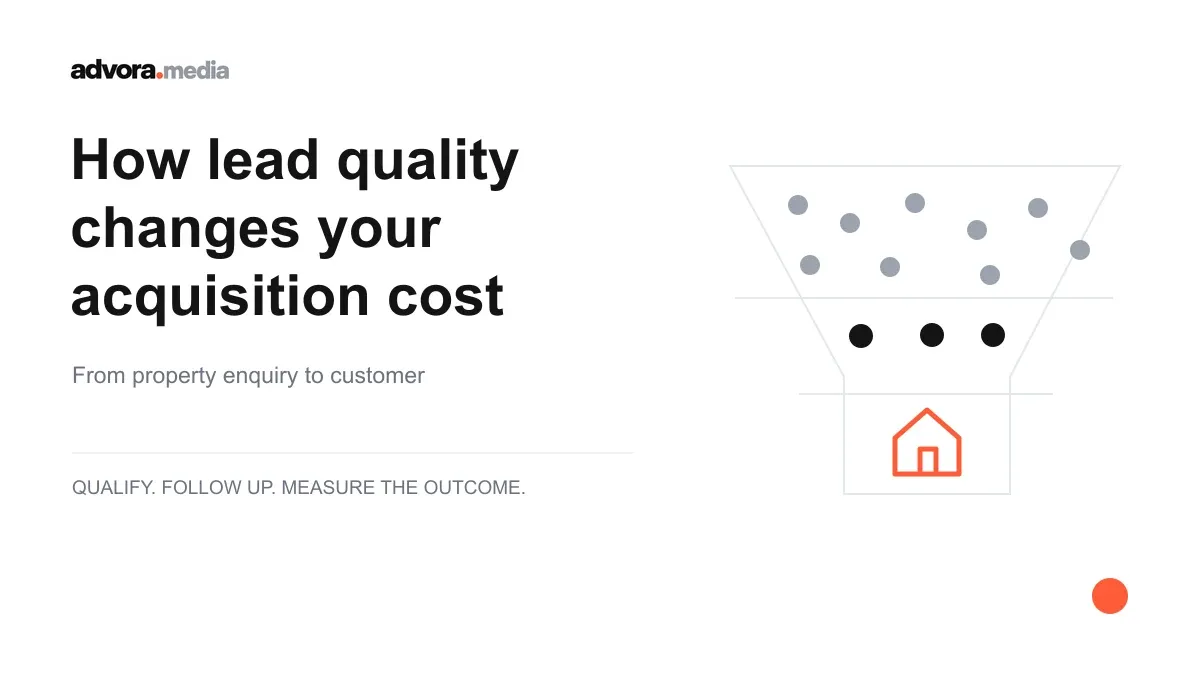
Lead quality changes acquisition cost through the proportion of enquiries that become customers. A more expensive lead can cost less to acquire as a customer if it is sufficiently more likely to progress through qualification, a site visit and a purchase. But better qualification alone does not guarantee lower customer acquisition cost: lead prices and downstream conversion rates still matter.
This article draws on an anonymous marketing practitioner’s account of working on residential property campaigns. It explains the decisions and sales process they described. It does not disclose the developer, reproduce project figures or claim a measured performance uplift; comparable campaign records were not available for verification.
Why a cheap property enquiry can become expensive
Submitting a form is an early action. It does not establish that someone can afford the property, wants that location, understands the offer or plans to buy. When reporting stops at the form submission, advertising can appear successful even while the sales team struggles to arrange relevant conversations.
The cost is more than media spend. Repeated calls, qualification, appointment coordination and follow-ups consume staff time. A campaign that produces fewer suitable conversations may require more sales effort for each eventual customer.
CPL remains useful for understanding how much an enquiry costs. The mistake is treating a lower CPL as sufficient evidence of a better campaign. The same reporting problem appears when revenue is confused with profit: our analysis of why a 4x ROAS campaign can still lose money explains why a strong headline metric needs a business outcome behind it.
Editorial perspective: quality begins before the first call
In the practitioner’s account, the useful shift was from filling the CRM to helping the sales team identify people who could realistically progress. They emphasised visible starting prices, clearer project information, a small number of qualifying questions, prompt follow-up and sending CRM outcomes back to the advertising platform.
They also described better conversations when advertising and sales worked as a connected process. The team contacted new enquiries promptly, understood requirements, arranged relevant site visits and followed up toward a booking. These are observations from their experience, not evidence that any single campaign setting caused an improvement.
The editorial lesson is to agree what a qualified lead means before asking a campaign to deliver more of them. Otherwise, marketing may count every contactable person as qualified while sales counts only people ready to visit. Both teams can report accurately against different definitions and still disagree about performance.
Define the stages before comparing acquisition costs
Enquiry and qualified lead
An enquiry is a new, deduplicated expression of interest. A qualified lead is someone whose requirements broadly match the available property: budget, preferred location, configuration and purchase timing. Record these criteria consistently. A working phone number is useful, but it is not proof of buying intent.
Keep uncontacted, unreachable, duplicate, unsuitable and future prospects separate. Someone who has not answered yet is not necessarily an unsuitable buyer. A suitable person planning a later purchase may need nurturing rather than immediate rejection.
Scheduled visit and attended visit
A scheduled appointment is a commitment to a next step; an attended site visit shows that the person actually took it. Track both so cancellations and no-shows do not disappear inside a broad “site visits” total. Also record whether the visitor still fits the project after seeing it.
Booking and completed customer acquisition
A booking is not automatically a completed transaction. Choose an explicit booking definition, record cancellations, and distinguish bookings from completed sales. If the campaign is being evaluated on bookings, label the metric “advertising cost per booking.” Do not silently present it as the cost of a completed customer acquisition.
How lead quality affects the maths
For a consistent cohort: advertising cost per qualified lead = advertising spend ÷ qualified leads. Advertising cost per attended visit = advertising spend ÷ attended visits. Advertising cost per confirmed booking = advertising spend ÷ confirmed bookings.
The relationship can also be written as: advertising cost per booking = CPL ÷ (lead-to-qualified rate × qualified-to-attended-visit rate × attended-visit-to-booking rate). Enter rates as decimals, and make each rate conditional on the preceding stage. This simplified funnel assumes bookings follow that sequence; track alternate routes separately if buyers can book without visiting.
If qualification improves while CPL and the later conversion rates remain unchanged, advertising cost per booking falls. If CPL rises, the improvement must be large enough to offset that rise. If qualified prospects stop attending visits or visits stop converting, the early improvement may never reach the booking stage.
Fully loaded customer acquisition cost needs a broader numerator: the sales and marketing costs allocated to acquiring new customers, divided by those new customers. Depending on the business, that includes agency fees, sales compensation, relevant software and other acquisition expenses as well as media. Use a consistent cost scope and account for the time between enquiry and completion.
Use the Lead Funnel & CAC calculator to explore these relationships with your own inputs. Select the real estate funnel and review every stage assumption. Its media-spend calculation is an advertising-only estimate; the final booking stage is not automatically a completed sale. Preset rates are directional starting points, not evidence of this project’s performance.
Make the creative help buyers qualify themselves
A property creative should give a prospective buyer enough information to recognise whether the offer fits. Make the actual starting price, project location and relevant property configuration easy to see. Keep the ad, form, landing page and sales conversation consistent about what is available and what the advertised price includes.
This may reduce some enquiries. That can be useful when the people opting out were never a fit, but fewer forms alone do not establish an improvement. Check whether suitable conversations, attended visits and bookings become more efficient.
Do not infer a person’s affordability from an audience label. Budget fit is something to establish through the offer, their stated requirements and the sales conversation. Nor does putting a price in a creative guarantee that a platform will find buyers at that price.
Meta describes Andromeda as an ads retrieval system, announced in December 2024. That description does not establish that displaying a property price identifies someone’s income or guarantees qualified enquiries. The practical reason for price clarity is straightforward: it helps the buyer understand the offer.