A well-designed WhatsApp sales funnel converts 10 to 12% of chat entries into paid orders; an unoptimised one converts 2 to 3%. With more than 550 million monthly users in India and per-message pricing now in force, WhatsApp commerce has become a paid media channel with real unit costs, and "98% open rate" screenshots no longer tell you anything. This breakdown sets out WhatsApp commerce benchmarks for 2026, maps where a typical funnel leaks at each of its five stages, and lays out the conversion design choices and WhatsApp Business API setup decisions that separate a 2% channel from a 10% one.
Key points
- The most rigorous public dataset puts WhatsApp at a 79.6% weighted open rate, 12% click rate and 0.34% opt-out per campaign; India-specific vendor composites are directionally consistent but should be read as claims.
- For click-to-WhatsApp ads, the metric that matters is chat-to-order, not click-to-chat; well-run Indian D2C accounts convert 8 to 15% of conversations to a paid order within seven days.
- The biggest leak in a WhatsApp sales funnel is engaged conversation to product selected (50 to 60%), and it is caused by pushing shoppers out to a website instead of keeping them in the thread.
- Pricing changed in July 2025 and again on 1 October 2026, so segmentation, frequency caps and prepaid conversion are now margin decisions, not optimisation tweaks.
How has conversational commerce in India changed by 2026?
India is WhatsApp's largest market, with more than 550 million monthly users and an estimated 25 million businesses on the WhatsApp Business app. Meta's own India research found that eight in ten Diwali shoppers had messaged a business, 64% of them on WhatsApp, and two-thirds said they were more likely to buy from a brand they could message.
The economics changed in July 2025 when Meta moved from conversation-based to per-message pricing, and again on 1 October 2026 when service replies inside the 24-hour window stopped being free. Conversational commerce in India has matured into a paid channel with real unit costs, which is exactly why benchmarks now matter.
Editor's note: For many D2C stores, WhatsApp is now where the first touch, cart recovery, payment link and delivery update all happen. The number that matters is no longer open rate but funnel economics: how many people who click a WhatsApp ad actually pay.
What do WhatsApp commerce benchmarks look like in 2026?
Ignore the "98% open rate" figure that still circulates; it traces back to early vendor marketing and nobody has reproduced it at scale. Four benchmark sets are worth using.
1. Chatarmin global benchmark (the most rigorous public dataset)
Measured on 11.8 million delivered messages across 382 brands: a 79.6% weighted open rate (72% median per brand), a 12% click rate counting every link and button tap, and a 0.34% opt-out rate per campaign. Revenue per campaign message averaged about €1.03, and automated flows earned €2.48 per contact entering them.
2. India composites from local BSPs (vendor claims, directionally useful)
RichAutomate's India benchmarks put the read rate for opt-in broadcasts at around 68%, falling to roughly 38% for senders pushing 3 to 4 million messages a month. A healthy broadcast CTR sits at 5 to 15%, broadcast-to-purchase conversion at 3 to 7%, and cart recovery via WhatsApp at 15 to 25% against 5 to 8% for email. Revenue per marketing message in India typically lands between ₹15 and ₹40.
3. Click-to-WhatsApp (CTWA) conversion
The useful WhatsApp conversion rate is chat-to-order, not click-to-chat. Well-run Indian D2C accounts report 8 to 15% of CTWA conversations converting to a paid order within seven days. Anything under 4% usually means a broken handoff rather than a bad audience.
4. Quality guardrails
Keep opt-outs under 2% per campaign and blocks under 1% per 1,000 messages, regardless of vertical. Meta's quality rating throttles your messaging limits when either slips.
Where does the WhatsApp sales funnel leak?
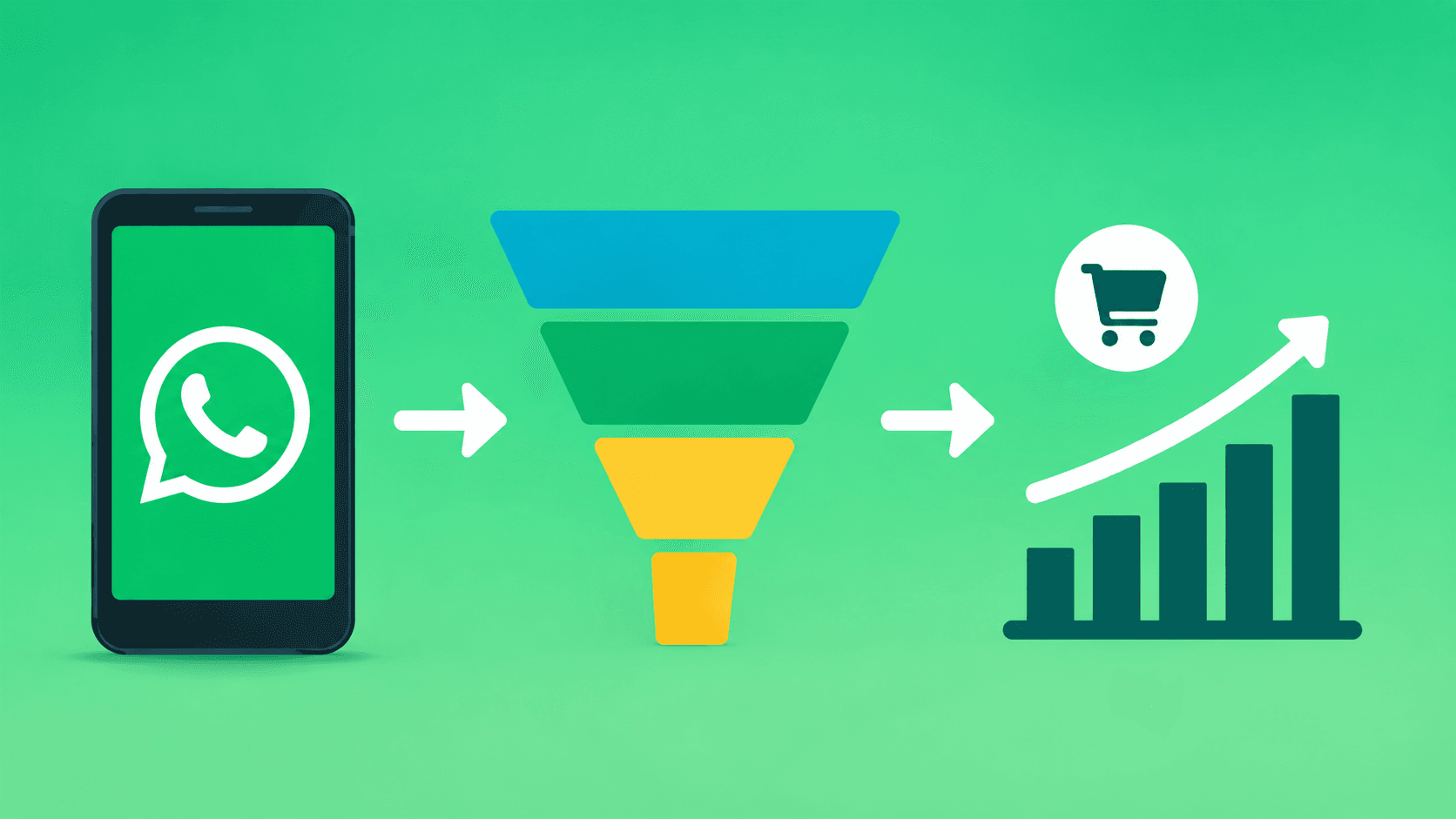
A WhatsApp sales funnel has five stages, and each has a characteristic drop.
1. Entry to first reply (20 to 35% drop)
Whether the entry is a CTWA ad, a website widget or a QR code, a fifth to a third of people who open the chat never send the pre-filled first message. The fix is a specific pre-filled text ("I want the Diwali gift box offer") rather than a generic "Hi".
2. First reply to engaged conversation (engagement halves if reply is slow)
If the brand's reply takes more than a few minutes, engagement halves. Surveys show 64% of users expect a reply within an hour and most prefer under ten minutes; after business hours, an automated flow must carry the conversation.
3. Engaged to product selected (50 to 60% drop)
This is the biggest leak. Chats that push users out to a website lose them; chats that show a catalog or product cards inside WhatsApp keep them.
4. Selected to payment initiated (30 to 40% drop)
Driven by COD hesitation and friction in moving to a payment link.
5. Payment initiated to paid (60 to 75% close rate on UPI)
UPI-based links in India close at 60 to 75%. The remainder is abandoned at the app switch, which is why nudges inside the same thread within 15 minutes recover a meaningful share.
Multiply the stages and a typical unoptimised funnel converts 2 to 3% of chat entries into orders; a tightly designed one reaches 10 to 12%. The gap is almost entirely design, not audience.
Which conversion design choices move the numbers?
Keep the buyer inside WhatsApp. Use the native catalog, multi-product messages and WhatsApp Flows for size, variant and address capture. Every redirect to a browser costs you a third of the people who tap it.
Design the first 60 seconds. The opening message should confirm the offer the user clicked, show one to three products, and offer two or three buttons, not a paragraph and a link. Quick-reply buttons convert several times better than typed responses.
Sequence cart recovery in three touches. A utility reminder at 30 to 60 minutes, a marketing message with social proof or a small incentive at 24 hours, and a final nudge at 72 hours. Stop after three; the fourth message is where opt-outs spike.
Make prepaid the default path. Offer a UPI payment link in-thread with a visible prepaid incentive such as free shipping or a small discount. Brands running COD-to-prepaid flows on WhatsApp report 20 to 40% reductions in return-to-origin, which is often worth more than the conversion lift itself.
Segment before you broadcast. Sending the same template to the whole list is what drives read rates from 70% towards 38%. Segment by last purchase, category viewed and language, and cap marketing messages per user to two or three a week.
Write in the shopper's language. Meta's India research found 76% of shoppers prefer local-language ads; Hinglish, Telugu or Tamil templates routinely outperform English ones outside the metros.
What does the WhatsApp Business API for e-commerce cost in India?
The WhatsApp Business API for e-commerce is accessed through a Business Solution Provider or directly via Meta's Cloud API. Current India rates are roughly ₹0.86 per marketing message and ₹0.115 per utility or authentication message, plus BSP platform fees and 18% GST.
Conversations opened from a CTWA ad or a Facebook call-to-action button give a 72-hour window in which your messages are free, which makes CTWA the cheapest acquisition path when the funnel behind it is well built. From 1 October 2026, service messages inside the 24-hour customer window are charged at the utility rate beyond 1,000 free messages per number per month, so support-heavy brands should budget for it.
Four setup decisions matter. Get Meta Verified or a verified business profile early, since trust signals lift first-reply rates. Connect the catalog to your store's inventory so out-of-stock products never appear in a chat. Integrate your payment gateway for in-thread UPI links. And pipe every conversation into your CRM with UTM-equivalent tagging so chat-to-order can actually be attributed.
What to ignore in WhatsApp commerce reporting
Ignore open rate on its own. It is now well documented, broadly stable across brands, and tells you almost nothing about revenue in 2026. Measure chat-to-order, revenue per message and opt-out rate weekly instead.
Ignore the "98% open rate" figure in any vendor pitch. It has never been reproduced at scale and the rigorous number is closer to 72 to 80%.
Ignore click-to-chat as a conversion metric for CTWA ads. A click that opens a chat and never sends a message is not a lead; chat-to-order within seven days is the number to report.
Editor's note: Automation volume is not a strategy. The brands pushing 3 to 4 million untargeted messages a month are the ones whose read rates fall to 38%, and from October 2026 they are paying for every one of those messages. Intent-led, segmented messaging is now the cheaper option as well as the better-performing one.
Conclusion: Insights from the Advora Editorial Team
Our reading of the 2026 data is that WhatsApp commerce in India has moved from a reach story to a design story. Open and click rates are now well documented and broadly stable; the variance between brands sits almost entirely in the three middle stages of the funnel, from engaged conversation to paid order, where product selection, payment friction and response time decide the outcome.
Three points stand out to us. First, the brands winning on WhatsApp treat it as a storefront, not a broadcast list: catalog, flows and payments live inside the thread, and the website is optional. Second, the October 2026 pricing change will punish lazy automation and reward intent-led messaging; the cost per conversation is rising just as attention is becoming scarcer, so segmentation and frequency caps are now margin decisions. Third, the most under-used lever we see is prepaid conversion: for COD-heavy categories, moving even a fifth of orders to UPI inside the chat does more for profit than any open-rate optimisation.
FAQs
What is a good WhatsApp open rate in 2026?
The most rigorous public benchmark, measured on 11.8 million messages across 382 brands, shows a 79.6% weighted open rate with a 72% median per brand. India-specific vendor data puts opt-in broadcast read rates around 68%, falling to roughly 38% for high-volume, unsegmented senders.
What is a good conversion rate for click-to-WhatsApp ads?
Measure chat-to-order rather than click-to-chat. Well-run Indian D2C accounts convert 8 to 15% of CTWA conversations into a paid order within seven days; under 4% usually points to a broken handoff rather than a weak audience.
Where does a WhatsApp sales funnel lose the most customers?
The largest drop, typically 50 to 60%, is between an engaged conversation and a product being selected. It is usually caused by redirecting shoppers to a website instead of showing catalog or product cards inside the chat.
How much does the WhatsApp Business API cost in India?
Roughly ₹0.86 per marketing message and ₹0.115 per utility or authentication message, plus BSP platform fees and 18% GST. CTWA conversations open a free 72-hour window, and from 1 October 2026 service messages beyond 1,000 free per number per month are billed at the utility rate.