Imagine a business that can produce more with fewer employees. Its software writes the advertising, answers routine customer questions and helps manage operations. Production becomes faster. Some costs fall. The business can sell at a lower price or keep a larger margin.
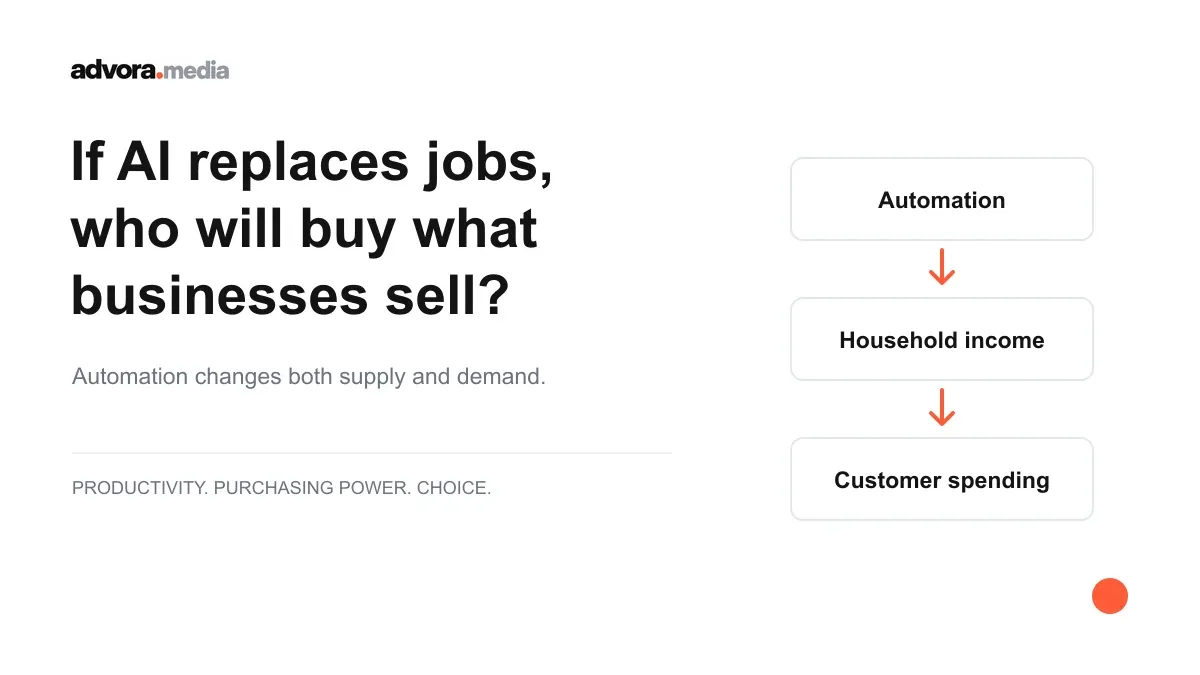
Now imagine many of its customers work in roles facing the same pressure. If their incomes fall, who buys the extra output?
That is the missing question in much of the debate about AI replacing jobs. Technology can expand what an economy produces. Whether people can afford that output depends on wages, prices, ownership and public policy. Cheaper production and shared prosperity are connected possibilities, not the same outcome.
Will AI replace jobs or change the tasks inside them?
A job is usually a collection of tasks. Automating a draft, a report or a customer query does not automatically remove the need for someone to verify information, resolve exceptions, understand a client or take responsibility for a decision.
The International Labour Organization’s 2025 assessment of generative AI and jobs estimated that one in four workers globally was in an occupation with some exposure to generative AI. Its assessment emphasised transformation as the more likely outcome for most jobs because human input remains necessary. Exposure is not a forecast that one in four workers will lose their employment.
Businesses may use automation to expand output, redesign roles, reduce recruitment or cut positions. The result will differ by task, company and market. Current exposure research does not establish a date when all work becomes optional.
The missing link is purchasing power
Consider an illustrative manufacturer that automates part of its operation. Lower costs might allow cheaper products, higher profits, better wages for remaining staff or new investment. Those choices distribute the benefit differently.
A household can benefit from lower prices while still being worse off if its income falls faster. Conversely, workers whose productivity and earnings rise may gain spending power. Looking only at the cost of production misses what happens on the customer side.
The IMF’s analysis of AI and the global economy identifies the potential for productivity gains alongside risks to income and wealth equality. It notes that AI can increase returns to capital and that outcomes depend partly on how the technology complements workers.
Our editorial inference is that a business should model changes in its customers’ ability to spend alongside its own automation savings. An efficient supplier still needs a market with purchasing power.
Why AI will not make everything free
Some digital tasks may become much cheaper. That does not mean the full cost of delivering a useful product disappears. A generated answer can still require verification, customer support, secure systems and someone accountable when it is wrong.
Physical goods face further constraints: materials, transport, equipment, land and energy. Automation can improve these processes without eliminating their inputs. Lower costs also do not guarantee lower prices; competition, scarcity and business choices affect what customers pay.
AI itself depends on physical infrastructure. The International Energy Agency’s 2026 energy-and-AI outlook projects that electricity consumption from data centres will roughly double between 2025 and 2030. That projection covers data centres overall, not only AI. The report also identifies constraints involving electricity, chips and infrastructure.
The useful distinction is between making a particular task cheaper and making everyday life affordable. A low-cost marketing draft does not, by itself, reduce someone’s rent or provide healthcare.
Could universal basic income make paid work optional?
Universal basic income is one proposed response to economic insecurity: recurring cash payments made broadly and without a work requirement. It could give people a financial floor, but the payment level, funding and surrounding public services would determine what that floor actually provides.
A future with highly productive companies does not automatically produce a system that shares their gains. Taxation, transfers, public services and ownership arrangements require institutional choices. Corporate generosity is not equivalent to an enforceable entitlement.
There is experimental evidence about guaranteed income, but it should not be stretched into a forecast of a fully automated economy. A US study described by NBER assigned 1,000 low-income participants to receive $1,000 a month for three years, with a comparison group receiving $50 a month. That is a bounded experiment involving selected participants, not a permanent universal programme funded by AI-generated wealth.
Basic income belongs in the discussion. So do affordable public services, support during job transitions, worker bargaining and broader participation in business ownership. None should be presented as a settled consequence of better software.
Editorial perspective: the real promise is more choice
The attractive part of a future with less compulsory work is the possibility of greater control over time. People might spend more time caring for family, studying, creating, volunteering or building something whose value cannot be measured by a salary.
But less paid work is not automatically more freedom. A person choosing shorter hours because their needs are secure is in a different position from someone losing employment without adequate support.