A polished media plan is easy to approve too quickly. The rows line up, the totals look convincing and the forecast seems precise. Yet the document can still confuse advertising spend with total costs, mix lead definitions or present a default conversion rate as evidence. Review the decisions behind the sheet before you review its appearance.
Use the checks below whether you receive a plan from an agency, a colleague or a generator. They are designed for digital advertising. A forecast does not become reliable simply because its formulas recalculate correctly.
Follow the step-by-step media plan walkthrough with screenshots
Create an editable plan to review
Check 1: can you explain the objective in one sentence?
A useful brief identifies the audience, offer, desired action and time period. “Generate course enquiries during October” is more testable than “grow the business.” It still needs an agreed definition of an enquiry and a method for evaluating its quality. If the team is actually trying to build awareness, an enquiry forecast may be the wrong approval yardstick.
Ask which figures are planning estimates and which are committed deliverables. Keep projected clicks, impressions and conversions distinct from contracted work such as producing creative. Nobody should read a forecast column as a guaranteed sales commitment.
Clarify the objective with the campaign brief builder
Check 2: does the money reconcile?
Channel budgets should add to the advertising budget. Additional production, management or other agreed costs should be identified separately. For an illustrative ₹80,000 media plan with ₹12,000 production and ₹8,000 additional costs, the campaign outlay is ₹100,000. The channels should total ₹80,000, not ₹100,000. Advora’s planner does not automatically include an agency fee.
Check the currency on every input and output. A cost copied from a different market is not made relevant by changing its currency symbol. Also check whether a figure includes tax and whether your source uses the same convention. Ask for the uncertainty to be written down instead of silently choosing the interpretation that makes the plan look cheaper.
Check 3: can the channel choice be explained?
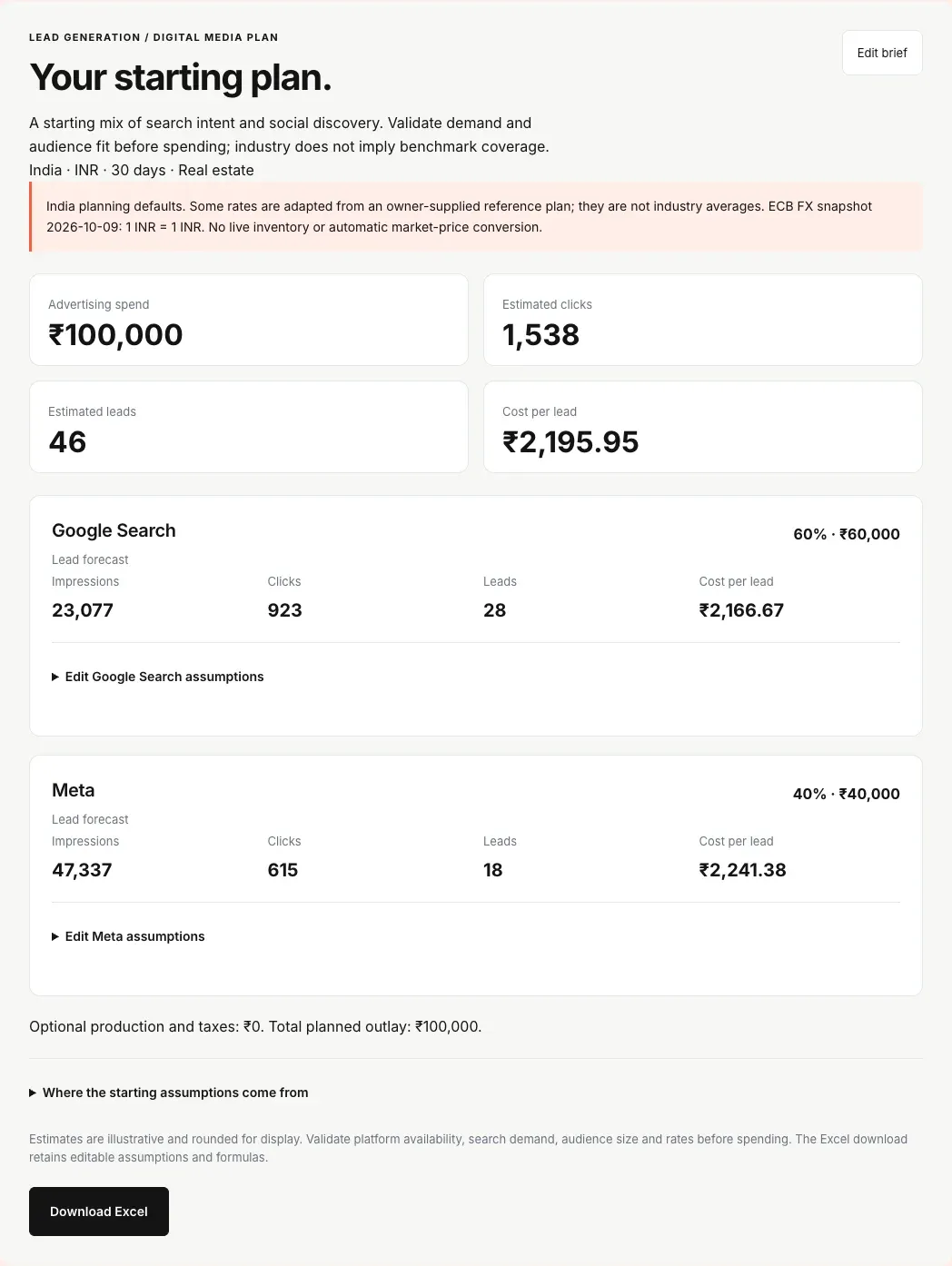
For each channel, ask: who will it reach, what will they see, what action should follow, and what makes the proposed volume plausible? Search demand, audience size and creative readiness are practical constraints. A generator’s allocation rule is not evidence that your specific market can absorb the spend.
Look for a reason to exclude channels as well as include them. A long platform list can create an impression of sophistication while weakening the ability to learn from any one platform. The right plan is the one the team can execute and evaluate, not the one with the most rows.
Review the budget-allocation approach
Check 4: are assumptions labelled with their source and scope?
CPC, CPM, CTR and conversion assumptions need context. Were they measured in your account, taken from a dated report or entered as a hypothetical starting point? Record the market, platform, objective, date range and conversion definition where available. Leave gaps visible. An unsupported industry estimate should not become a benchmark just because it has two decimal places.
For the media planner, an industry selection describes the campaign; it does not supply verified benchmarks for every sector. Some market/channel values are illustrative. Review the source notes before presenting a result to anyone else and replace defaults with comparable evidence where you have it.
Check 5: can you reproduce one row by hand?
For a hypothetical CPC row, ₹40,000 at ₹50 per click implies 800 clicks. With a 5% click-to-lead rate, that implies 40 leads and ₹1,000 per lead. If CTR is 2%, implied impressions are 40,000. The percentages must be used as decimals in these equations: 5% means 0.05, not 5.