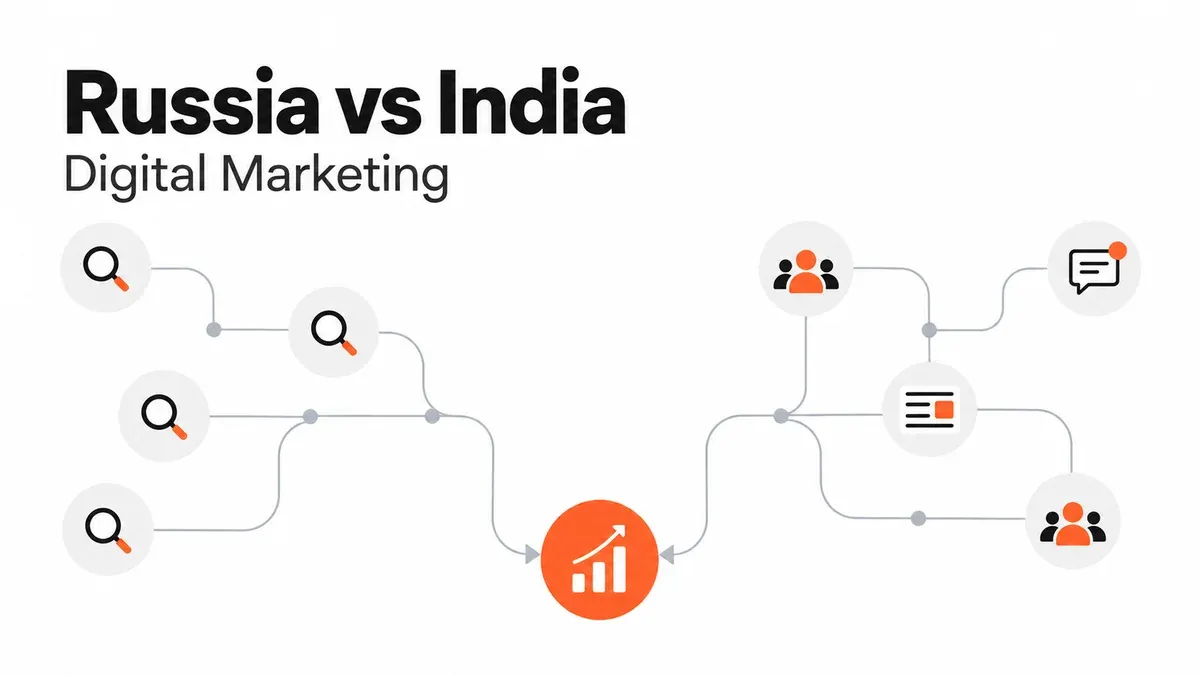
A campaign that works in India can fail in Russia before the creative has a chance to prove itself. The search engine may be different, the paid channel may be unavailable, or the landing page may attract readers who cannot complete the next step.
Digital marketing in Russia vs India is therefore a comparison of customer journeys as much as advertising platforms. This guide explains the differences in search, paid media, language and measurement, and how to test a market without importing assumptions from another one.
Research checked: 12 October 2026. This is a sourced editorial analysis, not a report of campaigns we have run in Russia. The numerical example below is hypothetical.
Russia vs India: the differences that change a media plan
Search: Google dominates India; Russia needs a two-engine view
Statcounter estimates that Google accounted for 96.63% of search-engine usage in India in September 2026. In Russia, it estimates Yandex at 70.33% and Google at 28.12%. These are measured market-share estimates, not a census of people, advertising budgets or the language of their searches. Sources: India search share and Russia search share.
For India, that gives Google a clear starting role in search planning. For Russia, a plan built only around Google would address part of the search market. The appropriate allocation still depends on the actual queries, customers and business objective.
Do not interpret Russia’s Google share as an English-speaking audience share. A person can use Google in Russian, or search in English and prefer a Russian explanation. Language demand needs its own investigation.
Paid media: search visibility and advertising access are different
Google’s current policy pauses Google Ads serving to users located in Russia. An English article can still compete in organic Google search there; that does not mean an advertiser can run a Google Ads campaign to the same audience. The restriction is about location and ad serving, not simply the language of the advertisement. Source: Google’s regional advertising restrictions.
A Russia-focused media plan should investigate locally available options, including Yandex Direct and VK Ads. Yandex Direct supports geographic targeting, while VK describes its advertising platform as serving VK properties and its advertising network. Neither is a guarantee that a particular foreign advertiser, payment method or campaign will be eligible. Sources: Yandex Direct targeting and VK business services.
For an Indian team entering Russia, the practical task is to rebuild the channel plan around verified availability. Confirm account access, payment arrangements, moderation requirements and the ability to serve customers before allocating a substantial budget. Existing Indian campaign structures should be treated as hypotheses to test.
Language: translate the customer journey, not only the advertisement
Start with the audience rather than the country label. An English-speaking advertising specialist and a local consumer may need different content, even if both are in the same city. India also requires audience-level language decisions; English should not be assumed to fit every region or buyer.
For search visibility in Russian, publish complete Russian pages at permanent URLs, with translated titles, useful examples and language-appropriate navigation. A visitor-triggered translation shortcut helps someone read but does not create an indexed Russian edition on your own domain. Google recommends distinct URLs for language versions and links between them. Source: Google’s multilingual-site guidance.
If the goal is specifically to reach people searching in English from Russia, an English page can be appropriate. Check the queries generating impressions and whether those visitors engage. Do not force a Russian version simply because a visitor appears to be in Russia.
Compare acquisition economics, not national stereotypes
There is no defensible universal answer to whether Russia or India has cheaper advertising. A valid comparison needs the same objective, comparable audience intent, agreed conversion definitions and a consistent accounting period. Auction prices alone cannot show whether a market is profitable.
Consider this hypothetical example, expressed in the same currency for both campaigns. It illustrates funnel mathematics, not a benchmark for either country.
Campaign A spends 1,000, generates 100 leads, qualifies 20 and acquires two customers. Its cost per lead is 10, its cost per qualified lead is 50, and its advertising-only acquisition cost is 500.
Campaign B spends 1,000, generates 50 leads, qualifies 25 and acquires five customers. Its cost per lead is 20, its cost per qualified lead is 40, and its advertising-only acquisition cost is 200.
Campaign B has twice the headline cost per lead but a 60% lower advertising-only acquisition cost. That conclusion changes if customer value, refunds or delivery costs differ. Full customer acquisition cost also needs the relevant sales and marketing costs beyond advertising.
Use the Lead Funnel and CAC Calculator to examine the conversion steps. For an ecommerce business, test contribution margins with the Break-Even ROAS Calculator before treating revenue return as profit.