A budget split is a decision about what to learn and what to deliver. It should not start with a rule that every business must put the same percentage into Google, Meta or video. A useful allocation connects an objective to demand, audience fit, measurable outcomes and the amount you can afford to test.
This guide uses an illustrative ₹90,000, 30-day campaign for a training business seeking course enquiries. None of the costs below are industry benchmarks or recorded campaign results. They are transparent assumptions you can replace before committing money.
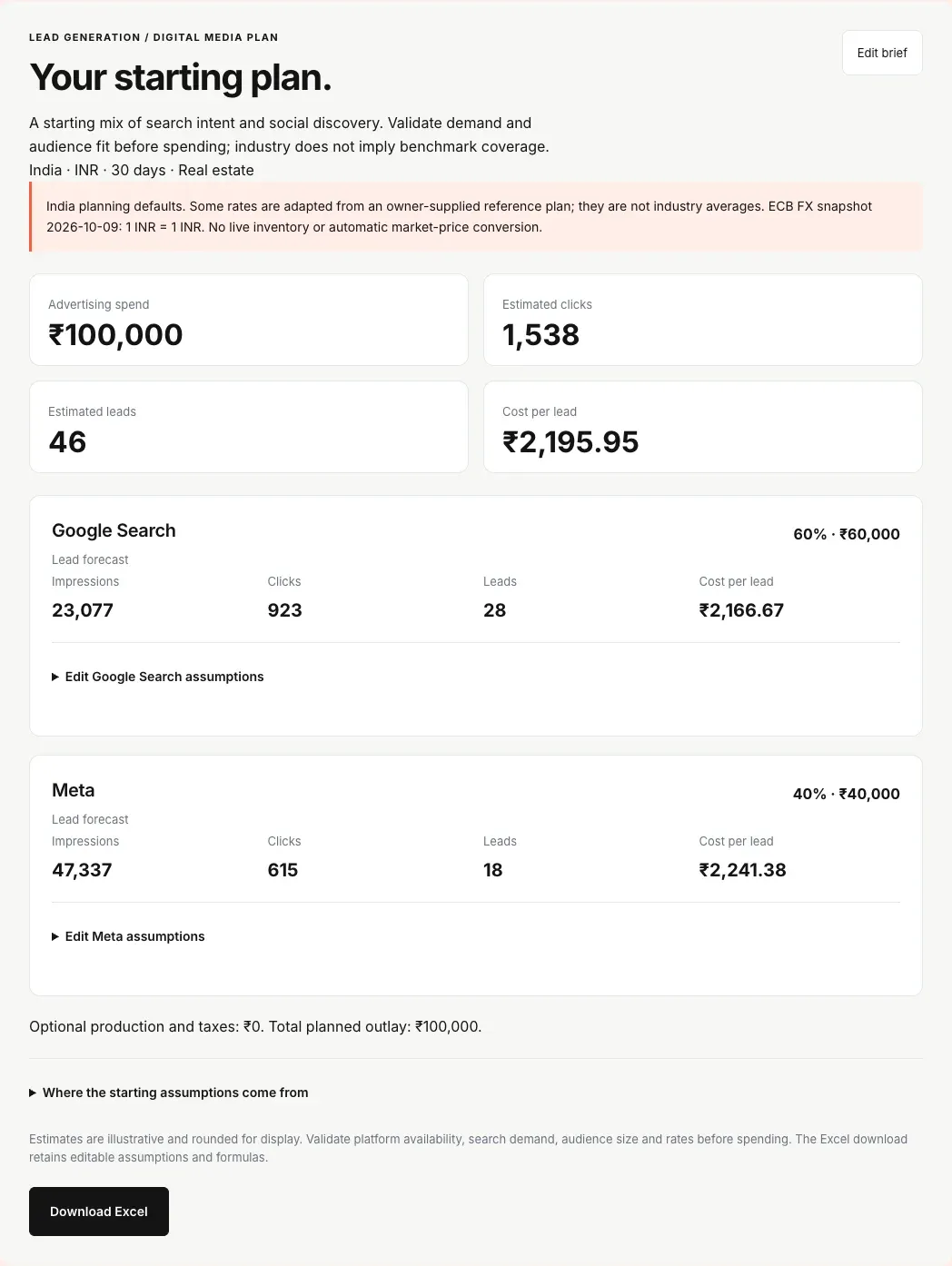
Follow the step-by-step media plan walkthrough with screenshots
Build your starting allocation in the media plan generator
1. Decide what the advertising budget includes
Separate advertising spend from the total campaign cost. If ₹90,000 is the media budget and you allow ₹12,000 for production plus ₹8,000 for additional costs, the planned outlay is ₹110,000. Do not divide ₹110,000 between channels and then discover that creative work must be paid from the same money. Any tax amount in a plan needs checking against the actual invoice; this example is not a tax calculation.
Write down the currency, campaign dates and spending authority beside the number. Give someone responsibility for approving reallocations. A budget without a decision owner can become a spreadsheet that everyone edits and nobody controls.
2. Define the outcome before choosing the platform
For the training business, the first tracked outcome is an enquiry. A qualified enquiry is a separate outcome: someone who meets the course requirements, can attend and has a relevant budget. An enrolment comes later. Combining those three definitions into one conversion column makes performance difficult to interpret.
Choose channels for a plausible job. Search may capture people already looking for the course, provided that relevant demand exists. Social may introduce the offer to a suitable audience, provided that the creative explains it clearly. These are reasons to investigate a channel, not proof that either one will work. Check audience availability and operational capacity before accepting a suggested split.
3. Calculate what the proposed split implies
Suppose the first plan assigns ₹54,000 to Search and ₹36,000 to social. For Search, assume ₹60 CPC and a 4% click-to-enquiry rate. That implies 900 clicks, 36 enquiries and ₹1,500 per enquiry. For social, assume ₹30 CPC and a 2% click-to-enquiry rate. That implies 1,200 clicks, 24 enquiries and the same ₹1,500 per enquiry.
The calculation is spend divided by CPC to estimate clicks, followed by clicks multiplied by conversion rate to estimate enquiries. The combined expectation is 60 enquiries from ₹90,000. This arithmetic does not establish that either channel can deliver the required click volume at the assumed price.
Check the cost and click relationships with the CPC calculator
4. Compare lead quality, not just cost per enquiry
Now suppose the planning assumption is that 50% of Search enquiries qualify and 25% of social enquiries qualify. Search then implies 18 qualified enquiries at ₹3,000 each; social implies six at ₹6,000 each. The original enquiry CPLs were identical, but the downstream economics are different. These qualification rates are invented for this example and must be replaced with your own definitions and evidence.
That does not justify moving the entire budget to Search. The next tranche of spend may reach different users, demand may be limited, and qualification estimates may be based on too few observations. It does justify asking a better question: where can the next increment of budget produce a useful outcome, with acceptable uncertainty?