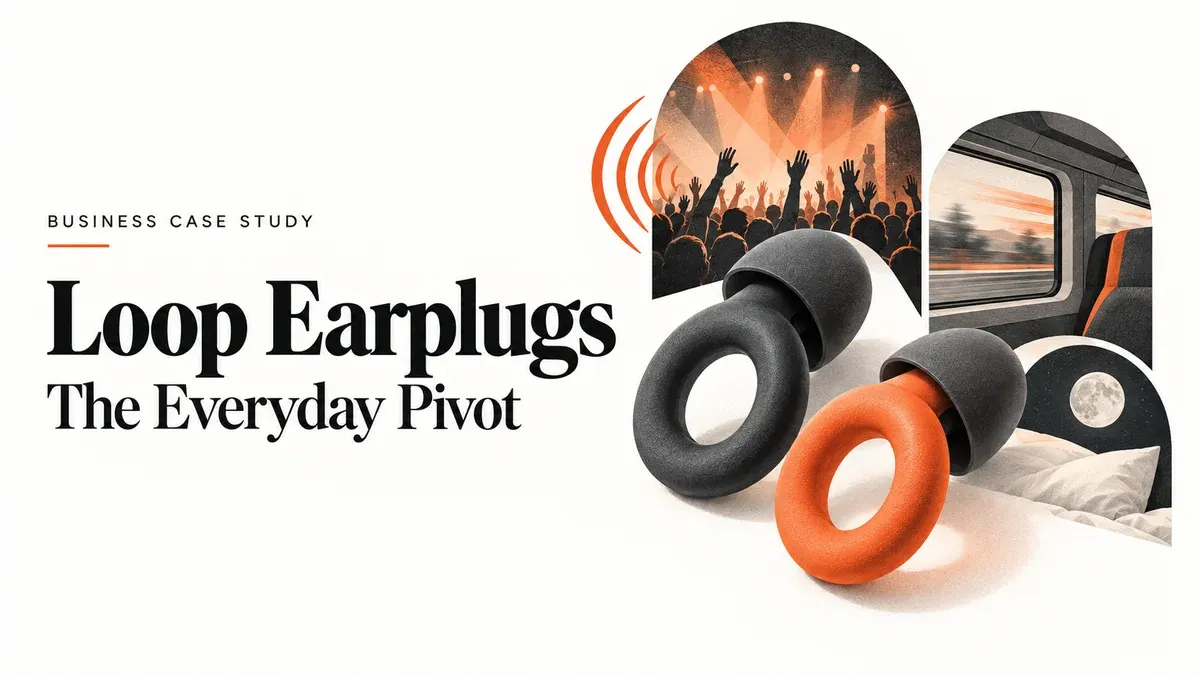
When your customers stop going to the places your product was designed for, the obvious conclusion is that demand has disappeared. Loop Earplugs found a more useful question: where else were people already using what it made?
The Belgian brand began with nightlife. Its subsequent expansion into sleep, concentration and everyday noise created a much broader business. This Loop Earplugs marketing strategy case study examines that change, the acquisition system behind it and the customer expectations that growth still has to satisfy.
The lesson for a smaller company is practical: before abandoning a product, investigate whether you have defined its customer too narrowly.
The starting point: a product people would choose to wear
Childhood friends Maarten Bodewes and Dimitri O founded Loop in 2016. Their own experience of tinnitus and dissatisfaction with existing earplugs helped shape a product that combined appearance, comfort and hearing protection. Loop describes its early focus as nightlife, followed by wider customer uses during the pandemic. Source: Loop’s company history.
That distinction matters. Earplugs already existed. The commercial opportunity was to make an established category relevant to people who did not like the available choices.
A product can struggle because customers do not understand its value. It can also struggle because customers understand the value but dislike using it. Those are different problems, requiring different investments.
Loop’s story invites businesses to examine the second problem. Design, fit and presentation can influence willingness to use a product. They do not eliminate the need for the product to perform.
What changed when nightlife stopped?
Forbes reported an approximately 80% revenue decline when lockdowns began. Loop responded by pursuing adjacent uses and shifting toward direct online sales, where customer feedback was easier to collect. The same report describes an October 2025 return to physical retail through 600 US Target stores. Source: Simone Melvin’s October 2025 Forbes profile.
This is not evidence that physical retail was inherently wrong or that direct-to-consumer selling is always superior. Each channel served a different stage of the business.
Our interpretation is that the early crisis increased the value of customer access. A direct relationship helped the company understand the situations behind purchases. Later, wider distribution could make an established brand easier to buy.
Loop’s own history says people were already using the products for sleep, focus, parenting and commuting. The company did not have to invent every new use. It had to notice and respond to behaviour outside its original nightlife story.
The growth figures, with the dates kept attached
Different accounts use different currencies and reporting periods. The milestones below are historical reported figures, not a claim about Loop’s current revenue or an independently audited valuation.
Period | Reported milestone | Source |
|---|---|---|
2019 | Approximately US$1 million in revenue | Forbes, October 2025 |
2021 | US$13 million in revenue; profitability reported | Forbes, October 2025 |
2022 | US$47 million in revenue | Forbes, October 2025 |
2023 | €126.5 million in revenue | Loop’s company profile |
2024 | Approximately US$220 million in revenue | Forbes, October 2025 |
Read the company’s founder profile alongside the Forbes report. The euro and dollar figures should not be used interchangeably to calculate growth. Revenue also does not tell us the amount of profit, cash available or what investors would pay for the business.
How the marketing strategy connects customer needs to products
Loop’s website offers routes such as sleeping, events, parenting and travelling, alongside a product comparison and a recommendation quiz. That lets a visitor begin with a situation rather than an unfamiliar model name. See the navigation on Loop’s website.
For a business selling several similar products, this is a useful way to reduce uncertainty. The shopper first identifies the problem, then compares the options intended for it.
A small furniture company could apply the principle through pages for compact apartments, rental homes and home offices. A coffee-machine manufacturer could distinguish hotel breakfast service from a small workplace. These are illustrative applications, not Loop campaign examples.
The discipline is consistency. If an advertisement promises help with one situation, the landing page should explain that situation, show the relevant product and address the objections specific to it.
A quiz can help when the choices genuinely require guidance. It is not automatically better than a clear comparison page. Measure completed purchases, returns and customer confusion, not simply how many people start the quiz.
Paid media: creative testing backed by a defined customer journey
TikTok’s published Loop case study describes a UK campaign with agency TRGT Digital, combining creative experimentation and retargeting. It reports a cost per acquisition 26% below Loop’s UK market average and ROAS more than 30% above its average benchmarks. These are platform-published campaign results, not company-wide profit margins. Read TikTok’s campaign account.
The useful lesson is the relationship between creative and buying readiness. Someone encountering earplugs for the first time may need an explanation. Someone comparing models needs differences. Someone returning to a product page may need reassurance about fit or delivery.
That does not prove every shopper follows a fixed sequence. People enter at different stages and switch between search, social media, marketplaces and recommendations.
Forbes also reported planned advertising expenditure above US$80 million for 2025. It was a spending plan reported during that year, not a verified final total. The comparison makes one thing clear: this should not be presented as a business built with free publicity alone.
Before copying a large advertising budget, calculate what remains after product costs, fulfilment, fees, returns and acquisition. Our analysis of why a 4x ROAS campaign can still lose money explains why attributed revenue is only part of that calculation.
SEO supported the same expansion
Loop’s SEO agency, Re:signal, describes work on technical issues, internal linking, content gaps and search journeys from awareness through purchase. Its case study reports organic revenue reaching 28.63% of total revenue for the period covered. The page does not establish that this remains the current share. Source: Re:signal’s Loop case study.
A separate awards account published by The Drum reports organic sessions rising 60.3% and revenue 106.9% for June 2022 to May 2023 against the preceding equivalent period. These are agency-submitted results for a specific comparison window. They should not be merged with other case-study percentages into one continuous growth claim. Source: The Drum’s 2023 awards account.
For a smaller business, the principle is to organise content around questions that influence a purchase. Explain the problem, help readers compare options and provide a useful route to the appropriate product.
Publishing many loosely related articles would miss the point. A focused page answering a real buying question can be more useful than a large library that never helps someone choose.
Partnerships made the product visible in relevant settings
Loop’s partnerships have included Coachella, McLaren and Swarovski, as documented in the Forbes profile. Our reading is that these associations connect the product with different meanings: live events, motorsport and personal style.
The analytical distinction is between borrowed fame and contextual relevance. A partnership is easier to understand when the audience can see why the product belongs there.