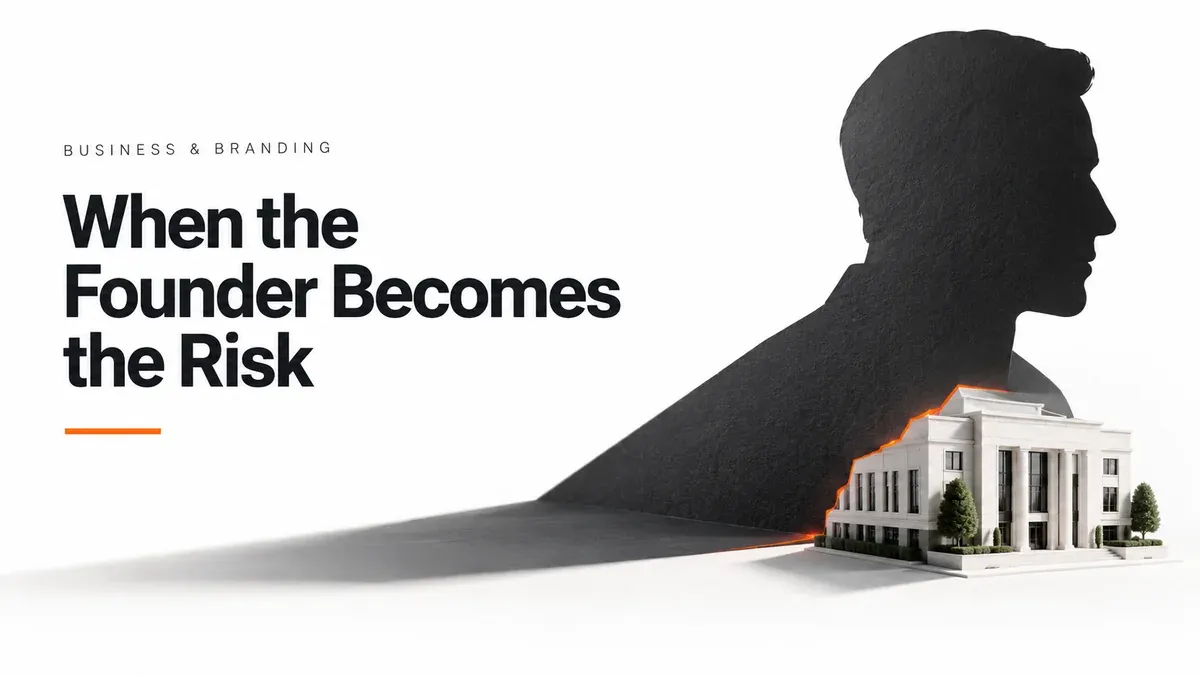
A customer asks about the founder’s latest statement before asking about the product. A sales team spends time explaining a controversy it did not create. A company’s offer has become entangled with a person’s public identity.
That is founder reputation risk: the possibility that perceptions of one individual affect trust in the organisation, its customer relationships or its ability to operate.
Tesla is a useful case because Elon Musk’s visibility makes the connection unusually prominent. It is also a case that demands care. Claims that one person alone caused every lost sale or change in market value go beyond what the evidence can establish.
There are several different risks inside the same headline
Customer rejection is one possibility. Someone who disagrees with a founder may decide the brand no longer fits their identity.
Operational dependence is another. If the founder is the only credible spokesperson, major relationship owner or final decision-maker, the business may struggle when that person is unavailable.
A third is communication risk. An inaccurate or premature public claim can create expectations that colleagues cannot meet.
These problems require different responses. A clearer delivery process will not automatically settle an inaccurate claim. A carefully written statement will not repair an unreliable product.
What Tesla itself says about reputation
Tesla’s 2025 annual report warns that negative perceptions may harm its brand and business. It also notes that public perception can affect the share price independently of operating performance. Source: Tesla’s Form 10-K.
This establishes that reputation is a recognised exposure. It does not establish a measured loss attributable to Musk’s political activity, a particular interview or any other single action.
Risk disclosures describe what can affect a business. Analysts still need to investigate what actually happened in a defined period.
The 2018 settlement shows why communication needs controls
In September 2018, the SEC announced settlements concerning Musk’s take-private statements and Tesla’s disclosure controls. Musk and Tesla each agreed to a $20 million penalty, without admitting or denying the allegations. The terms included his departure as chairman and additional communication oversight. Tesla subsequently disclosed court approval on 16 October 2018. SEC announcement; Tesla’s court-approval disclosure.
The significance for this article is organisational. A personal communication channel can become part of the company’s disclosure environment.
For a smaller business, the practical analogue is narrower: decide who checks important claims about pricing, availability, performance and delivery before they go public. A founder should not have to improvise commitments that operations later discover they cannot fulfil.
Controls can preserve a distinctive voice while protecting factual accuracy. They do not need to turn every ordinary post into a committee meeting.
Do not confuse sentiment, sales and valuation
A survey measures what respondents say. Deliveries record an operational outcome. Market capitalisation reflects the market value of shares at a point in time.
All three can move during a controversy. Their movement does not make them interchangeable.
Consider Tesla’s first quarter of 2025. The company reported 336,681 deliveries and said the Model Y changeover across four factories had cost several weeks of production. Source: Tesla’s Q1 production and delivery release.
That operational explanation does not prove reputation had no effect. It does mean a serious assessment must consider supply alongside demand, and avoid explaining the whole result through the CEO.
Pricing, competing products, incentives, financing and model availability can also influence buying decisions. To estimate a founder-specific effect, a study needs a credible comparison that accounts for other explanations.
Public attitudes can diverge and recover
YouGov’s research published in April 2024 found a contrast between negative general buzz and much more positive buzz among Tesla owners during 2023. Purchase consideration also behaved differently from publicity. Read the research.
A later US analysis, published in September 2026, reported Tesla’s net impression rising from -20 to -6 over a year, while purchase consideration rose from 5% to 9%. The figures used 12-week moving averages among US adults. They are survey measures, not sales conversion rates. Source and methodology: YouGov.
These findings should discourage two easy claims: that all attention is valuable, and that negative attention permanently destroys a brand.
Audiences differ. Existing owners, new prospects and people who would never buy the product may respond differently. A recovery in one market also cannot be assumed to represent every country.