
Advora.media
Language

Opens Google Translate in a new tab. Automatic translations may contain errors.

SEO & Search/ Insights

How to Do Keyword Research for SEO: A Worked Example

Keyword research is how you find the searches your customers actually type, then decide which ones a page can realistically win. This guide walks through the full process with a worked example for a Hyderabad dental clinic, using free keyword research tools, long-tail keywords, intent checks and the AI Overview problem every SEO now has to plan around.

Spreadsheet of keywords grouped by search intent on a laptop, illustrating how to do keyword research for SEO

To do keyword research for SEO, start with a seed list of what your customers call your product, expand it with free tools such as Google Keyword Planner, Search Console and autocomplete, group the results by search intent, check who already ranks, and pick the keywords a single page can realistically win. Most searches are long tail: Backlinko’s study of 306 million keywords found 91.8% of queries are long tail, and the median keyword gets just 10 searches a month. This guide walks through each step with a worked example for a dental clinic in Hyderabad.

Key points

  • Keyword research has five steps: seed, expand, group by intent, check the results page, and prioritise.
  • You can do it free. Google Keyword Planner, Search Console, Google Trends and Google’s own search suggestions cover most needs.
  • Long tail keywords are where most opportunities sit. They are less competitive and often closer to a purchase.
  • Search volume numbers are estimates, not facts. Even the best tools disagree with real Google data much of the time.
  • AI Overviews have cut clicks on many informational searches, so commercial and local keywords matter more than they did.

What is keyword research, and why does it still matter in 2026?

Keyword research is finding the words people type into Google when they need what you offer, then deciding which of those searches each page on your site should target. It shapes your site structure, your content plan and your page titles.

It matters because one well-chosen page can rank for hundreds of related searches. Ahrefs found the average page ranking first also ranks in the top 10 for about 1,000 other relevant keywords.

What has changed is where clicks go. An Ahrefs study of 300,000 keywords, published in February 2026, found that AI Overviews correlate with a 58% lower click-through rate for the top-ranking page. Keyword research now has to account for which searches still send visitors.

Editor’s note: The goal of keyword research is not a long list. It is a short list of searches you can win, mapped to pages that deserve to rank. Fifty well-chosen keywords beat 5,000 exported from a tool.

What do you need before you start?

You need three things: a clear idea of what you sell and where, access to free tools, and a spreadsheet.

Google Keyword Planner is free inside a Google Ads account, with no ad spend required. Accounts without active spend see search volume as ranges, such as 100–1K, rather than exact numbers.

Google Search Console shows the searches your site already appears for, with impressions, clicks and average position. For an existing site, it is the most accurate keyword data you have.

Google search itself gives you autocomplete suggestions, “People also ask” questions and related searches, all free.

Google Trends shows whether interest in a topic is rising, falling or seasonal.

Paid tools such as Ahrefs and Semrush add keyword difficulty scores and competitor data. They are useful but optional for a small site.

Step 1: How do you build a seed keyword list?

Seed keywords are the basic terms for what you offer. Write down what customers call your product or service, not what you call it internally.

Worked example. Our example is a dental clinic in Kondapur, Hyderabad, that wants more patients for implants, braces and root canal treatment.

Its seed list might be: dentist, dental clinic, dental implants, braces, clear aligners, root canal treatment and teeth whitening. Add the locations it serves, such as Kondapur, Gachibowli and Hyderabad.

Ask the front desk too. Patients often say “teeth straightening” rather than “orthodontics”, and that wording belongs on the list.

Step 2: How do you expand seeds into a full keyword list?

Run each seed through your free tools and collect every relevant variation.

In Keyword Planner, enter the seeds under “Discover new keywords”, set the location to Hyderabad or India and the language to English. Export the ideas with their volume ranges.

In Google search, type each seed and note the autocomplete suggestions. Then scroll to “People also ask” and “Related searches”.

In Search Console, open the Performance report and sort queries by impressions. Look for searches where you already appear on page two, which are often the quickest wins.

Worked example. Expanding “dental implants” might produce phrases such as “dental implants cost in Hyderabad”, “dental implants near me”, “single tooth implant price”, “are dental implants painful” and “implant vs bridge”. Expanding “braces” might add “clear aligners cost Hyderabad” and “braces for adults”.

Notice the pattern. Most useful phrases are long tail: three or more words, specific and lower in volume.

Why do long tail keywords matter so much?

Most search queries are long tail. Backlinko’s 306-million-keyword study found 91.8% of queries are long tail, though together they make up only 3.3% of total search volume.

That sounds like a reason to ignore them, but it is the opposite. Head terms such as “dentist” are fiercely competitive and vague, while long tail searches such as “dental implants cost in Hyderabad” are easier to rank for and much closer to a booking.

Long tail searches also add up. A page that answers a topic well ranks for many related long tail phrases at once.

Editor’s note: Treat “zero volume” with care. Tools often under-report small, specific searches, but Ahrefs’ own test found most low-volume keywords get roughly the traffic tools predict. Target them when they match real customer questions, not because they look easy.

Step 3: How do you group keywords by search intent?

Search intent is what the searcher wants to achieve. Google ranks pages that match it, so a page built for the wrong intent will struggle however good it is.

There are four main types:

  • Informational: the searcher wants to learn, such as “are dental implants painful”.
  • Commercial: the searcher is comparing options, such as “implant vs bridge” or “best dental clinic in Kondapur”.
  • Transactional: the searcher is ready to act, such as “book dentist appointment Kondapur”.
  • Local: the searcher wants a nearby business, such as “dentist near me” or “dental clinic Gachibowli”.

Worked example. The clinic tags each keyword with one intent in its spreadsheet. Local and transactional terms go to service and location pages, commercial terms to comparison pages, and informational questions to blog posts or FAQs.

Then it groups keywords that mean the same thing. “Dental implants cost in Hyderabad”, “implant price Hyderabad” and “how much do dental implants cost” belong on one page, not three.

Step 4: How do you check the search results page?

Before choosing a keyword, search it on Google and look at what ranks. The results page tells you more than any metric.

Check four things:

  • What type of page ranks? If the top results are blog posts, a service page will struggle, and the reverse.
  • Who ranks? If national brands and directories fill the top results, a small site will find it harder than if local clinics rank.
  • Is there a map pack? Local results mean your Google Business Profile matters as much as your website.
  • Is there an AI Overview? If Google answers the question itself, fewer people will click.

Worked example. Searching “dentist near me” from Kondapur would show a map pack, so the clinic’s Google Business Profile becomes a priority alongside its website. Searching “are dental implants painful” may show an AI Overview, which means a blog post on it will earn fewer clicks.
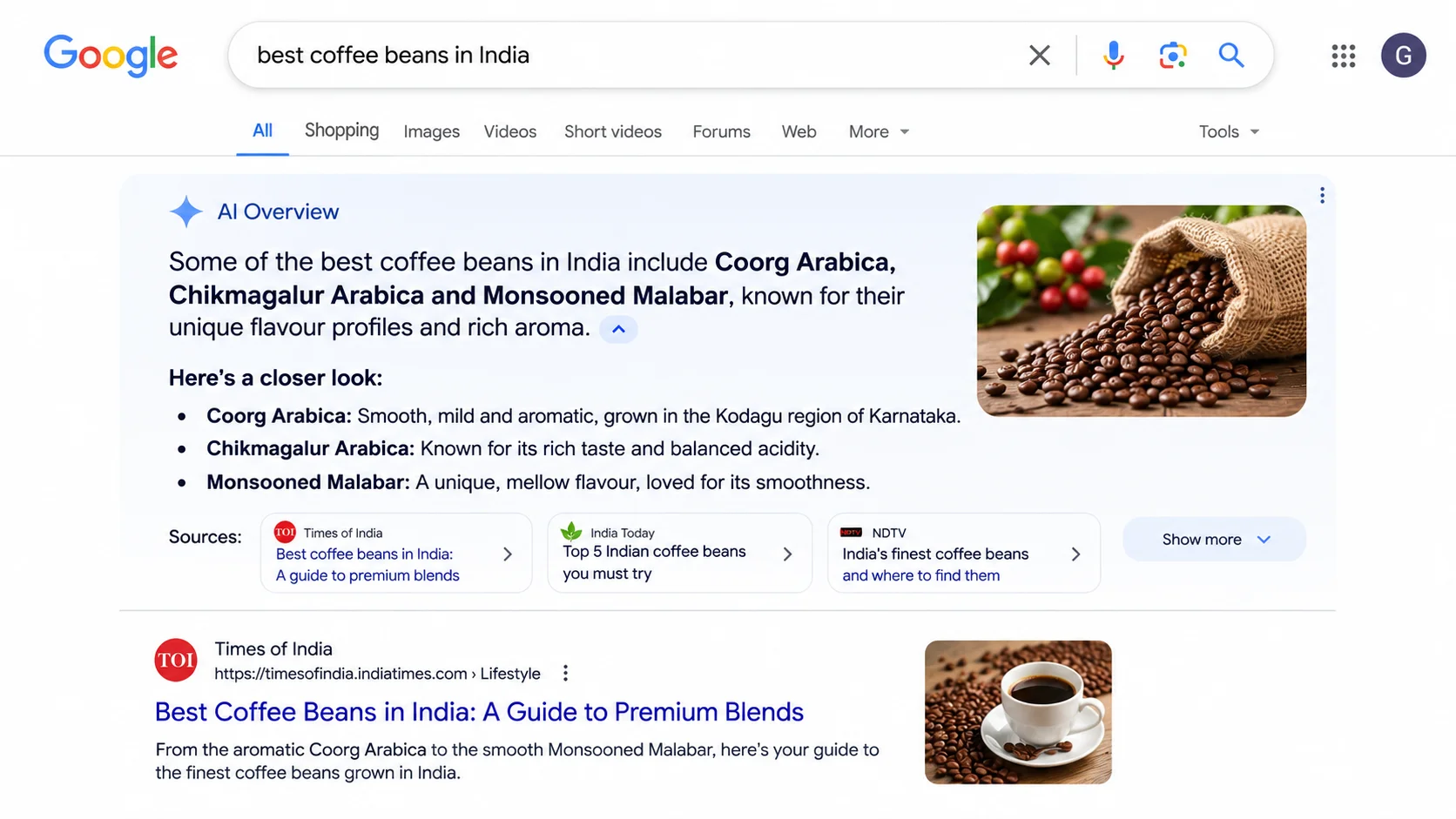
How do AI Overviews change keyword research?

AI Overviews summarise answers at the top of Google, and they take clicks from the pages below. Ahrefs measured a click-through drop of roughly 51% at position two and 19% at position 10 when an AI Overview appeared.

Pew Research found people clicked a traditional result on 8% of searches with an AI Overview, against 15% without one.

The practical response is to shift weight towards keywords that still send visitors. Commercial, transactional and local searches tend to keep more clicks than simple informational questions, because people still want to compare, book or visit.

Informational content still has value. It can earn citations inside AI answers and build trust, but it should not be your only traffic plan.

Step 5: How do you prioritise keywords?

Score each keyword group on three factors, then work on the highest scores first.

Business value. How likely is this searcher to become a customer? A “dental implants cost in Hyderabad” searcher is worth far more than one asking how teeth form.

Ranking chance. Based on your results-page check, could your site realistically reach page one within six months?

Click potential. Does the results page still send clicks, or does an AI Overview or map pack absorb them?

Use search volume as a tiebreaker, not the main factor. Ahrefs compared tool estimates with real Search Console data and found its own volumes were roughly accurate 60% of the time and Keyword Planner’s 45%, so treat every number as approximate.

Worked example. The clinic’s top priorities become its implants, aligners and root canal service pages, each targeting cost and location searches, plus its Google Business Profile for “near me” searches. Informational blog posts on pain, recovery and aftercare come next, supporting the service pages.

How do you turn keywords into pages?

Assign each keyword group to one page. This is called keyword mapping, and it stops two of your own pages competing for the same search.

Put the main keyword in the page title, the H1, the URL and the opening paragraph, written naturally. Use the related long tail phrases as subheadings or FAQ questions on the same page.

Worked example. The clinic’s dental implants page might use the title “Dental Implants in Kondapur, Hyderabad: Cost and Process”, with sections answering cost, pain, recovery and implant versus bridge. One page covers the whole group.

After publishing, check Search Console every month. New queries you did not target will appear, and they become the next round of keywords.

Which free keyword research tools should you use?

Google Keyword Planner: keyword ideas and volume ranges, free with a Google Ads account.

Google Search Console: the real searches your site appears for, with impressions and clicks.

Google Trends: seasonality and rising topics.

Google autocomplete, “People also ask” and related searches: real phrasing and questions, directly from Google.

Free versions of paid tools: Ahrefs, Semrush and others offer limited free keyword lookups, useful for checking difficulty on a handful of terms.

If you also run paid search, the same keyword list doubles as a starting point for campaigns. Our guide to Google Ads cost in India shows what those clicks cost by industry.

What to ignore in keyword research advice

Ignore volume as the deciding factor. A 50-search keyword that brings patients beats a 5,000-search keyword that brings students.

Ignore exact volume numbers. They are estimates that often disagree with real data. Use them to compare, not to forecast.

Ignore one page per keyword. Group close variants on one strong page instead of creating thin near-duplicates.

Ignore keyword stuffing. Repeating a phrase unnaturally does not help rankings and makes pages worse to read.

Ignore research you never revisit. Search behaviour changes, and Search Console will show you new opportunities every month.

Advora editorial team insights

Running SEO for real estate, healthcare, education and B2B manufacturing clients, we find the biggest mistake is choosing keywords from a tool without searching them on Google first. A five-minute look at the results page saves months of writing content that was never going to rank.

Our verdict for 2026 is that keyword research has moved from finding volume to finding value. With AI Overviews absorbing many informational clicks, the best opportunities for most Indian businesses are local, commercial and transactional searches that still lead to a call, visit or booking.

The second insight is about data. For any site that already gets traffic, Search Console is more valuable than any paid tool, because it shows what real people searched to find you. Start there before paying for anything.

FAQs

How do you do keyword research for SEO?
Build a seed list, expand it with Keyword Planner, Search Console and Google suggestions, group keywords by intent, check the search results, and prioritise by business value and ranking chance.

Can you do keyword research for free?
Yes. Google Keyword Planner, Search Console, Google Trends and Google’s own search suggestions cover most small business needs at no cost.

What are long tail keywords?
Longer, more specific searches, usually three or more words. They make up most search queries, are less competitive and are often closer to a purchase.

Is Google Keyword Planner free?
Yes, with a Google Ads account and no spend required. Without active campaigns, it shows search volume in ranges rather than exact numbers.

How many keywords should a page target?
One main keyword plus its close variants and related questions. Group keywords that share the same intent on a single page.

Do AI Overviews make keyword research less useful?
No, but they change priorities. Commercial, transactional and local keywords now tend to deliver more clicks than simple informational questions.


SEO & Search

Google AI Overviews: How They Pick Sources and How to Appear in Them

Google AI Overviews now appear on a large share of searches, and only about 38% of the pages they cite rank in the top 10 for the same query. This guide explains how AI Overviews pick sources, what they do to clicks, what Google says you need to appear in them, how to limit or measure them, and what to ignore.

Advora Editorial Team

SEO & Search

Generative Engine Optimization (GEO): The Complete Guide for Indian Marketers

Generative engine optimization (GEO) is the work of getting your brand cited in AI answers from Google AI Overviews, AI Mode, ChatGPT and Perplexity. This guide covers what GEO is, how it differs from SEO, what Google and OpenAI actually say about AI visibility, a step-by-step plan for Indian brands, and what to ignore.

Advora Editorial Team

SEO & Search

How to Get Backlinks for Free: 15 Methods That Still Work

You don’t need to pay for links to build them. This guide covers 15 free backlink methods that still work in 2026, including unlinked brand mentions, journalist requests after HARO, original data, broken link building and Indian industry associations, plus the free tools to track links and the tactics Google treats as link spam.

Advora Editorial Team