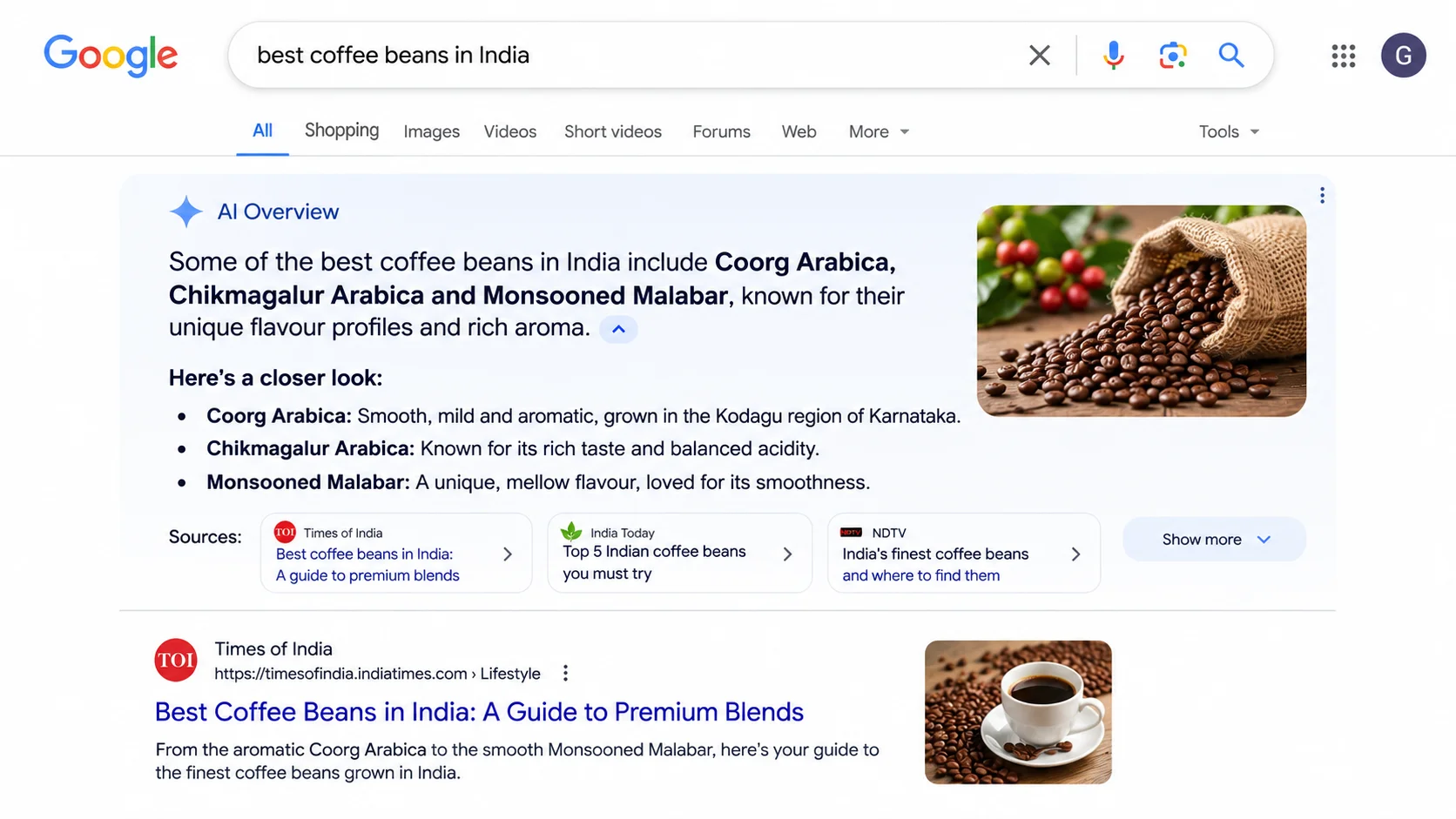
Generative engine optimization (GEO) is the practice of making your content more likely to be cited in AI-generated answers from Google AI Overviews, AI Mode, ChatGPT, Perplexity and similar tools. It builds on SEO rather than replacing it: Google says pages need no special optimisation for AI features beyond normal SEO fundamentals. What changes is the goal, from ranking a link to being quoted as a source in the answer.
Key points
- GEO comes from a 2023 research paper that found citations, quotations and statistics can lift visibility in AI answers by over 40%.
- Google says there are no extra technical requirements for AI Overviews or AI Mode.
- To appear in ChatGPT search, sites must allow OpenAI's OAI-SearchBot crawler.
- AI Overviews have cut clicks to top-ranking pages sharply, per Ahrefs.
- India is now ChatGPT's largest market by weekly users, and AI Mode works in eight Indian languages.
What is generative engine optimization?
The term comes from a research paper titled "GEO: Generative Engine Optimization", by researchers from Princeton, Georgia Tech, the Allen Institute for AI and IIT Delhi. It was accepted at KDD 2024.
The paper defines GEO as a framework that helps content creators improve how visible their content is in AI-generated answers. Its headline finding: adding citations, quotations from relevant sources and statistics significantly boosted source visibility, by over 40% across various queries.
The researchers also tested GEO on Perplexity, a live AI search engine, and saw visibility gains of up to 37%. Results varied by topic, which they said shows the need for domain-specific approaches.
Editor's note: The 40% figure comes from controlled experiments, not from Google AI Overviews or ChatGPT in production. Treat it as evidence that the tactics help, not a guaranteed uplift.
What is the difference between GEO and SEO?
SEO aims to rank a page in a list of links. GEO aims to get your content selected, summarised and cited inside an AI-written answer.
Traditional search shows ten ranked results. AI answers instead blend sources into one structured response and place citations inline, at varying lengths and positions.
What stays the same:
- Pages must be crawlable and indexed.
- Helpful, accurate, original content wins.
- Authority and trust still matter.
What changes:
- One answer may cite three to ten sources instead of ranking ten.
- Clear, quotable facts matter more than keyword density.
- Brand mentions across the web influence what AI tools say about you.
- Success is measured in citations and mentions, not only rankings.
Why does GEO matter for Indian marketers?
AI search is now mainstream in India. AI Overviews reach over 2.5 billion monthly users in more than 200 countries and 40-plus languages.
Google AI Mode in India: Google first launched AI Mode in India as a Search Labs experiment in English in June 2025. It added Hindi, then expanded AI Mode in October 2025 to seven more Indian languages: Bengali, Kannada, Malayalam, Marathi, Tamil, Telugu and Urdu. AI Mode crossed 1 billion monthly users within roughly a year of launch.
ChatGPT in India: In February 2026, Sam Altman said India had 100 million weekly ChatGPT users, second only to the US. By November 2026, OpenAI India's MD said India had become ChatGPT's largest market by weekly active users, with its user base doubling since January.
Voice and visual search: India is Google's largest user base for voice and visual search globally. That matters because AI Mode accepts spoken and camera-based questions.
Editor's note: The "largest market" claim is OpenAI's own statement, reported by The Economic Times, not an independently audited figure.
How do AI Overviews affect website traffic?
Clicks to top-ranking pages have fallen where AI Overviews appear. Ahrefs found that, as of December 2025, AI Overviews reduced the click-through rate for position-one pages by 58%, up from 34.5% in its earlier study.
Other studies point the same way: Seer Interactive measured organic CTR declines of 49.4% to 65.2%, and Authoritas 47.5%.
Google's view is different. It says clicks from results pages with AI Overviews are higher quality, meaning users spend more time on the site.
The practical takeaway: impressions may hold while clicks fall. Being cited in the AI answer is now part of keeping visibility.
How do AI search engines choose sources?
Google says AI Overviews and AI Mode may use "query fan-out", running several related searches across subtopics and data sources to build an answer.
For Google, eligibility is simple: a page must be indexed and eligible to show in Search with a snippet. There are no additional technical requirements.
For ChatGPT, crawler access matters. OpenAI says sites that block OAI-SearchBot will not be shown in ChatGPT search answers, though they may still appear as navigational links.
How do you rank in AI search? 10 steps
1. Fix crawlability first. Google's guidance includes allowing crawling in robots.txt and in any CDN or hosting setup, linking content internally, and providing a good page experience.
2. Allow OAI-SearchBot. OpenAI recommends allowing OAI-SearchBot in robots.txt to appear in ChatGPT search. You can still block GPTBot, which is used for model training, because each setting is independent.
3. Answer the question in the first paragraph. AI tools pull concise, self-contained answers. Lead with the answer, then explain.
4. Add statistics with sources. The GEO paper tested adding quantitative statistics instead of qualitative discussion. Use specific figures, dates and named sources.
5. Cite and quote credible sources. Citing sources and adding quotations from credible sources were among the tactics tested. Link to primary sources such as company filings, government data and official documentation.