
Advora.media
Language

Opens Google Translate in a new tab. Automatic translations may contain errors.

SEO & Search/ Insights

Google AI Overviews: How They Pick Sources and How to Appear in Them

Google AI Overviews now appear on a large share of searches, and only about 38% of the pages they cite rank in the top 10 for the same query. This guide explains how AI Overviews pick sources, what they do to clicks, what Google says you need to appear in them, how to limit or measure them, and what to ignore.

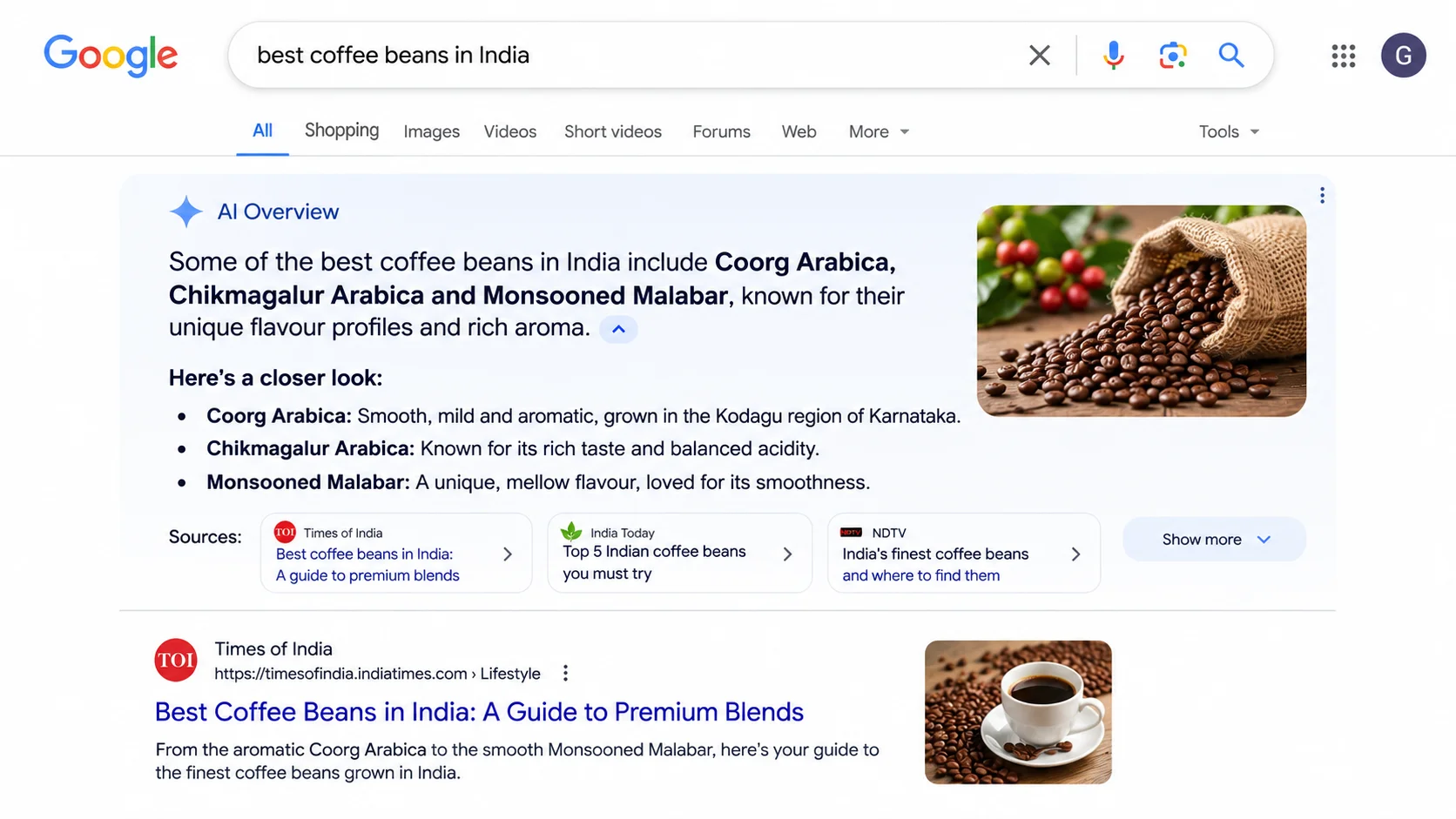
Google search results page with an AI Overview at the top showing cited source links

Google AI Overviews are AI-generated summaries at the top of search results, with links to supporting web pages. To appear as a cited source, Google says a page only needs to be indexed and eligible to show with a snippet; there are no extra technical requirements. But ranking isn't enough on its own: in a 2026 Ahrefs study, only about 38% of cited pages also ranked in the top 10 for the same query.

Key points

  • AI Overviews grew out of Google's 2023 Search Generative Experience (SGE) test.
  • Google uses "query fan-out", running related searches across subtopics, to build answers.
  • Most citations in Ahrefs' 2026 study came from pages outside the top 10 for the original query.
  • AI Overviews have sharply cut clicks to top-ranking pages, according to several studies.
  • Google-Extended does not control AI Overviews; snippet controls do.

What are Google AI Overviews?

AI Overviews are short AI-generated summaries that appear above regular results for some queries, with links to the pages they draw on. Google shows them only when its systems decide the summary adds value over classic Search, so many queries don't trigger one.

They started as SGE, which Google announced on 10 May 2023 as an opt-in test in Search Labs. On 14 May 2024, Google rolled out AI Overviews to everyone in the US.

In India: SGE launched as a Search Labs experiment in India in English and Hindi in August 2023. AI Overviews then rolled out fully to India, the UK, Japan, Indonesia, Mexico and Brazil in August 2024.

As of January 2026, AI Overviews run on Gemini 3, after earlier Gemini models including 2.5 variants.

Editor's note: "Google SGE" is the old name. Studies run on the 2023 SGE test measured an opt-in product, not today's AI Overviews.

How often do AI Overviews appear?

Estimates vary by dataset, but the trend is up:

  • A Similarweb-based report covered by TechCrunch in July 2026 found AI Overviews rose from 15% to 43% of searches in a year.
  • Semrush tracked 400 US commercial keywords and found AI Overviews on 88% of them in August 2026, up from 45.75% in September 2025.
  • Semrush's broader 2025 study found AI Overviews increasingly appearing on lower-funnel searches, with transactional queries rising from 1.98% to 13.94%.

Editor's note: Each study uses its own keyword set, country and device. Don't compare percentages across studies; watch the direction instead.

How do AI Overviews pick their sources?

Query fan-out. Google says both AI Overviews and AI Mode may run several related searches across subtopics and data sources to build a response. Your page can be cited because it ranks for a related sub-query, not the one the user typed.

Eligibility. A page must be indexed and eligible to show in Search with a snippet. There are no additional technical requirements.

What the data shows. Ahrefs analysed 863,000 keyword results and 4 million AI Overview URLs. About 37.9% of cited URLs appeared in the first 10 results blocks, 31.2% between 11 and 100, and 31.0% outside the top 100.

That's a big shift. Ahrefs found Google was taking far fewer citations straight from the SERP: about 76% in July 2025 versus about 38% in its 2026 update.

YouTube matters. Among cited pages that didn't rank in the top 100, 18.2% were YouTube URLs, making up 5.6% of all citations. Ahrefs also found YouTube mentions in titles, transcripts and descriptions to be the strongest correlating factor with AI Overview visibility across 75,000 brands.

How do AI Overviews affect traffic?

Clicks are falling. Ahrefs found that, as of December 2025, AI Overviews cut click-through rate for position-one pages by 58%, up from 34.5% in its earlier study. Seer Interactive measured organic CTR declines of 49.4% to 65.2%, and Authoritas 47.5%.

Exposure drives the drop. When AI Overviews launched in France in 2026, Ahrefs found that every extra point of AI Overview exposure cost a domain roughly one point of CTR. Health, with the highest exposure at 22.2%, saw CTR fall 20.4%.

Impressions may hold. Ahrefs' French study found impressions didn't fall; click-through rate did.

Google's view. Google says clicks from results pages with AI Overviews are higher quality, with users spending more time on the site.

How do you appear in AI Overviews?

1. Make sure Google can crawl and index you. Google's checklist includes allowing crawling in robots.txt and in any CDN or hosting setup, internal linking, and a good page experience.

2. Don't block snippets. A page needs to be eligible for a snippet. Check for accidental nosnippet tags or very low max-snippet values.

3. Cover the topic, not just the keyword. Because of query fan-out, cover the related questions and subtopics around your main query. Pages that only answer the exact keyword miss fan-out citations.

4. Answer clearly and early. Put a direct answer in the first paragraph, then support it with detail.

5. Use clear structure. Question-led headings, short paragraphs and lists make passages easier to use.

6. Keep structured data honest. Google's guidance is that structured data should match the visible text on the page.

7. Invest in YouTube. Given how often YouTube is cited, video with clear titles, descriptions and transcripts is worth building.

8. Publish what others don't have. Original data, local pricing and expert experience are harder to replace with a summary.

9. Keep pages current. Update figures, dates and prices regularly, especially on fast-changing topics.

For AI search beyond Google, see our guide to generative engine optimization.

How do you limit what AI Overviews use?

nosnippet: Removes snippets from all search results and stops the content being used as a direct input for AI Overviews and AI Mode. It also removes your snippet from regular results.

max-snippet: Caps snippet length and also limits how much content may be used as a direct input for AI Overviews and AI Mode.

data-nosnippet: Excludes specific sections of a page from snippets.

noindex: Removes the page from Search entirely. Use only as a last resort.

Google-Extended does not control AI Overviews. It limits AI training and grounding in some of Google's other systems. Blocking it won't keep you out of AI Overviews.

How do you measure AI Overview performance?

Search Console: AI Overview and AI Mode appearances count within overall search traffic in Search Console. There's no separate AI Overview report.

Watch CTR, not just impressions. Compare impressions and clicks over time for queries where AI Overviews appear.

Track citations manually. Check your top 20 to 50 queries regularly and record whether your pages are cited.

Watch branded search. If AI Overviews mention you, branded searches may rise.

What to ignore with AI Overviews

Ignore llms.txt for Google. Google says Search doesn't use it.

Ignore blocking Google-Extended to "opt out". It doesn't affect AI Overviews.

Ignore "rank first and you'll be cited". In Ahrefs' 2026 data, most citations came from outside the top 10.

Ignore old SGE data. It measured a different, opt-in product.

Ignore special AI markup. Google says no extra markup or optimisation is required.

Advora editorial team insights

From SEO work for Indian brands, the biggest change we see is that "ranking" and "being cited" have split. A page can hold position one and lose clicks to an AI Overview, while a well-structured page on page two gets cited.

The practical response is topic coverage. Pages that answer the main query and the obvious follow-up questions tend to show up more, because query fan-out rewards breadth.

Our verdict: keep your SEO fundamentals tight, build topic clusters around your money pages, add video where it helps, and track clicks and citations together.

FAQs

What are Google AI Overviews?
AI-generated summaries at the top of Google results, with links to the pages they draw on.

Is Google SGE the same as AI Overviews?
SGE was the 2023 opt-in test. It became AI Overviews when Google rolled it out to all US users in May 2024.

How do I appear in Google AI Overviews?
Make sure your page is indexed and eligible for a snippet, cover the topic and its related questions, and answer clearly. Google says no extra technical requirements apply.

Do I need to rank in the top 10 to be cited?
No. In Ahrefs' 2026 study, about 38% of cited pages ranked in the top 10 for the same query.

Do AI Overviews reduce website traffic?
Several studies say yes. Ahrefs found a 58% lower click-through rate for position-one pages where AI Overviews appeared.

How do I stop my content appearing in AI Overviews?
Use nosnippet, max-snippet or data-nosnippet. Blocking Google-Extended doesn't work for AI Overviews.

Are AI Overviews available in India?
Yes. They rolled out fully in India in August 2024.


SEO & Search

Generative Engine Optimization (GEO): The Complete Guide for Indian Marketers

Generative engine optimization (GEO) is the work of getting your brand cited in AI answers from Google AI Overviews, AI Mode, ChatGPT and Perplexity. This guide covers what GEO is, how it differs from SEO, what Google and OpenAI actually say about AI visibility, a step-by-step plan for Indian brands, and what to ignore.

Advora Editorial Team

SEO & Search

How to Get Backlinks for Free: 15 Methods That Still Work

You don’t need to pay for links to build them. This guide covers 15 free backlink methods that still work in 2026, including unlinked brand mentions, journalist requests after HARO, original data, broken link building and Indian industry associations, plus the free tools to track links and the tactics Google treats as link spam.

Advora Editorial Team

SEO & Search

How to Do Keyword Research for SEO: A Worked Example

Keyword research is how you find the searches your customers actually type, then decide which ones a page can realistically win. This guide walks through the full process with a worked example for a Hyderabad dental clinic, using free keyword research tools, long-tail keywords, intent checks and the AI Overview problem every SEO now has to plan around.

Advora Editorial Team