Advora.media
Language

Opens Google Translate in a new tab. Automatic translations may contain errors.

Performance Marketing/ Insights

What Small Businesses Can Learn From Elon Musk’s Marketing

You do not need a celebrity audience to build a trusted business. Translate the useful parts of Musk’s approach into small tests, clear promises and measurable customer value.

Illustration of a small business owner demonstrating a product to a customer beside the title Build Trust Before Fame.
AI-generated editorial illustration. Not a documentary photograph. Credit: Advora Editorial Team

A small business owner watches a billionaire launch a product and wonders whether the missing ingredient is confidence, publicity or a bigger vision.

Usually, the next useful step is closer to the customer. Show how the product works. Explain the price. Resolve the concern that stops someone buying. Deliver what was promised.

Founder-led marketing for small businesses means using the founder’s knowledge and credibility to help customers make a decision. It does not require becoming a celebrity.

After examining Elon Musk’s personal brand, Tesla’s changing marketing approach and founder reputation risk, this is Advora’s practical application for businesses with limited time and money.

Start with usefulness that a customer can recognise

In his November 2025 conversation with Nikhil Kamath, Musk encouraged aspiring entrepreneurs to focus on useful products and services and create more value than they consume. That is his stated advice, not a guarantee that usefulness automatically produces a viable business. Watch the original conversation.

Translate the principle into a specific customer outcome. A coffee-machine supplier might help a small café serve consistently during the morning rush. A manufacturer might reduce a buyer’s recurring rework. An agency might help a client understand which enquiries become customers.

These are illustrative examples, not reported client results.

Write one sentence: “We help this customer achieve this outcome under these conditions.” If the sentence requires a long explanation of your ambition, narrow it until a prospective buyer can recognise the problem.

1. Build one piece of proof before a large content calendar

A founder has access to the work itself. That can be a stronger starting point than posting general motivational advice.

For the coffee-machine supplier, proof might be a demonstration of preparation, output and cleaning under stated conditions. Include the setup and limitations so the audience can judge whether the result applies to its own premises.

For a service business, it might be a walkthrough of a real process, using customer permission and removing confidential information. If results are shown, include the period, starting point and relevant costs.

The objective is to reduce uncertainty. A polished video that leaves every buying question unanswered has done less work than a simple demonstration that resolves one important concern.

2. Give the customer a manageable next step

Do not force every interested viewer directly into a large commitment.

A suitable next step might be a product demonstration, a paid diagnostic, a sample order or a clearly scoped pilot. Choose the step that lets both sides assess fit.

Define the conditions: who the offer is for, what it includes, what it costs and what happens afterwards. Make it easy for an unsuitable customer to recognise that the offer is not relevant.

This helps distinguish curiosity from demand. Ten conversations with buyers who have the right need can teach more than hundreds of enquiries from people attracted by a vague promise.

3. Turn the founder’s knowledge into reusable answers

Record the questions that appear repeatedly in sales conversations. Start with the ones that affect the decision, such as maintenance, lead time, exclusions, suitability and total cost.

Have the founder answer those questions in plain language. Publish the answers on the company website and reuse them in short videos, proposals and follow-up messages.

One useful explanation can support several channels. The point is consistency, not posting identical material everywhere without considering context.

A founder who is uncomfortable on camera can write, narrate a demonstration or join a small customer session. Choose a format that reveals knowledge rather than forcing a performance.

4. Count the cost of founder-led acquisition

Organic visibility still consumes resources. Time spent scripting, recording, answering messages and selling has an economic cost, even when there is no media invoice.

Here is a deliberately hypothetical example for a small service business. These are planning assumptions, not Musk, Tesla or Advora client results.

Monthly activity

Assumption

Cost

Founder content and sales time

20 hours valued at ₹1,000 per hour

₹20,000

Production and editing

Allocated cost

₹10,000

Paid distribution

Test budget

₹15,000

Other sales support

Allocated cost for this activity

₹5,000

Total acquisition cost

All four items

₹50,000

Suppose the activity produces 50 qualified enquiries and five new paying customers. The qualification-to-customer rate is 10%. The fully allocated acquisition cost is ₹50,000 ÷ 5, or ₹10,000 per customer.

Counting only the ₹15,000 media bill would produce a paid-media cost of ₹3,000 per customer. That is a different measure and should be labelled accordingly.

If each customer’s first purchase contributes ₹12,000 after direct delivery costs but before acquisition costs, five purchases contribute ₹60,000. Deduct the ₹50,000 acquisition cost and ₹10,000 remains before other overheads and taxes.

At three customers, the same assumptions produce ₹36,000 contribution against ₹50,000 acquisition cost, a ₹14,000 shortfall before other overheads. That is why modest conversion changes can matter more than a large view count.

The founder’s time in this example is an economic allocation. If it is not paid out as salary, cash expenditure will differ. Also ensure the same labour cost is not counted again in delivery costs or overheads.

Use comparable customer cohorts and sales windows. Some buyers may take longer to close, and content may influence purchases recorded under another channel. This simple example is not an incrementality study.
5. Buy distribution when you have something useful to distribute

Tesla’s experience should not become a reason to refuse paid advertising. A founder without an established audience may need help reaching appropriate customers.

Start with a message that has already generated useful responses in customer conversations. Send people to a page that answers the same question and offers a relevant next step.

Set a test budget the business can absorb. Decide what would justify continuing, revising or stopping before the campaign begins. Use our guide to planning an advertising budget from a sales target to connect the activity with an outcome.

If enquiries are plentiful but unsuitable, investigate the promise, audience and qualification process. If qualified prospects do not buy, investigate the offer and sales experience before assuming you need more reach.

6. Use deadlines to learn, without promising what you cannot deliver

Short internal deadlines can help a team finish a small test. Public delivery commitments have a different purpose: customers use them to plan.

For example, give the team one week to produce a demonstration of an existing capability. Do not promise customers an unfinished product by Friday merely to create urgency.

Keep the test small enough to evaluate. If it fails, record whether the problem was the customer, message, offer, delivery or measurement. A failed experiment is useful when it changes the next decision.

Do not romanticise exhaustion or risking every available rupee. Protect essential obligations and the ability to try again. A survivable test is more useful to most small businesses than a dramatic all-or-nothing bet.

7. Make trust visible beyond the founder

Let the person who handles installation explain it. Let the delivery lead answer practical questions. Give customers clear contact details and an agreed escalation path.

When a founder makes every promise personally, growth can increase the number of things only that founder can resolve.

A simple handover helps: document the customer’s requirement, promised outcome, exclusions, owner and next date. The business should remember the commitment even when the founder is busy.

This is how personal credibility becomes an organisational asset. Customers begin to trust the company because the experience matches the explanation.

A 30-day pilot for a small team

This schedule is an editorial recommendation, not a validated growth formula. Adjust it to the buying cycle and available capacity.

Period

Action

Deliverable

Week 1

Speak with five relevant customers or prospects about a recurring problem.

A defined audience, problem and purchase objection.

Week 2

Create one demonstration and a page answering the main questions.

A useful proof asset and clear next step.

Week 3

Distribute through an appropriate existing channel and a bounded paid test if justified.

Tracked enquiries and documented feedback.

Week 4

Review lead quality, sales progress, costs and delivery capacity.

A decision to continue, revise or stop.

Five conversations help surface questions; they do not establish market-wide demand. Thirty days may also be too short to observe completed sales in real estate or industrial equipment. Track progress and revisit the cohort when the sales cycle has matured.

Advora editorial perspective: borrow the discipline, respect your constraints

The most useful inspiration from a famous founder is permission to take a customer problem seriously. It is not permission to ignore the resources needed to solve it.

A small business does not need to sound as ambitious as a space company. It needs a promise that matters to its customer, evidence that the promise is credible and a way to deliver it repeatedly.

Consistency becomes valuable when each cycle teaches something. Repeating an ineffective message for a year is persistence, but it is not necessarily progress. Change the method when the evidence demands it, while remaining clear about the customer you intend to help.

Build one useful result. Explain it honestly. Make the next commitment responsibly. That is a version of founder-led marketing a small team can begin without waiting to become famous.

Frequently asked questions

What is founder-led marketing?

It uses the founder’s knowledge, visibility and relationships to support customer acquisition and trust. It can include explanations, demonstrations and conversations rather than only social-media content.

Can founder-led marketing work without a large following?

It can be useful with a small, relevant audience. The practical test is whether it helps appropriate buyers understand the offer and take the next step, not whether the founder becomes widely known.

How should a small business measure it?

Track qualified enquiries, customer acquisition costs, conversion over an appropriate time window and contribution after delivery costs. Include founder time when assessing economic efficiency.

Should a founder stop paid advertising?

Only if the business evidence supports that decision. Founder content and paid distribution can work together. Avoid abandoning a productive channel to imitate another company’s history.

How long should the first test run?

A month can reveal whether the process and message generate useful responses. It may not reveal final sales results. Evaluate customers over the full buying cycle before drawing firm conclusions.

Performance Marketing

Facebook and Instagram Ads Cost in India 2026: CPM, CPC and CPL Benchmarks

Meta ads in India cost roughly ₹50 to ₹250 per 1,000 impressions, ₹5 to ₹30 per click and ₹150 to ₹2,000 per lead in 2026, among the cheapest rates in the world. Cheap reach is not cheap results, though. This guide gives the 2026 benchmarks for Facebook and Instagram, what moves the price, realistic daily budgets, GST, and how to read the numbers.

Advora Editorial Team

Performance Marketing

How to Calculate ROAS (and Why 4x Can Still Lose Money)

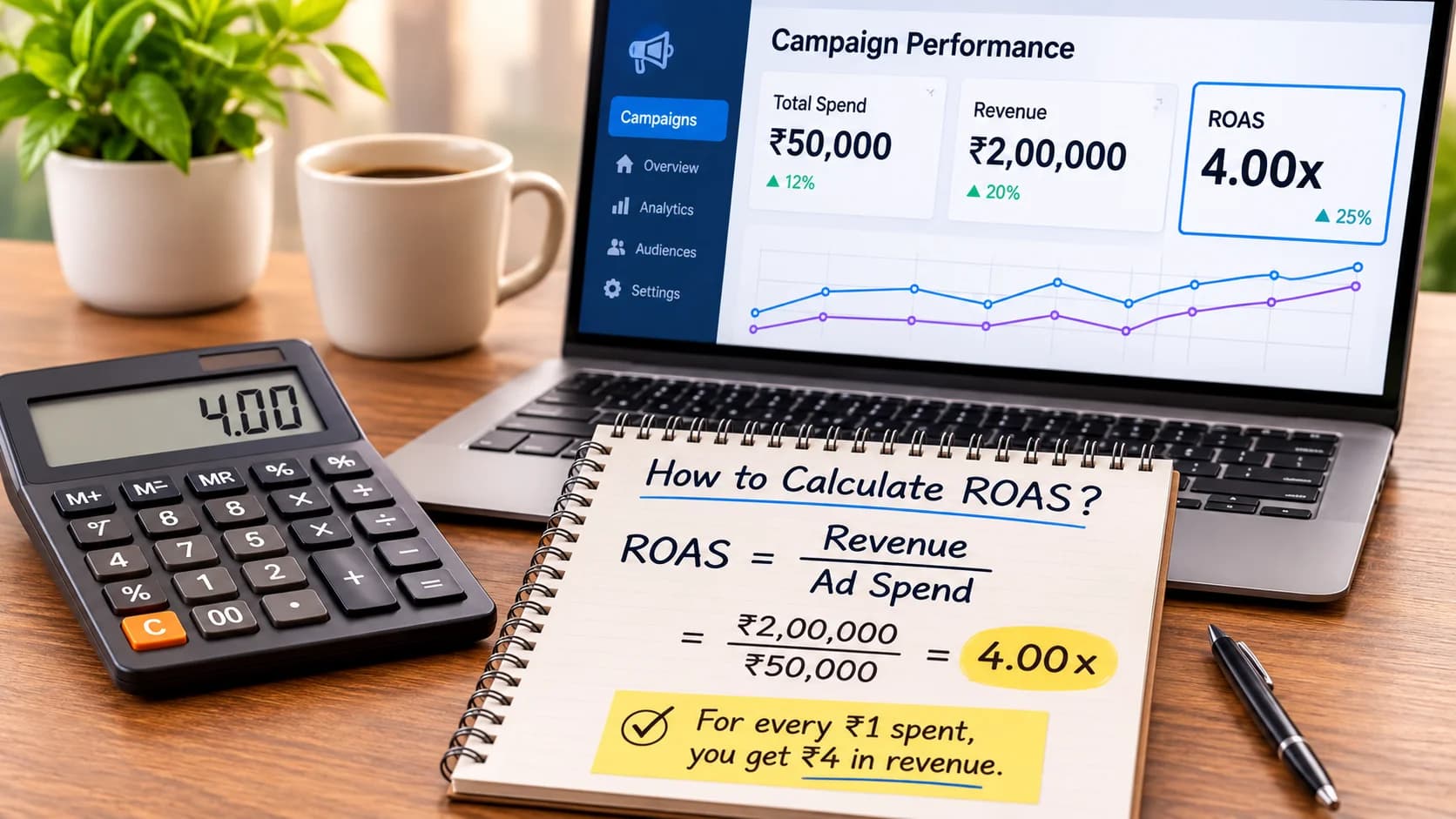
ROAS is revenue divided by ad spend, and it is the most misread number in Indian performance marketing. A 4x ROAS can lose money once GST, discounts, shipping, returns and COD failures are taken out. This guide shows the ROAS formula, a worked example in rupees, how to calculate your breakeven ROAS, and the three adjustments that turn a dashboard figure into a real one.

Advora Editorial Team