
Advora.media
Language

Opens Google Translate in a new tab. Automatic translations may contain errors.

Creator Economy/ Insights

How to Become a UGC Creator in India (Portfolio, Rates, Brands)

UGC creators in India get paid per video, not per follower, making it one of the few creator jobs you can start without an audience. This guide explains how to become a UGC creator in India in 2026: building a portfolio from scratch, what to charge from ₹1,500 to ₹25,000 a video, pricing usage rights, and where brands look for UGC creators.

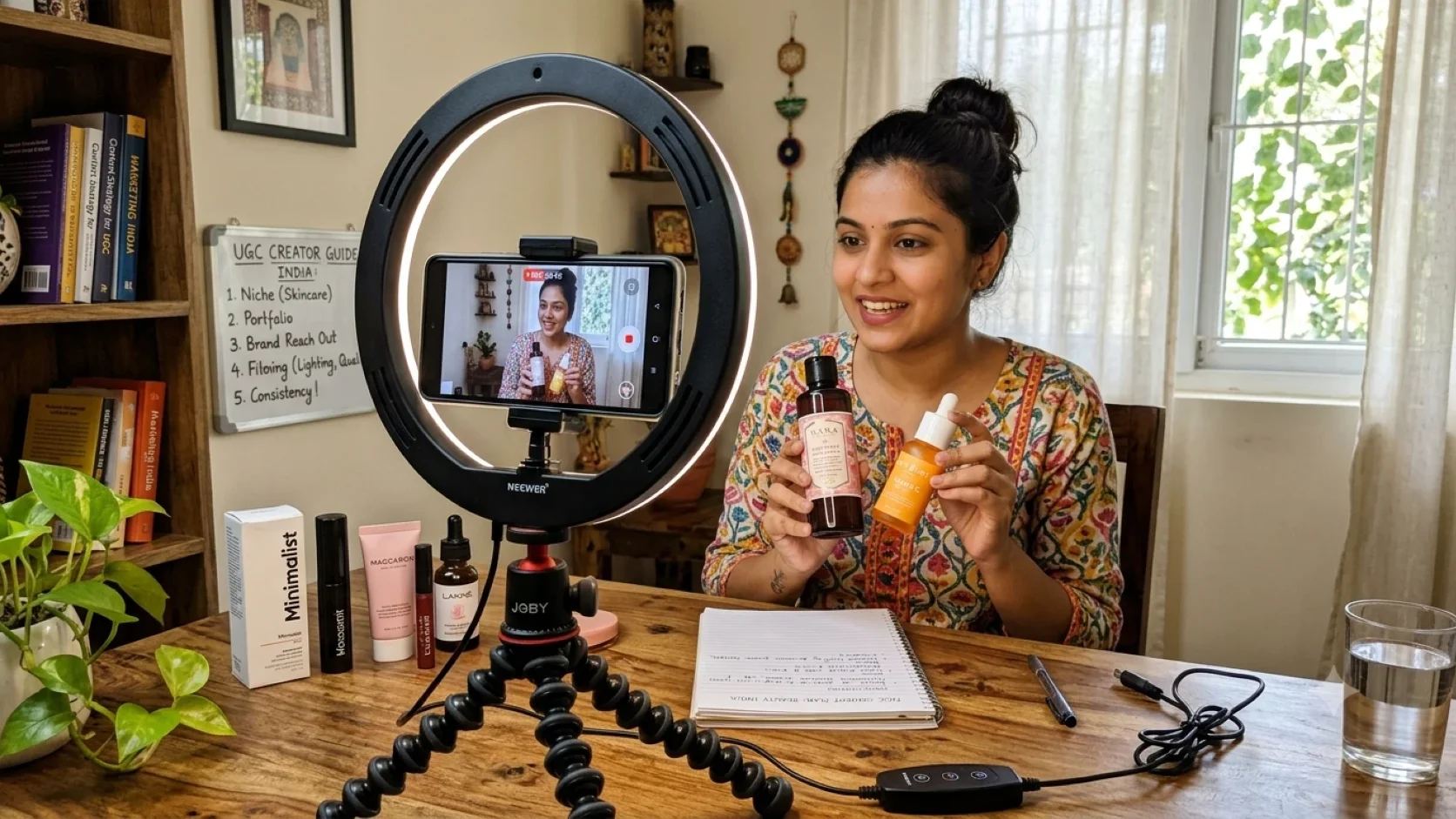
 Creator filming a skincare product review on a phone at home, illustrating how to become a UGC creator in India

To become a UGC creator in India, pick two or three product categories, make five to eight sample videos with products you already own, put them in a simple portfolio, and pitch D2C brands that run paid ads on Meta and YouTube. UGC creators are paid per video rather than per follower: industry executives quoted in 2026 put a standard 20 to 45-second video at roughly ₹1,500 to ₹25,000 depending on quality and track record, with usage rights adding 25% to 100% on top. You do not need a large following to start, but you do need a portfolio, clear pricing and a contract that covers how your video will be used.

Key points

  • UGC creators make videos that brands post or run as ads on their own channels. Your follower count barely matters.
  • Beginners in India typically charge ₹1,000 to ₹5,000 per video, intermediate creators ₹5,000 to ₹15,000, and experienced specialists more.
  • Usage rights are where income grows. Paid ads rights, whitelisting and perpetual use should always be priced separately.
  • D2C brands running performance ads are the biggest buyers, because they need a steady supply of new videos to test.
  • UGC income is taxable, gifted products above ₹20,000 a year attract TDS, and GST applies once turnover crosses the threshold.

What is a UGC creator?

A UGC creator makes short, natural-looking videos and photos that a brand uses on its own channels: its Instagram page, website, Amazon listings and, above all, its paid ads. The content looks like a real customer filmed it on a phone, which is the point.

The key difference from an influencer is who owns the audience. An influencer posts on their own feed and is paid for reach. A UGC creator hands over a video file and is paid for the asset itself.

One industry executive summed it up to Storyboard18 in 2026 as being paid per asset, not per audience. That is why people with a few hundred followers can earn from UGC while they would struggle to get influencer deals.

Editor’s note: UGC is not easier than influencing, just different. Brands judge you on whether your video stops the scroll and sells the product. Your hook, lighting, clarity and pace matter far more than your follower count.

Why are Indian brands paying for UGC?

Brands running ads on Meta, YouTube and Instagram need a constant supply of fresh creative, because ads stop performing as audiences see them repeatedly. UGC is cheaper and faster to produce than studio shoots, so brands can test many hooks and angles at once.

Creator-led ads also tend to perform well. Running a creator’s video from the creator’s own handle, through Meta’s partnership ads or TikTok’s Spark Ads, adds a further lift, with TikTok measuring 59% higher engagement.

Meta has published its own analysis showing partnership ads cut incremental purchase costs in European tests. For a D2C brand watching its return on ad spend, that makes good UGC worth paying for.

Do you need followers to become a UGC creator?

No. Brands buy your video, not your audience, so a small or private account is fine for most UGC work.

What you do need is proof you can make good content. That proof is your portfolio, not your follower count.

Followers become useful later. If a brand wants to run your video as a partnership ad from your handle, a real, engaged account helps, and you can charge more for it.

How do you build a UGC portfolio from scratch?

You can build a portfolio with products you already own. Brands care that you can make a convincing video, not that a brand paid for it.

1. Pick two or three niches. Choose categories you understand and use, such as skincare, haircare, food, home, fitness, baby products, gadgets or apps. Niche creators are easier for brands to hire.

2. Make five to eight sample videos. Use products from your home, and cover different formats: a testimonial, an unboxing, a how-to demo, a before-and-after, and a problem-solution video.

3. Keep them short and vertical. Film in 9:16 for Reels, Shorts and Stories. Most ad-ready UGC runs 15 to 45 seconds, with a strong hook in the first two to three seconds.

4. Show range. Include at least one video in Hindi or your regional language if you can. Many Indian brands need content in several languages.

5. Put it in one link. A simple Google Drive folder, Notion page, Canva site or dedicated Instagram account works. Add your niches, languages, turnaround time and contact details.

Editor’s note: Write “sample, not sponsored” on any spec video you make for a brand that has not hired you. It is honest, and it avoids giving the impression of a partnership that does not exist.

What should a UGC portfolio include?

Your best three videos first. Brands decide in seconds, so lead with your strongest work.

A clear list of formats you offer. For example, testimonials, unboxings, tutorials, voiceovers and hook variations.

Your niches and languages. State them plainly, such as “skincare and haircare, English and Hindi”.

Turnaround time. Many brands need videos within five to seven days.

Your starting rates or a rate card on request. Some creators list prices; others share them on enquiry.

Any results. If a brand shares that your video became a winning ad, add it, with permission.

What do UGC creators charge in India in 2026?

UGC rates in India are not standardised, and estimates vary widely. Industry executives quoted by Storyboard18 put a standard 20 to 45-second video at between ₹1,500 and ₹25,000, depending on production quality, category and track record.

A typical 2026 tiering looks like this:

  • Beginner: ₹1,000 to ₹5,000 per video
  • Intermediate: ₹5,000 to ₹15,000 per video
  • Experienced: ₹15,000 to ₹45,000 per video
  • Premium or niche experts: ₹45,000 and above

Format changes the price too. Simple unboxings sit at the lower end, while lifestyle videos and ad-specific edits made for Meta and YouTube command more.

Creators without a track record may be offered only the product as barter, or a few hundred rupees up to about ₹2,000 per video. Treat that as a short-term way to build a portfolio, not a long-term rate.

For comparison with influencer pricing, see our influencer rate card for India.

How do usage rights change UGC pricing?

Usage rights decide where and how long a brand can use your video. Your base rate should cover organic use only, and every additional right should cost extra.

The common rights and typical add-ons in India are:

  • Organic use: the brand posts on its own social pages. Included in the base rate.
  • Paid ads use: the brand runs your video as an ad for a set period. Usually 30% to 50% extra for 30 or 60 days.
  • Whitelisting or partnership ads: the brand runs ads from your handle. Often 50% to 150% extra.
  • Perpetual or unlimited use: no end date. Often 100% or more extra.
  • Exclusivity: you agree not to work with competitors for a period. Price by length and category.
  • Raw footage: unedited clips the brand can recut. Usually extra.

Industry estimates in 2026 put extended usage rights at between 25% and 100% of the base fee. A ₹3,000 video can therefore become a ₹4,500 to ₹9,000 deal once paid ads and whitelisting are included.

Editor’s note: Never hand over paid ad rights for free. A video that becomes a brand’s winning ad can run for months and earn the brand lakhs. Your contract should state the platforms, duration and whether ads run from your handle.

How should you price bundles and retainers?

Brands often buy in batches, because they need several hooks to test. A bundle of five to 10 videos is usually priced 15% to 25% below the single-video rate.
Monthly retainers are the most stable income. A brand might ask for a fixed number of videos each month for an agreed fee, often with hook variations included.

Hook variations are a useful upsell. The same video with three different opening lines gives a brand three ads to test, for a small extra charge.

Where do brands look for UGC creators in India?

Brands find UGC creators in four main places.

UGC and creator marketplaces. Platforms such as Collabstr list Indian UGC creators with portfolios and fixed prices, and Indian platforms such as Winkl and Find Influencer also connect creators with brands. International platforms including Billo, Trend and Insense serve global brands.

Instagram and LinkedIn. Brands and agencies search hashtags such as #ugccreatorindia and scroll creator portfolios. Posting your UGC samples on a dedicated account helps you get found.

Agencies. Performance marketing and creative agencies hire UGC creators for their D2C clients, and repeat agency work is often steadier than one-off brand deals.

Creator communities. Many creators find work through referrals in WhatsApp and Telegram groups.

How do you pitch brands directly?

Direct outreach is often the fastest way to land your first paid client.

Pick brands that run ads. Check Meta’s Ad Library to see which D2C brands are actively advertising. Brands with many live ads need new creative constantly.

Make a sample for them. A short spec video using their product, clearly labelled as a sample, is more convincing than a message alone.

Contact the right person. Growth managers, performance marketing leads and founders at small D2C brands decide on UGC, not general customer support.

Keep the message short. Say what you make, link your portfolio, attach the sample and state your turnaround time.

Follow up once. Brands are busy, and a polite follow-up after a week often gets a reply.

What does a good UGC brief and contract include?

Before you film, make sure the brief and agreement cover:

  • Deliverables: number of videos, length, format, aspect ratio and hook variations.
  • Key messages and claims: what you can and cannot say about the product.
  • Revisions: usually one or two rounds included.
  • Usage rights: platforms, organic or paid, duration, whitelisting and exclusivity.
  • Payment: amount, advance, deadline and who pays for the product.
  • Turnaround: delivery date and approval timeline.

Be careful with claims. ASCI’s advertising code requires claims to be truthful and backed up, so avoid saying a product cures or guarantees anything unless the brand supplies proof.

What tax rules apply to UGC creators in India?

UGC income is taxable as business or professional income. Keep invoices and records for every job.

GST registration becomes mandatory once your turnover from services crosses the threshold, after which you charge 18% GST on your fees.

Free products count too. Under Section 194R, brands must deduct 10% TDS on products or benefits worth more than ₹20,000 a year, so barter deals are not tax-free.

If you work for international brands, payments usually arrive in US dollars through platforms or bank transfers. Speak to a chartered accountant about export of services and the paperwork needed.

How much can a UGC creator earn per month in India?

Income depends on volume, rates and usage rights, so there is no single figure.

A beginner making a handful of videos a month at ₹1,500 to ₹3,000 each earns side income. An experienced creator delivering 15 to 25 videos a month with paid ad rights can build a full-time income.

Retainers and usage fees make the difference. Creators who sign monthly packages and charge for ad rights earn far more than those selling one-off videos at a flat price.

What to ignore in UGC creator advice

Ignore “you need followers first”. Brands buy videos, not audiences.

Ignore rates without usage rights. Any rate quoted without stating organic or paid use is incomplete.

Ignore endless free work. A few portfolio pieces or barter jobs are fine at the start, but move to paid work quickly.

Ignore buying followers to look established. It damages trust and does nothing for your videos.

Ignore AI-only shortcuts. Brands still value real people using real products, and Meta requires labels on ads with photorealistic AI-generated people.

Advora editorial team insights

Working with D2C, real estate, healthcare and education clients on Meta and Google, we see brands judge UGC creators on three things: a strong first three seconds, a clear product moment, and fast, reliable delivery. Creators who meet deadlines and take feedback well get rebooked far more than those with fancier editing.

Our verdict for 2026 is that UGC is one of the most accessible creator careers in India, because it rewards skill over audience. The creators earning well are the ones who treat it as a service business, with a portfolio, a rate card and contracts that price usage rights properly.

The second insight is about specialisation. Generalist UGC creators compete on price. Creators who own a niche, such as skincare in Hindi or app walkthroughs in Telugu, become the obvious choice for brands in that category and can charge more.

FAQs

How do I become a UGC creator in India?
Pick two or three niches, make five to eight sample videos with products you own, build a simple portfolio and pitch D2C brands that run paid ads.

How much do UGC creators earn in India?
Beginners typically charge ₹1,000 to ₹5,000 per video and intermediate creators ₹5,000 to ₹15,000, with usage rights adding 25% to 100% or more.

Do I need followers to become a UGC creator?
No. Brands pay for the video, not your audience. Followers help only if a brand wants to run ads from your handle.

What should be in a UGC portfolio?
Your best three videos first, the formats you offer, your niches and languages, turnaround time and contact details.

Where can I find brands looking for UGC creators?
UGC marketplaces such as Collabstr, Indian creator platforms, Instagram and LinkedIn, agencies, and direct outreach to D2C brands running ads.

Do UGC creators pay tax in India?
Yes. UGC income is taxable, GST applies above the registration threshold, and brands deduct 10% TDS on gifted products worth more than ₹20,000 a year.


Creator Economy

ASCI Influencer Guidelines Explained: Disclosures That Keep You Safe

ASCI's influencer guidelines require a clear label like "Ad" or "Collaboration" on any post with a material connection to a brand, shown upfront and for set durations in video. This guide covers the approved labels, placement rules, health and finance requirements, CCPA penalties of up to ₹50 lakh, and what brands must check.

Advora Editorial Team

Creator Economy

Micro-Influencers: Why They Outperform and How to Find Them

Micro influencers, creators with roughly 10,000 to 100,000 followers, usually get higher engagement than big creators and cost far less per post. This guide covers what the data says about micro vs macro influencers, 2026 rates in India, how to find and vet creators, how to brief them, and the disclosure rules you must follow.

Advora Editorial Team

Creator Economy

How Much YouTubers Earn in India: CPM by Niche

Indian YouTubers typically earn about ₹15 to ₹170 per 1,000 long-form views, and far less on Shorts, depending on niche and audience. This guide breaks down 2026 RPM and CPM by niche, what 1 lakh or 10 lakh views actually pay, the YouTube Partner Program rules changing in February 2027, tax basics and the income streams beyond ads.

Advora Editorial Team