

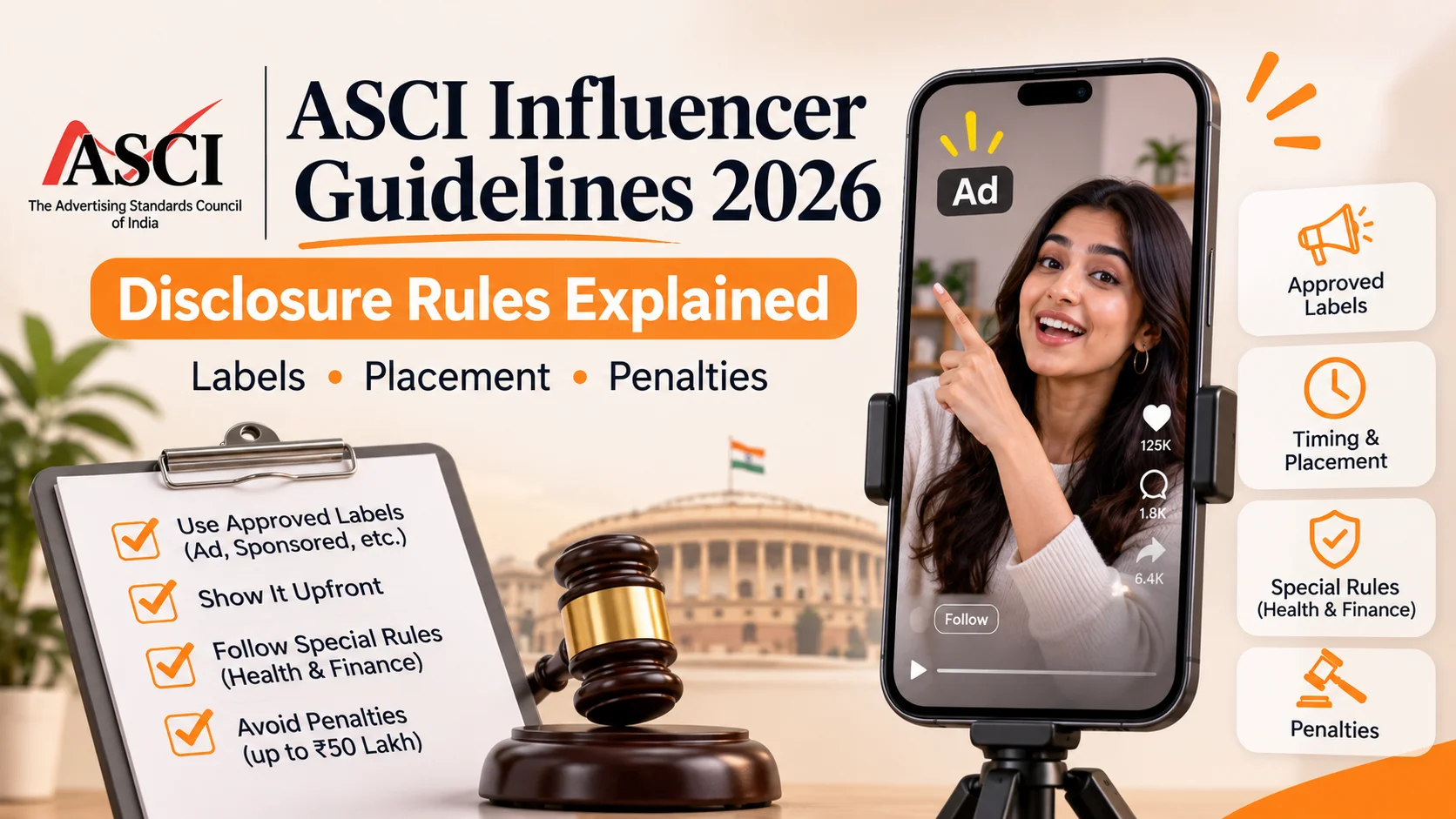
ASCI's influencer guidelines say any post promoting a brand you have a material connection with must carry a clear disclosure label, such as "Ad", "Sponsored" or "Collaboration", placed upfront where the average viewer will see it. Video labels must stay on screen for set durations, and health and finance influencers must also show their qualifications. Separately, the government's Endorsement Know-hows can lead to penalties of up to ₹10 lakh, and up to ₹50 lakh for repeat offences.
Key points
- ASCI issued its final influencer guidelines in May 2021 and updated them in 2023 and 2025.
- Approved labels include Advertisement, Ad, Sponsored, Collaboration, Partnership, Employee and Free gift.
- Video labels must stay on screen for minimum durations based on video length.
- Finfluencers giving investment advice must be SEBI-registered and display their registration number.
- In FY26, 97.3% of influencer ads ASCI processed needed modification.
What are the ASCI influencer guidelines?
The Advertising Standards Council of India (ASCI) is the advertising industry's self-regulatory body. It issued final guidelines for influencer advertising on digital media on 27 May 2021, after a draft released for public feedback in February 2021.
The guidelines apply to advertising content, where a brand is promoted directly or indirectly and there's a material connection between the brand and the influencer.
ASCI built them after consulting creators, brands, lawyers, global guidelines and media platforms.
Editor's note: ASCI is a self-regulatory body. Its guidelines sit alongside the government's Consumer Protection Act rules, which carry legal penalties.
What counts as a material connection?
A material connection is any relationship with a brand that could affect how your audience sees your endorsement. It includes payment, but also free products, employment and other benefits.
ASCI's approved labels reflect this range: alongside "Ad" and "Sponsored", the list includes "Employee" and "Free gift". If a brand sent the product free, it still needs a label.
Which disclosure labels does ASCI allow?
ASCI's updated guidelines allow any one or more of these labels:
- Advertisement
- Ad
- Sponsored
- Collaboration
- Partnership
- Employee
- Free gift
- Instagram's "Paid Partnership" tag
Language: The label must be in English or translated into the language of the ad, so the average viewer understands it.
What doesn't count: ASCI's draft said no other labels may be used, because consumers may not recognise short forms. A bio-level disclosure ("all posts may be sponsored") isn't accepted either.
Where and how long must the label appear?
Upfront and prominent. The disclosure should appear upfront, not buried after other hashtags or below "more".
Picture-only content (Stories, Snapchat). The label should be superimposed over the picture so the average viewer can see it clearly.
Video without a caption: the label must be superimposed on the video for a minimum duration:
- Videos of 15 seconds or less: at least 3 seconds
- Videos over 15 seconds and under 2 minutes: one-third of the video's length
- Videos of 2 minutes or longer: the entire section where the brand or its features are mentioned
Audio: ASCI's guidelines say the label must be announced clearly at the beginning and end of the audio.
Editor's note: Using both a caption label and a superimposed label on Reels and Shorts is the safest approach, since many viewers never open captions.
What extra rules apply to finance influencers?
In August 2023, ASCI added requirements for finance influencers. Those giving investment advice must be registered with SEBI and display their SEBI registration number.
In April 2025, Addendum 2 clarified the position. Influencers can share general financial information, such as saving tips or the benefits of insurance, without a licence. Technical advice, like recommending stocks or funds, still needs SEBI registration or relevant credentials.
Broader financial advice requires qualifications such as CA, CS or an IRDAI insurance licence.
SEBI's own rules apply too. ASCI's guidelines don't override SEBI. SEBI-registered firms can't use influencers for promotions, even through third parties.
What extra rules apply to health influencers?
Health influencers must have relevant qualifications for the advice they give, such as a medical degree or certification as a nurse, nutritionist, dietician, physiotherapist or psychologist.
They must disclose qualifications and registration details prominently, superimposed upfront on visuals or stated as the opening remark in videos.
The Department of Consumer Affairs also extended its influencer guidelines on 11 August 2023 with extra disclosures for health and wellness endorsements.
As with finance, ASCI's 2025 addendum lets health influencers share general information without professional qualifications.
What does the government require?
On 20 January 2023, the Department of Consumer Affairs issued "Endorsements Know-hows!" for celebrities, influencers and virtual influencers on social media.
They require clear, simple disclosure terms such as "advertisement", "sponsored", "collaboration" or "paid promotion".


