Advora.media
Language

Opens Google Translate in a new tab. Automatic translations may contain errors.

Brands/ Case study

WHOOP Business Model: How a Screenless Band Made Recovery Worth Paying For

How WHOOP combines a screenless wearable, subscription pricing and athlete-led marketing, with practical lessons on recurring value and customer trust.

Explore the visual story →

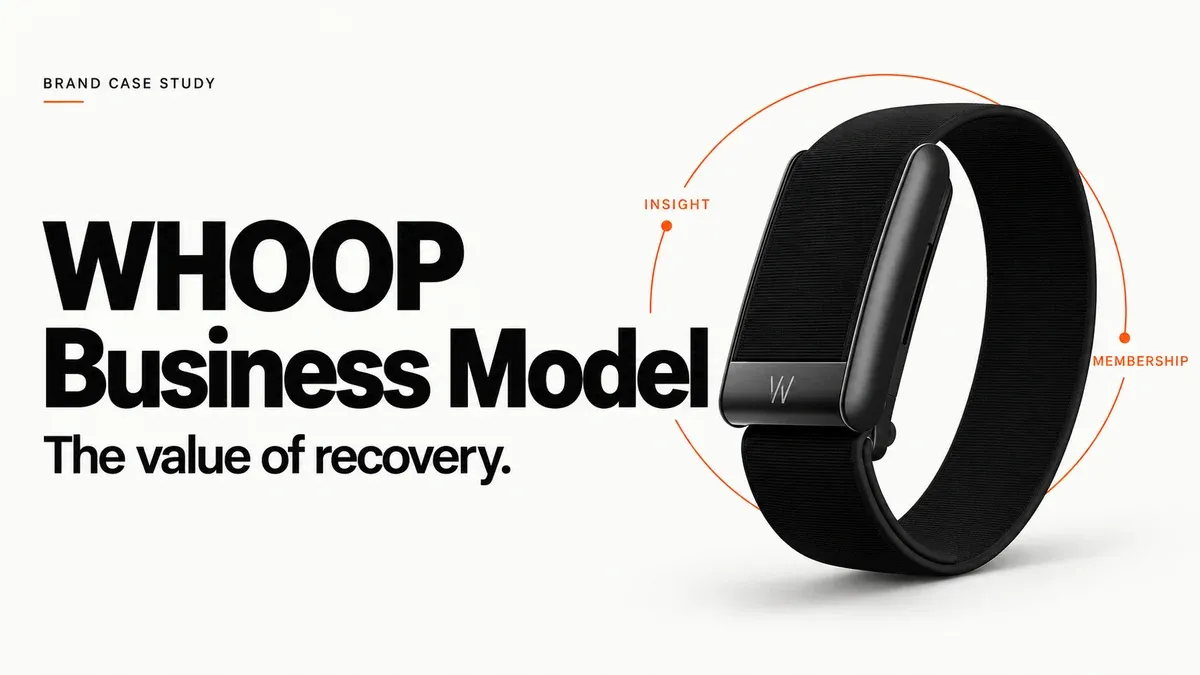
WHOOP business model cover featuring a black WHOOP band and the headline The value of recovery.
WHOOP business model: the value of recovery. Credit: Advora Media, AI-assisted editorial composition using the editor-supplied WHOOP product reference.

A screen is usually the easiest way to demonstrate what a wearable can do.

Show the steps. Display the workout. Deliver a notification.

WHOOP took a different approach. Its screenless band put the explanation on a phone and asked customers to care about something less visible: how their bodies were responding to training, sleep and everyday demands.

That created an unusual marketing challenge. The company had to explain why a device with fewer obvious features deserved a place on someone’s wrist and a recurring charge on their card.

The WHOOP business model became compelling when its product, pricing and positioning began supporting the same promise: ongoing insight into performance and recovery.

For marketers, the interesting question is how the company made that promise valuable enough to buy repeatedly, and what happens when the subscription relationship tests customer trust.

The WHOOP business model, explained simply

WHOOP sells a wearable membership. Customers pay for access to its connected service, with hardware included under the applicable membership terms.

Its May 2018 consumer membership launch bundled the WHOOP Strap 2.0, app-based analytics and community features for $30 per month, with an initial six-month commitment. The minimum entry commitment was therefore $180. These are historical launch terms, not a current price quotation. WHOOP’s membership launch announcement

The commercial logic is straightforward:

Wear the device → receive insights → make a decision → return for the next insight → decide whether the membership remains worthwhile.

Every renewal depends on that chain continuing to feel useful.

Part of the model

What the customer receives

Business implication

Wearable hardware

A way to collect measurements during everyday use

Creates the connection to the service, but brings manufacturing and replacement costs

App and analytics

Interpretation of sleep, strain and recovery data

Gives customers a reason to return

Membership

Continued access under the selected plan

Creates recurring revenue and recurring expectations

Athlete associations

A recognisable performance context

Helps people understand who the product is for

Hardware upgrades

Access to newer devices under eligibility rules

Can support renewal or create friction if terms are unclear

This is a hardware-and-service business. Calling the strap “free” describes how an offer may be presented; it does not mean the device costs nothing to manufacture, ship or support.

The problem came before the positioning

In his account of WHOOP’s origins, founder Will Ahmed describes overtraining as a Harvard squash player: periods of progress followed by exhaustion he struggled to explain.

His interest was in understanding the relationship between effort and recovery. He began studying the subject and developed the idea into a company.

That personal account offers a useful starting point for understanding the brand. A person who already trains seriously does not necessarily need another reminder to exercise. They may need help deciding whether to push harder, change their routine or recover.

Those are different customer problems.

A product built around motivation might lead with activity goals. A product built around recovery has to make the consequences of yesterday’s behaviour understandable today.

The distinction gives WHOOP a clearer story than a broad promise to track everything.

It also explains why the founder’s experience is relevant without making it scientific proof. A personal problem can identify an opportunity; validating the resulting product requires separate evidence.

Why having no screen helped define the brand

Removing a familiar feature only works when customers understand what they gain in return.

For WHOOP, the screenless design makes the product visibly different from a smartwatch. Our reading of the positioning is that this difference supports a focused proposition: wear the sensor, then use the app to interpret the information.

That does not establish that screenless devices are inherently more accurate. Nor does it mean every customer prefers them.

It does make the comparison more interesting.

Instead of asking only, “How many features does this watch have?”, a prospective customer can ask, “Will this service help me understand my training and recovery?”

That is a different buying conversation.

For another brand considering a stripped-back product, the practical test is simple: can a customer explain the benefit of the missing feature without repeating the company’s advertising?

If the answer is no, subtraction may simply look like a compromise.

The subscription pivot changed the buying decision

WHOOP’s device became available to consumers for $500 in November 2016, according to contemporary reporting. Its 2018 membership offer lowered the initial commitment and bundled the device with ongoing services. Sports Business Journal’s contemporary coverage

Consider the difference from a buyer’s perspective.

A substantial upfront hardware purchase asks: “Am I confident this device will be worth owning?”

A membership asks: “Am I willing to commit to using this service, and will it remain worth renewing?”

The second question can be easier to answer initially, but it returns.

That is the trade-off. A subscription can reduce the initial purchasing barrier while increasing the company’s obligation to demonstrate continuing value.

It also changes the work marketing must do. Acquisition campaigns bring people in, but onboarding, useful explanations, product communication and renewal terms all become part of the commercial experience.

A strong launch cannot compensate indefinitely for a service that becomes easy to ignore.

Recurring revenue still has to cover recurring costs

It is tempting to describe the pivot as a move from difficult hardware economics to attractive software economics. That skips the strap still sitting on the customer’s wrist.

Hardware costs remain. So do delivery, support, replacements, product development and the infrastructure behind the service.

For a business with this structure, an important question is how long it takes a customer relationship to recover its acquisition and fulfilment costs.

A simplified management calculation is:

Payback period = acquisition and initial fulfilment costs ÷ monthly contribution after ongoing variable costs.

This is a general analytical framework, not a calculation of WHOOP’s undisclosed unit economics.

The distinction matters because subscriber growth alone cannot establish profitability. A company could attract more customers while spending too much to acquire or serve them.

For the same reason, a campaign’s reported return on advertising spend should be examined alongside contribution margin. Advora’s explanation of why a 4x ROAS campaign can still lose money explores that measurement problem.

Athlete marketing made the product’s purpose easier to understand

WHOOP’s connection to elite sport gives its proposition a recognisable setting.

A recovery-focused wearable on an athlete is easy to interpret: this person has a reason to care about training, sleep and physical readiness.

In May 2024, WHOOP announced Cristiano Ronaldo as both a global ambassador and an investor. That is a commercial relationship, and it should be described as one rather than presented as independent product validation. WHOOP’s Ronaldo partnership announcement

From a marketing perspective, the fit is significant.

The association does three jobs:
  • Explains the use case: recovery matters to people whose work depends on physical performance.
  • Creates aspiration: the product becomes associated with disciplined preparation.
  • Attracts attention: a recognisable athlete can introduce the brand to audiences beyond its original niche.

However, endorsement is not evidence that the device caused an athlete’s success. Public visibility also does not reveal the partnership’s acquisition cost, conversion rate or incremental sales.

The lesson for smaller brands is to choose partners whose expertise or routines make the product easier to understand. A relevant demonstration can be more useful than fame without a credible connection.

How big has WHOOP become?

WHOOP announced a $575 million funding round at a $10.1 billion valuation on March 31, 2026.

In that announcement, the company reported more than 2.5 million members, 103% year-over-year bookings growth in 2025, a $1.1 billion exit bookings run rate and positive operating cash flow for 2025. These are company-reported figures tied to that announcement. WHOOP’s Series G announcement

The labels matter:

Metric

What readers should understand

Valuation

A financing valuation, not annual sales

Funding raised

Investment capital, not customer revenue

Bookings

A commercial measure that should not automatically be treated as recognised revenue

Exit run rate

An annualised pace at a particular point, not necessarily the full-year result

Positive operating cash flow

A cash-flow measure, not the same as net profit

These distinctions prevent a successful funding story from becoming an inaccurate business story.

The upgrade controversy exposed the subscription’s weak point

A membership makes customers think beyond the product they receive today. They also form expectations about what continued payment will entitle them to tomorrow.

WHOOP’s 2025 hardware upgrade controversy illustrates how sensitive those expectations can become.

On May 10, 2025, the company updated its policy to offer a free WHOOP 5.0 upgrade on Peak to members with more than 12 months remaining. It also said eligible customers who had already paid an upgrade fee would receive refunds.

WHOOP acknowledged that an earlier blog article incorrectly described eligibility based on having been a member for six months. The company said the previous policy concerned time remaining on a membership. WHOOP’s policy clarification

That distinction is commercially important and easy for customers to misunderstand.

The lesson extends beyond wearables: upgrade rules belong in the customer proposition. They should be consistent across sales pages, help articles, support conversations and checkout.

Before changing a membership offer, a brand should ask:

  1. What did existing customers reasonably understand when they bought?
  2. Which groups gain or lose under the new terms?
  3. Can the difference be explained in one clear sentence?
  4. Is the explanation visible before payment?

A business may have sound reasons to change pricing. Customers still need an understandable account of what changed and why.

The FDA story needs its 2026 update

WHOOP’s expansion into health-related features also introduced a different kind of scrutiny.

In July 2025, the US Food and Drug Administration issued a warning letter concerning Blood Pressure Insights, stating that the feature was being marketed without the required clearance or approval. FDA warning letter

That was not the final development.

On June 17, 2026, the FDA issued a closeout letter. Following changes to the product and its labelling, and in line with updated general-wellness guidance, it said it did not intend to enforce device requirements against Blood Pressure Insights as modified. The letter was specific to that modified product. It was not blanket FDA approval of WHOOP or all its features. FDA closeout letter

For marketers, the practical point is that product claims need careful boundaries. Language describing a wellness feature cannot casually imply diagnostic capabilities.

A strong brand promise needs to stay within what the evidence and applicable rules support.

Advora’s perspective: the daily decision is the real marketing asset

Our interpretation is that WHOOP’s most useful business lesson lies in the decision it helps customers revisit.

A dashboard can be impressive once. A question such as “How should I approach today?” can remain relevant.

That creates a demanding standard for a subscription product. The information must be understandable, arrive at a useful moment and help the customer do something with it.

For a marketing team, this suggests a better retention question than “How do we send more reminders?”

Ask: “Which recurring customer decision becomes easier because our product exists?”

Then examine whether customers actually experience that benefit. Measure activation, continued use, renewal, cancellations and support friction together. Do not substitute engagement claims for evidence of value.

Five lessons brands can use

Lesson

Practical application

Start with a specific frustration

Describe the customer’s difficult decision before listing product features

Make differentiation understandable

Explain what customers gain from an unusual design choice

Connect pricing to continuing value

Establish why the service deserves renewal, beyond the initial purchase

Choose credible partners

Select people whose work demonstrates a relevant use case

Treat terms as part of the brand

Make commitments, renewals and upgrade eligibility clear before checkout

WHOOP shows how positioning and pricing can reinforce each other. It also shows why the work continues after someone subscribes: the product must remain useful, and the relationship must remain understandable.

Frequently asked questions

What is WHOOP’s business model?

WHOOP operates a wearable membership model that combines hardware with access to its app and services under the selected plan. Its consumer subscription launch in 2018 marked a significant shift from the earlier upfront device purchase.

Why does WHOOP charge a subscription?

The membership structure supports an ongoing service rather than only an initial hardware transaction. For customers, the relevant question is whether continued access provides enough value to justify renewal.

Is the WHOOP device free?

Hardware may be included without a separate upfront device charge under a membership offer. Customers still pay for the membership, and upgrades have eligibility conditions. “Included” is a clearer description than “free.”

Why is WHOOP screenless?

WHOOP separates the wearable sensor from the app where users view insights. That gives it a distinctive product experience, but the absence of a screen does not itself establish better measurement accuracy.

What makes WHOOP’s marketing strategy distinctive?

Its positioning links recovery and performance with elite sport. Athlete partnerships help make that proposition visible and aspirational, while the membership model requires the product to keep earning customers’ interest.

Does Cristiano Ronaldo own WHOOP?

Ronaldo is an investor and global ambassador. That does not mean he owns the company outright.

What can other subscription brands learn from WHOOP?

Give customers a clear reason to return, measure the economics of serving them, and explain membership terms consistently. Acquiring a subscriber and keeping their trust are connected responsibilities.

Is this a medical review of WHOOP?

No. This is a business and marketing case study. It does not independently test the device or offer medical advice.

Editorial note: This analysis distinguishes company-reported figures from regulatory records and Advora’s interpretation. Financial figures retain their reporting dates. No firsthand product testing or access to WHOOP’s internal customer economics is claimed.

Keep reading

More in Brands ↗

Brands

Lenskart Marketing Strategy: Case Study

Lenskart spends less than 7% of revenue on marketing and still became the brand India thinks of first for spectacles. The trick is that its 3,100 stores, its founder’s television seat and a lens-first supply chain do most of the advertising. This case study follows the spend, the campaigns and the ₹7,278 crore IPO, and separates what is copyable from what is structural.

Advora Editorial Team