The Lenskart marketing strategy spends proportionally less every year and reaches more people every year, because the stores and the founder do most of the work. Advertising spend was ₹448 crore in FY25, about 6.7% of revenue, down from 7.8% two years earlier, while revenue grew to ₹6,652 crore and the company turned a ₹297 crore profit. The November 2025 IPO raised ₹7,278 crore at a valuation near ₹70,000 crore. This case study explains how a category with no brand loyalty produced India’s first eyewear brand people name unprompted.
Key points
- Lenskart’s marketing cost fell from 9.7% of revenue in FY23 to 7.5% in H1 FY26 while absolute spend rose to ₹448 crore. The brand gets more efficient as it gets bigger, which is rare in Indian consumer internet.
- Stores are the main media. Lenskart had 2,137 Indian stores in June 2025, 2,439 by December 2025, and is adding more than 450 a year. Each one is a billboard, a trial room and an eye test.
- The founder is the ambassador. Peyush Bansal’s seat on Shark Tank India since 2021 gave the brand a weekly prime-time presence no paid campaign could buy, and the 2023 Karan Johar ad made him the punchline.
- Celebrity casting followed audience shifts: Katrina Kaif in 2017 for women who did not see eyewear as fashion, Bhuvan Bam in 2019 for a youth audience, Karan Johar from 2023 for aspiration at a fair price.
- The IPO earmarked only ₹320 crore for brand marketing over four years, against ₹864 crore for stores and leases. Retail, not advertising, is where Lenskart is placing its growth bet.
What is the Lenskart marketing strategy built on?
Lenskart was founded in 2010 by Peyush Bansal, Amit Chaudhary and Sumeet Kapahi as an online-only spectacles retailer. The marketing problem it inherited was structural: Indians bought glasses from a neighbourhood optician they trusted, saw spectacles as a medical purchase rather than a fashion one, and bought a new pair only when the old one broke. No amount of advertising fixes a category people avoid thinking about.
The strategy that emerged attacks each of those habits in order. Stores replaced the optician relationship with a branded one. Celebrity campaigns reframed glasses as something you choose for how you look, not just how you see. Low prices, a wide range and free home eye tests gave people a reason to buy a second pair.
Underneath all three sits a vertically integrated supply chain. Lenskart designs and manufactures most of its frames and lenses, which keeps prices low enough that “fair price” can be the message rather than a discount. The marketing is an output of the business model, not a layer on top of it.
Editor’s note: This is the Advora verdict on Lenskart, and it is the opposite of last week’s CRED and Dream11 cases. Those brands bought attention and hoped a product would hold it. Lenskart built a distribution machine first and let advertising point at it. A marketer who copies the Karan Johar ad without the 2,400 stores behind it is copying the wrong half.
How did Lenskart’s celebrity campaigns evolve?
Lenskart’s first brand ambassador was Katrina Kaif in October 2017, with the #HowDoILook campaign conceptualised by Enormous Brands. Bansal said at the time that women did not see eyewear as a fashion category, and the campaign was built to change that single belief. The spot worked around the sound of frames clicking on and off as she chose between looks.
In March 2019 the brand signed Bhuvan Bam, the YouTube creator behind BB Ki Vines, as its first male ambassador. His first film, #HalkaRakhYaar by Mullen Lowe Lintas, launched the Lenskart Air lightweight range in November 2019 and pitched the brand at a younger, mobile-first audience. Choosing a creator over a film star was unusual for a national television campaign in 2019 and signalled where Lenskart’s customers actually spent their time.
The third phase began in January 2023 with “The War of Fair Prices”, written by Tanmay Bhat, Puneet Chadha, Devaiah Bopanna, Deep Joshi and Vishal Dayama, the team behind CRED’s films. Karan Johar refuses to be seen in glasses that cost so little and asks Bansal to add middlemen so the price goes up. The founder’s cameo turned the CEO into a recurring character, and the ad landed while Shark Tank India had already made him a household face.
Johar stayed on through 2024, when “Glasses Badlo Vibe Badlo” paired him with Kiara Advani in a Lenskart store. The campaigns drew on the Koffee with Karan persona the audience already knew, in the same against-type logic CRED had used with Rahul Dravid. Across seven years the ambassador changed three times, and each time the change tracked a shift in who Lenskart needed to reach next.
How does Shark Tank fit into Lenskart’s advertising strategy?
Peyush Bansal joined the first season of Shark Tank India in December 2021 and has been on every season since. The show put a Lenskart founder on prime-time television for several hours a week, in a role that made him look thoughtful, frugal and on the side of small entrepreneurs. None of it cost Lenskart a media rupee.
The brand built around it deliberately. afaqs reported in 2023 that Lenskart was openly capitalising on the Shark Tank appearance, with Bansal’s own screen presence feeding into the Karan Johar ads. The founder’s quotes, pitches and investments became content that Lenskart did not have to produce, and his face became a trust signal in a category built on trust.
This is the single most efficient marketing decision in the case study. A brand ambassador costs several crore a year and is seen for 30 seconds at a time. A founder on the most watched business show in India is seen for hours, unpaid, saying things that make the company look good.
What role do stores play in Lenskart’s branding?
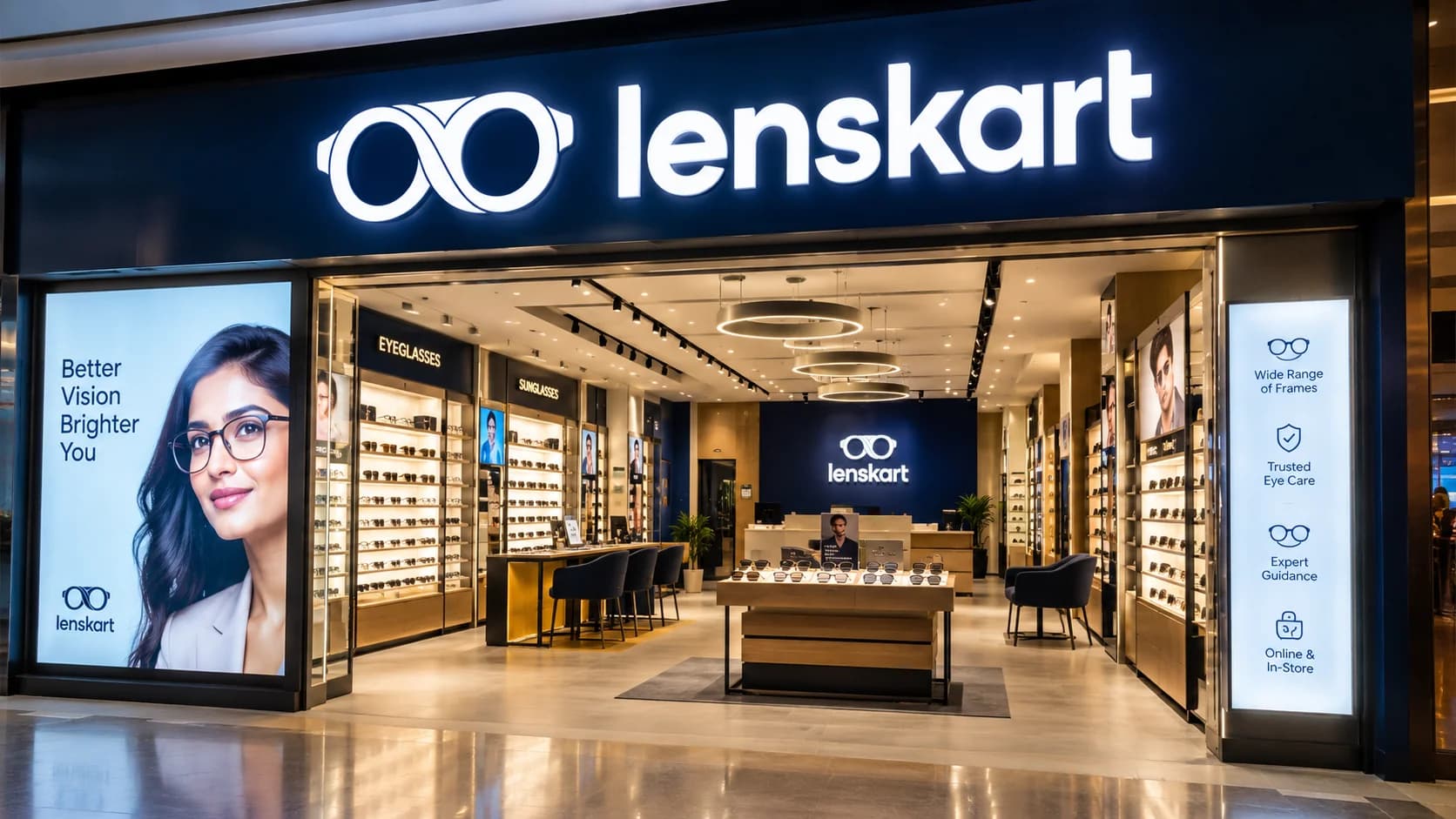
Lenskart operated 2,806 stores globally at the time of its IPO, 2,137 of them in India, and had reached 2,439 Indian stores and 705 international stores by December 2025. It added 282 Indian stores in FY25 and targets more than 450 net additions in FY26, with 620 new company-owned stores planned from IPO proceeds by FY29. For a brand that began online, physical retail is now the primary channel and the primary medium.
Each store does three marketing jobs at once. The signage on a high street builds reach in the catchment every day without a media buy, which is why Lenskart’s marketing-to-revenue ratio keeps falling as the network grows. The trial experience and the in-store eye test convert a browser into a buyer on the spot, and the AI-enabled eye-testing Lenskart is rolling into 500-plus stores makes the visit feel clinical as well as commercial.
The international footprint works the same way. The 2022 acquisition of Japan’s Owndays gave Lenskart several hundred stores across Southeast Asia and the Middle East, and the company now operates in nine countries outside India. Those markets are being built store-first too, with brand awareness spend following the retail footprint rather than leading it.
Editor’s note: Watching Hyderabad’s high streets over the past three years, the spread of Lenskart signage in Kukatpally, Madhapur and Himayatnagar has been faster than any paid campaign we have run for a retail client. A store with good lighting on a busy corner is a 24-hour hoarding that also happens to take payment.
How much does Lenskart spend on marketing?
Lenskart’s advertising and promotion spend rose from ₹294 crore in FY23 to ₹352 crore in FY24 and ₹448 crore in FY25, a 27% increase in the final year. The company employed 169 people across marketing and sales at the time of its IPO filing.
The ratio is the more telling number. Marketing cost as a share of revenue fell from 9.7% in FY23 to 6.74% in FY25 and 7.5% in H1 FY26, which Lenskart attributed to tightly integrated campaigns, a shift to influencer-led content and performance tracking. In plain terms, the brand is spending more rupees but needing fewer of them per rupee of sales.
The IPO use-of-proceeds shows where management thinks growth comes from. Of the fresh issue, ₹320 crore is earmarked for brand marketing over four years, ₹24 crore in FY26 and ₹98 crore a year from FY27 to FY29, covering performance marketing, paid media, influencers, content, PR and offline activations. Against that sit ₹272.6 crore for new company-owned stores and ₹591.44 crore for leases, nearly three times the marketing line.
Separately, Lenskart committed to spend up to ₹400 crore on marketing through TLG between May 2025 and April 2029. Either way, the brand will keep spending in the ₹450 to ₹600 crore range a year, while revenue is growing at 28% to 38%. The gap between those two growth rates is the whole strategy.
Did the strategy make Lenskart profitable?
Yes, and the sequence matters. Lenskart lost ₹64 crore in FY23 and ₹10.2 crore in FY24, then posted a ₹297.3 crore net profit on ₹6,652 crore of revenue in FY25, with EBITDA of ₹1,115 crore. The turn to profit arrived in the same year marketing hit its highest absolute level and its lowest share of revenue.