The Dream11 marketing strategy was built on one idea: own cricket so completely that playing fantasy cricket anywhere else felt wrong. It paid ₹222 crore for the IPL 2020 title, ₹358 crore for the Team India jersey and ₹3,913 crore on advertising in FY25 alone, with MS Dhoni as the face throughout. Then the Promotion and Regulation of Online Gaming Act, passed on 21 August 2025, removed 95% of its revenue overnight. This case study separates what that spend built from what the law took away.
Key points
- Dream Sports spent ₹3,913 crore on advertising and promotion in FY25, 58% of total expenses, almost unchanged from ₹3,958 crore in FY24. Few Indian consumer brands have ever spent more.
- Sponsorship was the core channel. Dream11 was IPL title sponsor in 2020, IPL partner since 2019, principal sponsor of four franchises in 2024, and Team India’s lead sponsor from July 2023 at roughly ₹4 crore a match.
- Paid contests generated about 95% of revenue and all of the profit. The August 2025 ban ended them, revenue fell to ₹7,374 crore in FY25 and the company posted its first loss, ₹479 crore.
- The audience survived. Dream11 kept over 25 crore registered users and about 1 crore daily actives through the ban, and now claims 30 crore users on a free-to-play, ad-supported model.
- On 27 August 2026 Dream11 declared its pivot complete, from fantasy sports to a global sports engagement platform. Its CMO of eight years left the same year.
What was the Dream11 marketing strategy before the ban?
Dream11 was founded in 2008 by Harsh Jain and Bhavit Sheth and spent its first decade as a niche product. Its marketing changed gear in 2018 with the #KheloDimaagSe campaign fronted by MS Dhoni, which framed fantasy cricket as a skill game and gave the brand its long-running “dimaag” positioning. The choice of Dhoni, a captain known for calm decision-making, was the strategy in one casting decision.
From there the plan had three layers that stayed constant for seven years. The first was celebrity cricketers as ambassadors, with Dhoni, Rohit Sharma, Shikhar Dhawan, Hardik Pandya and Shreyas Iyer appearing in rotating film series. The second was sponsorship of every level of Indian cricket, from IPL franchises to the national team. The third was performance marketing timed to match days, when intent to build a team peaked.
Dream Sports CMO Vikrant Mudaliar said in 2021 that digital, television and sponsorships made up close to 100% of marketing spend. There was no print, no outdoor of note and no brand work outside the sport. Every rupee was placed where a cricket fan would be in the hour before a match.
Editor’s note: This is the most single-minded media strategy in recent Indian marketing. Most brands diversify channels to manage risk. Dream11 concentrated them to maximise the one moment that mattered, and the concentration worked right up until the risk arrived from outside the media plan.
How did Dream11 use the IPL?
Dream11 became an official IPL partner in 2019 and the title sponsor in 2020, after Vivo withdrew during the India-China standoff. It paid ₹222 crore for the single season, beating BYJU’S at ₹201 crore and Unacademy at ₹170 crore, and asked for a three-year deal that the BCCI declined. The 2020 season, played in the UAE, was the most watched IPL to that point, and Dream11 crossed 10 crore registered users during it.
The 2021 activation showed the model at full scale. Two parallel campaigns ran side by side, “Team Hai Toh Mazaa Hai”, six 25-second films about the joy of building a team, and “Dream11 Pe Dimaag Lagao”, six 15-second call-to-action films. Both closed on Dhoni’s line about putting your mind to Dream11, so brand and performance shared one sign-off.
After Tata took the title in 2022, Dream11 stayed inside the tournament through franchise deals. By 2024 it was principal sponsor of Kolkata Knight Riders, Punjab Kings, Gujarat Titans and Sunrisers Hyderabad, and launched “Team Se Bada Kuch Nahi” by Tilt Brand Solutions, which played on the rivalries between its own ambassadors. The earlier “Yeh main kar leta hoon, aap Dream11 pe team banao” line had already become a meme on its own.
The IPL was not just reach. It was the only period in the year when a paid contest felt like a national activity rather than a private habit, and Dream11’s spend was built to convert that feeling into deposits inside the same evening.
What did the Team India sponsorship add?
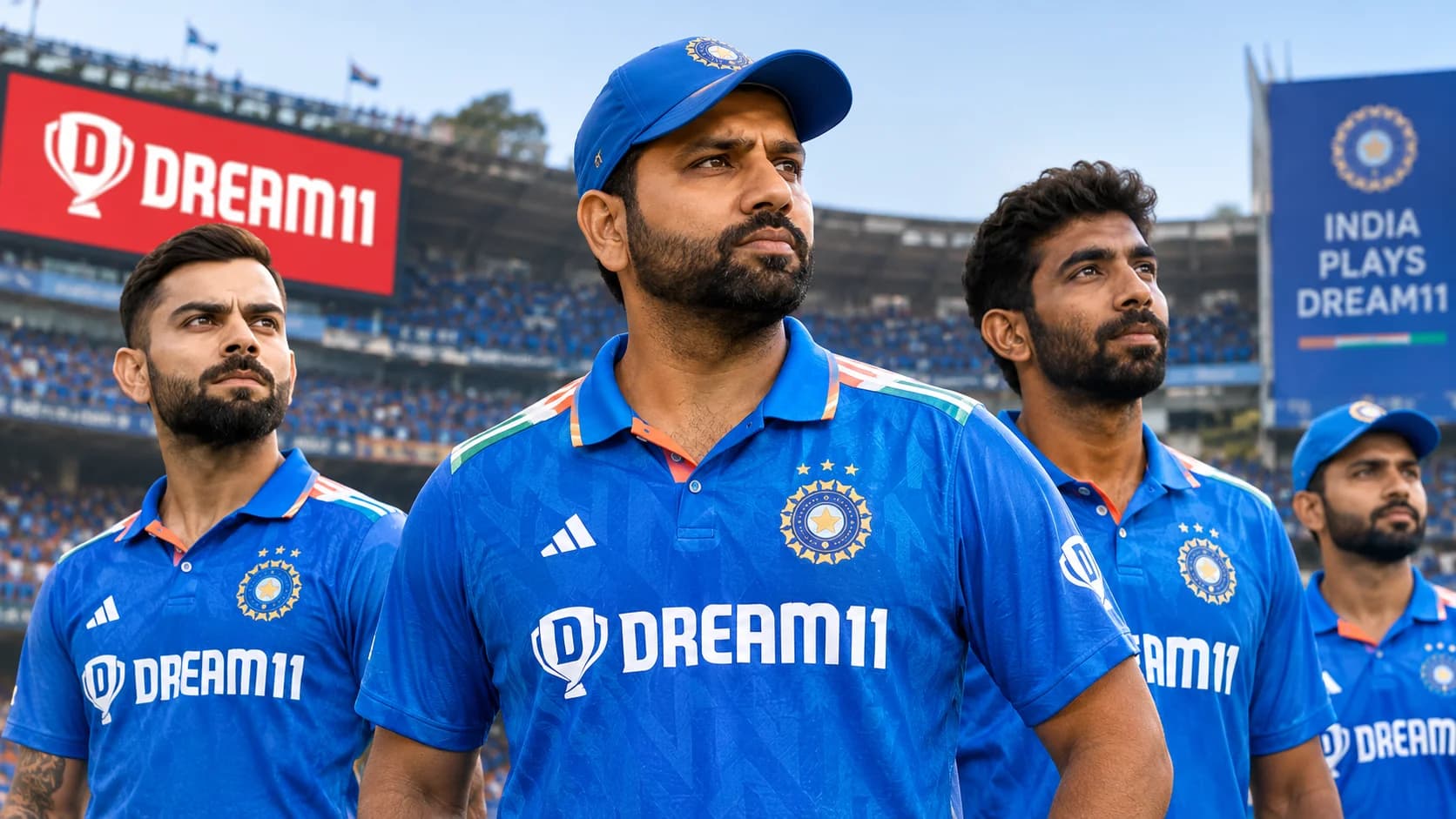
In July 2023 Dream11 became lead sponsor of the Indian cricket team on a three-year deal worth ₹358 crore, about ₹4 crore a match, running to March 2026. The jersey put the brand on every bilateral series, the 2023 ODI World Cup at home and the 2024 T20 World Cup win. For a fantasy platform, having its logo on the players users were picking was the most direct product placement in sport.
The deal ended abruptly in August 2025 when the ban made Dream11 ineligible. India played the Asia Cup with a blank jersey, and in September 2025 Apollo Tyres won the replacement rights for ₹579 crore over two and a half years, about ₹4.5 crore a game, beating Canva and JK Cements. The jersey was worth more without Dream11 than with it, which says something about how the BCCI had priced the earlier deal.
How much did Dream11 spend and what did it earn?
Dream Sports’ advertising and promotion line rose from ₹2,158 crore in FY22 to ₹2,964 crore in FY23, ₹3,958 crore in FY24 and ₹3,913 crore in FY25. Across those four years that is roughly ₹13,000 crore, most of it concentrated into cricket seasons.
For most of that period the spend was profitable. Dream Sports reported total income of ₹8,346 crore and a profit of ₹1,295 crore in FY24, and reached an $8 billion valuation in 2021 after an $840 million round. Tencent held a minority stake, which became a political talking point during the 2020 title sponsorship.
FY25, which ended five months before the ban, was the first wobble. Revenue slipped to ₹7,374 crore and the company posted a ₹479 crore loss, driven by a ₹575 crore one-time tax charge from redomiciling its parent to India and ₹778 crore in director benefits linked to ESOPs. Advertising stayed flat, which suggests the brand saw no reason to pull back.
Editor’s note: Here is the Advora verdict. Dream11 was not a marketing failure; it was a marketing success that outran its regulatory cover. The spend-to-revenue ratio was sane, the channel strategy was right, and the product converted. The lesson is not about ads, it is about what a brand owes itself when its entire category depends on a legal interpretation.
What happened after the gaming ban?
Parliament passed the Promotion and Regulation of Online Gaming Act on 21 August 2025, banning online games played for money regardless of skill, chance or a combination of the two. Dream11 paused all paid contests the next day. Harsh Jain told staff that 95% of revenue and 100% of profit had disappeared, and the rules operationalising the Act came into force on 1 May 2026.
The response was fast and public. Within a month Dream11 relaunched as a free-to-play, ad-supported product on the same app, with prizes funded by brand partners such as Swiggy, Astrotalk and Tata Neu rather than entry fees. The company said about 70% of its users were aged 18 to 35, and pitched that audience to advertisers it had previously kept at arm’s length.
Dream Sports also committed to no layoffs, with roughly 500 engineers redeployed across FanCode, DreamSetGo, Dream Game Studios and a new finance vertical, Dream Money. It launched free-to-play Dream11 in 11 international markets and, on 27 August 2026, announced that its pivot to an AI-first global sports engagement platform was complete. Vikrant Mudaliar, CMO for eight years, departed the same year.