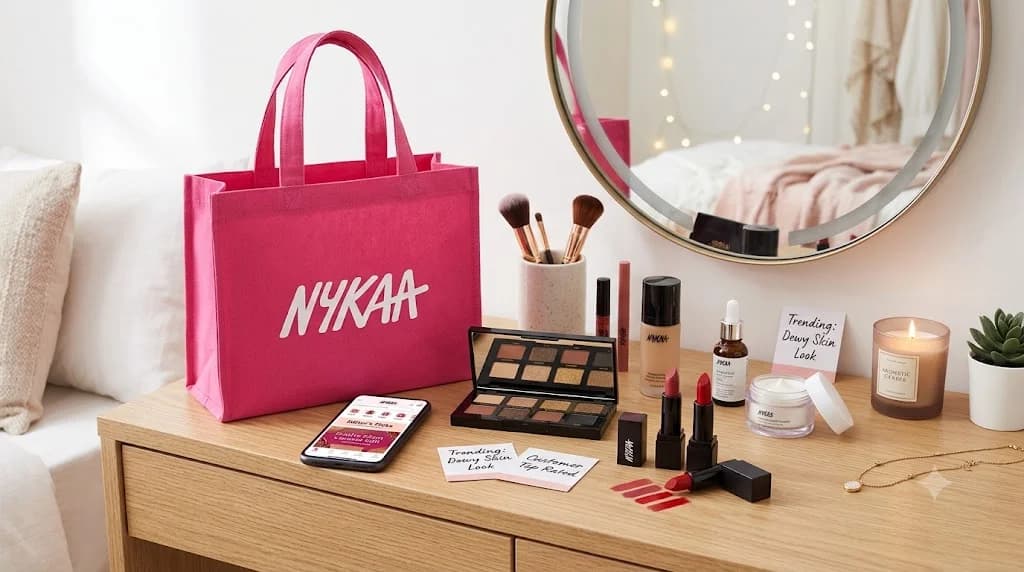
The Nykaa marketing strategy is content first, commerce second: teach Indian consumers how to use beauty products, then sell them those products on the same platform. It spent ₹995 crore on marketing in FY25, about 12.5% of revenue, on creators, tutorials, flagship sales and events, and crossed ₹10,000 crore in revenue for the first time in FY26 with a record ₹204 crore profit. This case study follows how the playbook was built, what the spend buys now, and why owned brands are becoming its most important channel.
Key points
- Nykaa’s marketing spend rose 35% to ₹995 crore in FY25, 12.5% of revenue, and Q2 FY26 marketing and selling expenses rose 29% to ₹368 crore. It is one of the few Indian internet brands increasing spend and profit at the same time.
- FY26 revenue reached ₹10,022 crore, up 26%, on GMV of ₹19,963 crore, with EBITDA up 59% to ₹752 crore and profit after tax up 183% to ₹204 crore.
- Content and creators are the core channel. Nykaa built a tutorial library, the Beauty Book blog and a creator network before influencer marketing went mainstream in India.
- Pink Friday and the Pink Summer Sale are traffic engines. The Q1 FY27 summer sale drew 3.5 crore unique visitors and 10 crore visits, with GMV up about 40% year on year.
- House of Nykaa, the owned-brand portfolio including Dot and Key and Kay Beauty, grew GMV 49% to ₹3,176 crore in FY26 and now sells in 1.5 lakh general trade stores.
What is the Nykaa marketing strategy built on?
Falguni Nayar founded Nykaa in 2012 after a career in investment banking, with a simple observation: Indian women had money to spend on beauty and nowhere trustworthy to learn what to buy. Department stores carried a few international brands, chemists carried the rest, and nobody explained how to use any of it. Nykaa set out to be the explainer and the shop at once.
The strategy that followed has three layers. Authenticity came first, with Nykaa sourcing directly from brands and authorised distributors in a market full of counterfeits. Content came second, with tutorials and reviews that taught customers what a product did before asking them to buy it. Range came third, with a catalogue that grew to thousands of brands, including exclusive launches available only on Nykaa.
Early leadership was explicit about the difference between advertising and content. Advertising, as the brand team put it, is what brands say about themselves, while rich content keeps people engaged and drives sales. Nykaa built its marketing budget on the second idea and used the first sparingly.
Editor’s note: This is the Advora verdict on Nykaa, and it sits closest to Lenskart among the cases we have covered this month. Both built a trust layer first, Lenskart with eye tests and stores and Nykaa with tutorials and authenticity, and both now spend heavily on top of that foundation. The difference is that Nykaa’s trust layer is content, which is cheaper to scale and harder for a competitor to copy quickly.
How does Nykaa use content marketing?
Nykaa’s content operation is the reason it ranks for a large share of Indian beauty search. The Beauty Book blog covers how-to guides, ingredient explainers and product comparisons across skincare, makeup and haircare, and functions as an encyclopedia that sends readers straight to product pages. Every page targets the questions a beginner asks, which are the questions with the most search volume.
Video followed. Nykaa TV on YouTube publishes tutorials, launches and creator collaborations, with the brand posting more than ten videos a month in its early years and the channel growing past a million subscribers. The NykaaPlay format now mixes tutorials, influencer stores and shopping in one feed, and the company’s investor materials put the creator content ecosystem at the centre of its strategy.
Product pages are content too. Customer reviews with photos, ratings, ingredient lists and shade swatches turn each listing into a buying guide, which lowers return rates and lifts conversion. In a category where the main fear is buying the wrong shade, the review layer is as important as any campaign.
How does Nykaa work with influencers?
Nykaa worked with micro-influencers and beauty YouTubers before most Indian brands had an influencer budget, and the network has become a formal part of the business. FY25 commentary from management credited a larger influencer network and digital content for a 28% rise in customers. Investor materials now describe Nykaa as India’s largest creator and content ecosystem for beauty.
The rationale is in the company’s own data. Nykaa’s presentations cite that three in four Indian consumers rely on influencer recommendations for discovery, and that 76% of content consumed is creator content. Rather than fight that trend with brand advertising, Nykaa supplies the creators with products, affiliate stores and tutorials that link back to its platform.
Creator content also lowers paid acquisition cost. A tutorial that ranks on YouTube or Instagram for months does the work of a paid ad without the media bill, and the affiliate structure means Nykaa pays when it sells. That is the mechanism behind the company’s ability to grow spend and margin together.
What are Nykaa’s biggest campaigns and events?
Nykaa’s marketing calendar is built around owned events rather than third-party sponsorships. Pink Friday, its November sale, is the flagship and grew 36% year on year in Q3 FY25. The Pink Summer Sale and Nykaa Birthday Sale anchor the first half of the year, with the Q1 FY27 summer sale reaching 3.5 crore unique visitors, over 10 crore visits and about 40% GMV growth.
Nykaaland is the brand’s beauty festival, a live event with creators, brand booths and performances that functions as content, sales and PR at once. Nykaa Wali Shaadi targets the wedding season with bridal edits and partner brands. Management said both initiatives were designed to build brand equity, and they contributed to marketing reaching 12.5% of revenue in FY25.
The events also earn money. Nykaa’s Q3 FY25 investor presentation noted that revenue outgrew GMV partly because of marketing income from brands at marquee events like Nykaaland and Nykaa Wali Shaadi. Nykaa charges brands to be visible on its platform and at its events, so a share of the marketing line is funded by the brands it sells.
Editor’s note: Running campaigns for beauty and wellness clients, we have seen Pink Friday function as Nykaa’s own Diwali. Brands plan launches and discounts around it, and customers wait for it, which means Nykaa owns a shopping occasion the way Amazon owns Prime Day. Owning the calendar is cheaper than renting someone else’s.
How much does Nykaa spend on marketing?
Nykaa’s advertising and marketing spend rose from ₹739 crore in FY24 to ₹995 crore in FY25, an increase of about 35%. That was 12.5% of revenue, up about 94 basis points. The nine-month figure for April to December 2024 was ₹714 crore, showing how heavily the spend concentrates in the festive quarter.
The trend continued into FY26. Marketing and selling expenses rose 29% to ₹368 crore in Q2 FY26, or 15.7% of that quarter’s revenue, as Nykaa invested ahead of the festive season. Fashion carries a disproportionate share, with Nykaa Fashion’s advertising at ₹100.7 crore in Q3 FY25 against revenue of ₹199 crore for the segment.
What makes the spend unusual is the margin trajectory. FY26 EBITDA reached a record 7.5%, beauty EBITDA was 9.6% with a Q4 exit rate of 10.3%, and fashion moved from a minus 8.3% margin to minus 2.6%, turning positive in Q4. Nykaa is spending more and earning more per rupee of revenue, which says the marketing is acquiring customers who stay.
What role do stores and owned brands play?
Nykaa began online and now treats stores as a marketing channel as much as a sales one. It added 76 stores in FY26 to reach 313 across 99 cities, and 11 more in Q1 FY27 for 324 stores in 105 cities, with double-digit same-store sales growth. New formats include fragrance-led stores and interactive spaces designed for trial and content creation.
House of Nykaa, the owned-brand portfolio, is the bigger strategic shift. It delivered ₹3,176 crore of GMV in FY26, up 49%, with Dot and Key at ₹1,790 crore, Nykaa Cosmetics above ₹400 crore and Kay Beauty, the Katrina Kaif brand, at ₹380 crore. These brands now sell well beyond Nykaa, through about 1.5 lakh general trade outlets.