The Zepto marketing strategy sells one promise, groceries in about ten minutes, and sells it the way a content creator would: fast, topical and built to be shared rather than watched. Zepto spent ₹1,389 crore on advertising in FY26, doubled revenue to ₹22,624 crore and grew annual transacting users to 4.8 crore, while losing ₹5,905 crore. The twist is that its own advertising business earned ₹1,636 crore in the same year, more than the marketing bill. This case study follows how that happened and what it means for the paused IPO.
Key points
- Zepto’s advertising and promotion spend rose from ₹1,187 crore in FY25 to ₹1,389 crore in FY26, about 6% of revenue. That is lower intensity than most Indian consumer internet brands at a similar stage.
- Advertising revenue from brands on Zepto’s app grew from ₹49 crore in FY24 to ₹651 crore in FY25 and ₹1,636 crore in FY26. Zepto now earns more from selling ads than it spends buying them.
- Marketing is run like a creator studio. The chief brand officer has said Zepto judges campaigns on shares and comments, not on reach, and chases cultural moments within hours.
- Celebrity work is targeted, not constant. Akshay Kumar and Jr NTR fronted the March 2025 Super Saver campaign to sell price, not speed, and to reach north and south India in one push.
- The business behind the brand is still burning cash. FY26 net loss was ₹5,905 crore, adjusted EBITDA loss per order improved from ₹136 to ₹79, and Zepto deferred its IPO in August 2026.
What is the Zepto marketing strategy built on?
Aadit Palicha and Kaivalya Vohra founded Zepto in 2021 after dropping out of Stanford at 19, with an earlier grocery venture that failed to gain traction with kirana partners. The second attempt used dark stores, small warehouses closed to the public and placed within a couple of kilometres of customers, to deliver in about ten minutes. Speed was the product, and speed was the message.
Three ideas have shaped the marketing since. The promise is simple enough to need no explanation, which lets every ad spend its seconds on entertainment rather than education. The audience is young, urban and online, so social platforms and creators carry more weight than television. And the founders themselves are part of the brand, with Palicha one of the most followed startup voices on LinkedIn.
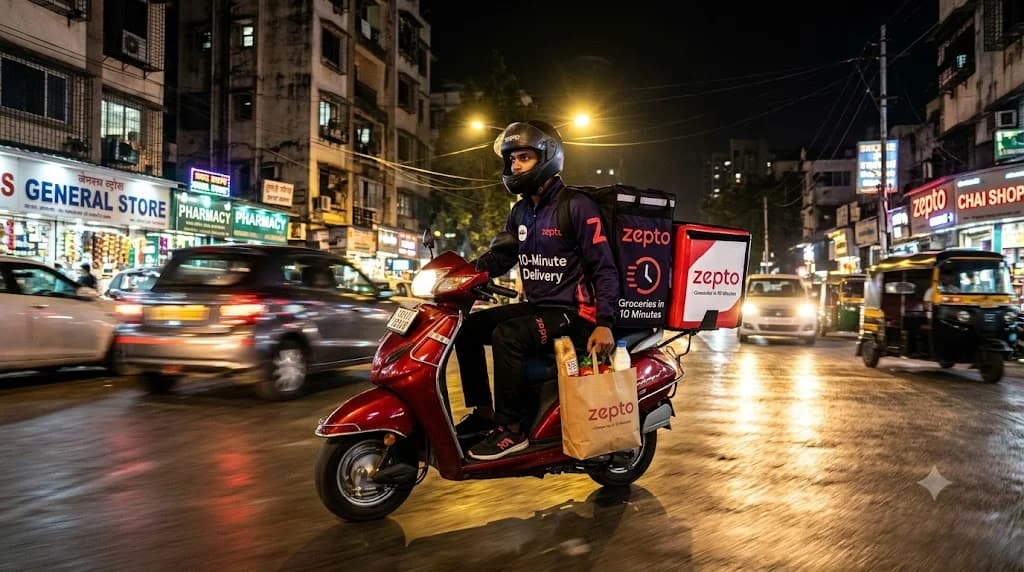
By March 2026 Zepto ran 1,139 dark stores across 66 cities and handled about 2.3 million orders a day, with roughly 64 crore orders across FY26. At that scale, the store network is its own advertisement, because every rider in a purple jacket on a city road is a moving reminder of the brand.
Editor’s note: This is the Advora verdict on Zepto, and it is closest to the CRED and Dream11 cases from this month. All three bought attention with venture capital. The difference is that Zepto built an ad business on top of the attention and now sells it back to the brands on its shelves, which neither CRED nor Dream11 managed at this scale.
How does Zepto approach advertising?
Zepto’s chief brand officer, Chandan Mendiratta, has described the marketing team as working more like a content creator’s studio than an advertising department. In his words, ad filmmakers think about reach and impact while creators think about shares, comments and engagement, and Zepto applies the creator lens to its campaigns. The brief is to build a cultural moment people want to talk about, not just a film.
That philosophy explains the brand’s output. Zepto posts and reacts at the pace of social media, joins trending moments within hours, and treats its app, billboards and founder accounts as one channel. Mendiratta has declined to share marketing budgets in interviews, but said the brand does not spend heavily on traditional media compared with its rivals.
The first brand film, in 2022, already worked this way. A character known as the “Nahi Milega” uncle, who insisted you could not get groceries in ten minutes, went viral on social media for a week before Zepto revealed the brand film behind him. Boman Irani shared it, and the campaign then moved to outdoor and an in-app grocery list from the uncle himself.
What are Zepto’s biggest campaigns?
The 2022 launch work came from L&K Saatchi & Saatchi, which won the branding mandate and produced films around the ten-minute promise with quirky characters and situations. Palicha said at the time that quick commerce could change how India shops and offered a rare chance to build a category-defining brand.
In March 2025 Zepto shifted its message from speed to price. The in-house “Prices Itne Low, Ek Baar Dekh Toh Lo” campaign featured Akshay Kumar and Jr NTR in parallel films, each persistently popping up around a sceptical customer’s home until she checked Zepto’s Super Saver prices. Two stars, one north and one south, let a single campaign reach both markets.
The rest of the calendar is topical. Zepto’s billboard banter with Shaadi.com in 2025, in which Anupam Mittal offered Palicha a bride and Palicha replied that he was married to Zepto, became one of the most shared brand exchanges of the year. In 2026 the brand joined the “Melodi” moment after a viral Parle Melody gift, and in September partnered with Milky Mist on an in-app Dahi Handi game.
Editor’s note: The Akshay Kumar and Jr NTR campaign is the one we cite to clients. It shows Zepto knew that speed was already understood and that price had become the barrier. The creative was simple, but the strategic shift from “fast” to “cheap enough” was the hard decision, and it came before the category’s price war peaked.
How much does Zepto spend on marketing?
Zepto’s advertising and promotional expenses were ₹1,187 crore in FY25 and ₹1,389 crore in FY26, according to its updated draft prospectus. At about 6% of FY26 revenue, that is a lower ratio than Nykaa’s 12.5% or boAt’s 12.7%, though the absolute number is larger than both.
The IPO filing sets aside ₹520 crore of proceeds for marketing and promotion through Zepto’s marketplace subsidiary. That compares with ₹1,735 crore for dark store leases, ₹1,629 crore for new dark stores and ₹1,325 crore for technology. Infrastructure, not advertising, is where most of the money is going.
The larger costs sit elsewhere. Delivery and handling expenses rose more than 90% to ₹3,046 crore in FY26, and dark-store costs were ₹2,150 crore. Discounts and the cost of running near-instant delivery are the real customer acquisition spend, with the advertising line a smaller part of the picture.
How does Zepto’s ad business change the marketing math?
Zepto sells advertising to the brands on its app, from sponsored listings to banner placements and campaign analytics. That business barely existed in FY24 at ₹49 crore, reached ₹651 crore in FY25 and ₹1,636 crore in FY26, a 151% jump. The growth came from products such as Zepto Atom, an analytics platform for brands, and Zepto GPT, an AI interface that lets partners query their own performance data.
Set against its own spend, Zepto earned ₹1,636 crore from ads and spent ₹1,389 crore on promotion, a net positive of about ₹247 crore in FY26. A year earlier the same comparison showed a ₹536 crore gap. One analysis estimates that without ad revenue the FY26 loss would have been nearly ₹7,400 crore instead of ₹5,905 crore.
This is the most important marketing fact in the case. Every customer Zepto acquires with advertising becomes an audience it can sell to Amul, Hindustan Unilever, Milky Mist and thousands of D2C brands. The marketing budget is effectively an investment in ad inventory.
Has the strategy made Zepto profitable?
Not yet. Zepto’s net loss was ₹1,215 crore in FY24, ₹4,700 crore in FY25 and ₹5,905 crore in FY26, a 26% rise in the last year. Free cash flow was negative ₹4,330 crore, and cash reserves fell from ₹7,440 crore to ₹5,680 crore.
The unit economics are improving. Adjusted EBITDA loss per order fell from ₹136 in FY25 to ₹79 in FY26 and ₹59 in Q4 FY26, and the adjusted EBITDA loss as a share of revenue fell from 36% to 20%. Q4 FY26 revenue grew 27% quarter on quarter to ₹7,498 crore while the quarterly loss narrowed 9%.