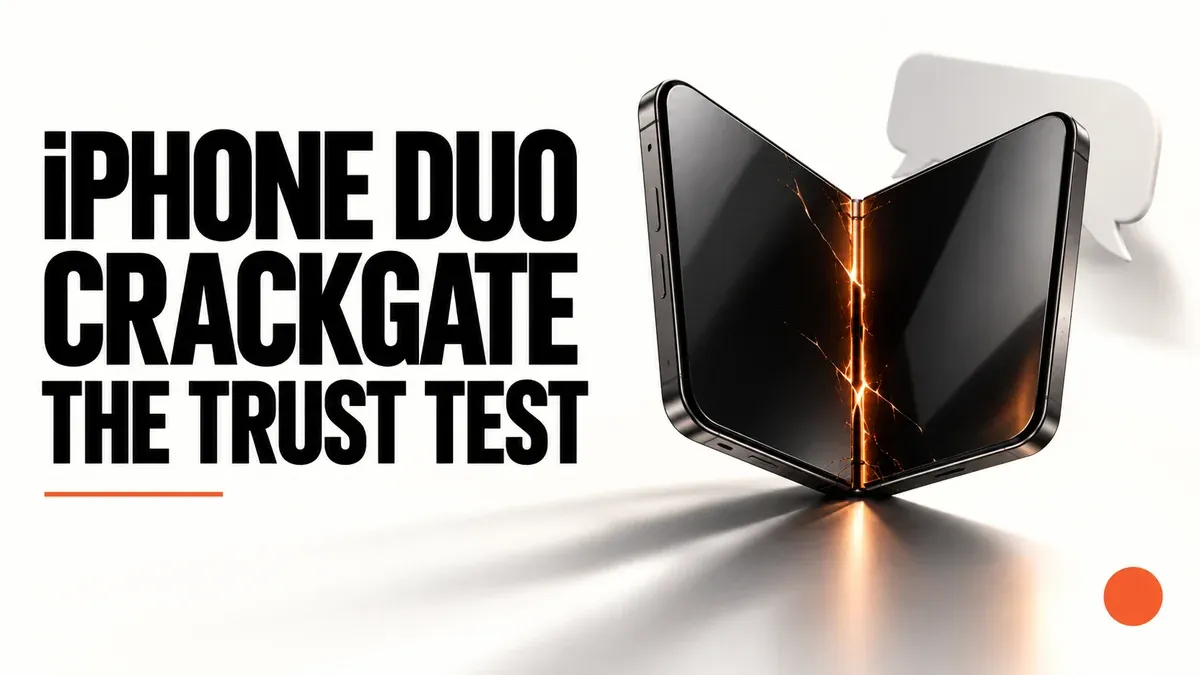
An expensive phone develops a crack. A customer shares a photograph. A competitor arrives with a joke.
Within days, a hardware complaint becomes a marketing story.
That is the situation surrounding Apple’s iPhone Duo and Samsung’s latest competitive advertising. Early reports of damaged folding displays have created an opening for Samsung to promote its experience in foldable phones.
But the most interesting question is bigger than which company produced the sharper advertisement. What happens when a premium brand sells confidence, then its customers encounter uncertainty?
The controversy offers a useful case study in product expectations, competitive positioning, customer service and the limits of viral marketing.
Reporting checked on 29 October 2026. Technical explanations under investigation are distinguished from established facts.
What happened to the iPhone Duo?
Apple’s Indian store lists the iPhone Duo starting at ₹2,99,900. At that price, the product sits well beyond an ordinary smartphone purchase. Source: Apple India.
Soon after launch, owners began sharing photographs and accounts of cracked inner displays.
One Australian customer reported a failure after approximately six hours of ownership and fewer than 20 openings. The same customer said an Apple Store apologised and replaced the device immediately.
Moderators of the relevant Reddit community said they had reviewed additional photographs and Apple documentation. Their verification covered the damaged device and subsequent service, not an independent determination of what caused the damage. Source: original owner report and moderator clarification.
That distinction matters. A documented broken phone establishes that a failure occurred. It does not establish how often the failure happens across all phones sold.
On 26 October, MacRumors published a statement from Apple acknowledging an inner-display issue affecting a small number of units and directing affected customers to AppleCare for replacement. Apple did not disclose a failure percentage or a definitive cause in that statement. Source: Apple’s response reported by MacRumors.
There is enough evidence to take the complaints seriously, but insufficient public data to calculate a reliable failure rate.
What the teardown explains, and what it does not
iFixit’s teardown investigated the hinge and the locations of reported damage. Its analysis suggested that the relationship between the folding display and its underlying support structure could create concentrated stress. A central support bar failing to retract sufficiently was one possible explanation.
This remains a hypothesis, not a conclusive diagnosis of every affected device.
The teardown also awarded a provisional repairability score of 5 out of 10, its highest for a foldable at the time. It praised aspects of component access while identifying the inner display and hinge as difficult repair areas. Source: iFixit’s teardown.
These findings answer different questions:
Question | What it tells a buyer |
|---|---|
How durable is the phone? | How reliably it withstands use |
How repairable is it? | How practical it is to disassemble and fix |
How expensive is a repair? | The financial consequence of a particular failure |
How good is the service? | The effort and time required to resolve a problem |
A device can be comparatively repairable and still experience failures. A technically possible repair can also be expensive or inconvenient. Treating these measures as interchangeable produces misleading buying advice.
Why the price makes the story more powerful
A high price does more than increase the amount at risk. It changes the promise a customer believes they are buying.
Someone purchasing an experimental product may accept compromises. Someone purchasing a premium product may expect the manufacturer to have removed those compromises. The same phone can occupy both categories.
That tension is central to this story. The customer sees an established brand and a premium price. The manufacturer is introducing a new physical design with its own engineering challenges.
When those expectations collide, disappointment can become personal: I paid more because I expected to worry less.
This is our interpretation of the brand challenge, rather than a measured finding about every iPhone Duo buyer.
It also explains why a small number of visually dramatic failures can attract disproportionate attention. A cracked screen is easy to understand. Manufacturing tolerances, inspection procedures and failure-rate denominators are much harder to communicate. The photograph travels faster than the explanation.
Samsung’s advertisement changes the buying question
According to Android Authority, a Samsung-sponsored Instagram video shows a sliced green apple attempting to fold before introducing the Galaxy Z Fold 8.
The advertisement finishes with the line “Years ahead in Foldables.” It also makes comparisons about thickness and weight. Those are the advertisement’s claims, not evidence that the campaign increased sales. Source: Android Authority’s coverage.
The creative idea is simple enough to understand without a technical explanation. Its strategic purpose is more interesting.
Instead of letting the conversation remain focused on the excitement of a new Apple product, Samsung encourages a different question: who has more experience making this type of phone?
That is a change in the basis of competition.
Buying question | What becomes important |
|---|---|
Which launch is attracting attention? | Novelty and cultural relevance |
Which brand fits my existing devices? | Familiarity and ecosystem compatibility |
Which company understands foldables? | Experience and product development |
What happens if something goes wrong? | Service, repair access and confidence |
Samsung’s message attempts to make experience more important at the exact moment buyers are discussing reliability. That does not prove Samsung has won the customer. It shows how competitive advertising can influence the criteria customers use to choose.
The danger of winning attention but weakening the category
There is a risk in this approach. An advertisement intended to make people doubt a competitor could make them doubt foldable phones generally.
A viewer might conclude that Samsung is the safer choice. Another might decide that all folding phones look too complicated and keep their existing handset. Both reactions are plausible. Neither should be assumed without evidence.
This creates a practical challenge for Samsung: criticism needs to lead somewhere constructive.
After drawing attention to uncertainty, the brand needs to explain why its own product deserves confidence. Product demonstrations, clear service terms and useful customer guidance can do that work.
The joke gets the audience to look. The evidence has to give them a reason to buy. For marketers, this is the difference between generating conversation and reducing purchase hesitation.
Samsung’s own history makes the comparison complicated
Samsung has also had to improve an early foldable design. In July 2019, the company outlined changes to the original Galaxy Fold before its revised launch. These included extending the protective display layer beyond the bezel, reinforcing parts of the device and reducing the space between the hinge and body. Source: Samsung’s 2019 launch update.
That history does not automatically invalidate Samsung’s current advertising. It does, however, suggest a more credible argument than claiming immunity from problems.
Experience can mean having encountered difficulties, investigated them and improved the product. For any brand, this is a stronger foundation for trust than suggesting that nothing can ever go wrong.
The useful competitive claim is demonstrated learning. It needs evidence across product generations, service performance and customer outcomes. Longevity alone is not a reliability test.
Can Samsung supply Apple and compete against it?
The supply-chain story presents an apparent contradiction: Samsung mocks Apple while reportedly supplying its display technology.
The precise commercial details require care. Reports of a three-year exclusive agreement and an approximately $250 panel price were attributed to the leaker Instant Digital. They should not be presented as publicly confirmed contract terms. Source: 9to5Mac’s report and attribution.
The underlying business model is less surprising than the social-media framing suggests. A company can compete for the end customer while participating in another company’s supply chain. Those activities involve different products, commercial relationships and responsibilities.
Even where a supplier relationship is established, it does not by itself determine responsibility for a finished device’s failure. Materials, mechanical design, assembly, manufacturing variation and operating conditions may all matter.
A broken display does not automatically prove defective display manufacturing. Equally, a suspected hinge problem does not justify declaring every other component faultless. Responsibility requires investigation.