Advora.media
Language

Opens Google Translate in a new tab. Automatic translations may contain errors.

Brands/ Case study

Bournville’s “Don’t Rush It”: How Chocolate Turns Time Into Value

A deeper analysis of Bournville’s “Don’t Rush It”: the language of permission, the psychology of savouring, premium positioning and the evidence needed to connect a memorable film with business results.

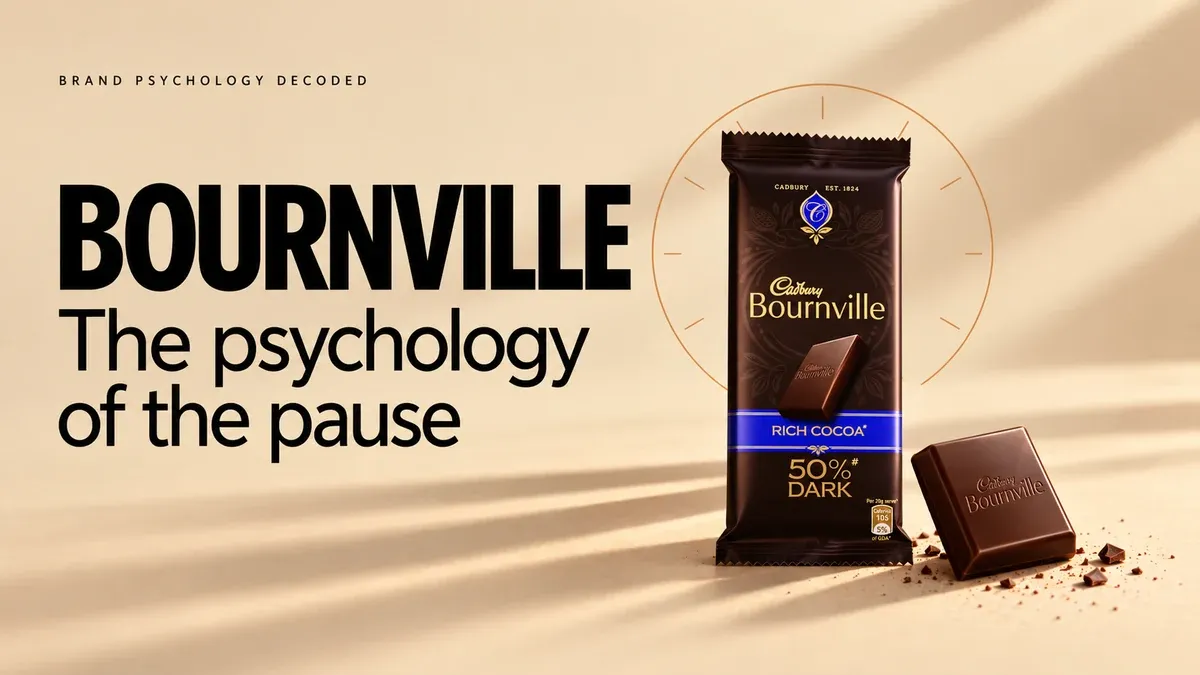
Cadbury Bournville Rich Cocoa 50% Dark pack on a warmly lit surface with long shadows, beside the headline The psychology of the pause.
Editorial cover based on a Bournville Rich Cocoa product reference; AI-assisted composition. Credit: Product reference: Apollo Pharmacy, https://www.apollopharmacy.in/otc/cadbury-bournville-50-dark-chocolate-31gm. Packaging: Cadbury / Mondelez. Editorial composition: Advora Media.

A premium chocolate has a difficult question to answer: what makes a few small pieces worth choosing when a shopper has so many other ways to buy something sweet?

Cadbury Bournville’s “Don’t Rush It” campaign offers an unusually economical answer. Give the chocolate your time.

The phrase contains a proposition about taste, an instruction about behaviour and a suggestion about personal freedom. It asks the consumer to make room for an experience. That is where this Bournville marketing strategy becomes more interesting than a conventional premium-product advertisement.

Our central interpretation: the campaign tries to turn attention into perceived value. Its commercial challenge is to turn that value into a reason to choose Bournville again.

Brand Psychology Decoded is Advora’s analysis of the decisions behind brand communication. This case study separates published campaign evidence, relevant research and our own strategic interpretation. It does not claim access to Bournville’s internal brief or campaign sales results.

The campaign in context: what we actually know

The Indian “Don’t Rush It” campaign was reported in December 2024. Ogilvy India developed the creative, with Good Morning Films producing the film. The production team’s award entry describes an ambition to connect premium positioning with the chocolate’s distinctive, unhurried eating experience. Read the production team’s campaign account.

The film places chocolate enjoyment inside a heist. A participant pauses to eat while the urgency around him loses its authority. Campaign coverage describes both the other robbers and the police allowing that moment to continue. Manifest’s account of the film sets out the sequence.

The premise is absurd, but the strategic question is precise: how desirable must an experience be for someone to refuse to hurry through it?

Why “Don’t Rush It”? The taste argument needs precision

The starting point is intensity. Launch coverage connects the message with enjoying Bournville gradually and making dark chocolate more desirable in India. It also reports the brand’s intention to associate the product with moments of slowing down. Read the contemporary campaign announcement.

This does not establish that Bournville has no bitterness. Nor does it demonstrate that eating slowly makes the product sweeter. Those are different claims, requiring product-specific evidence.

The more interesting interpretation concerns the customer’s standard of judgement. A quick bite invites an immediate verdict: do I like this? An invitation to savour asks the eater to give the experience attention before moving on.

That is an attempt to influence how the product is appreciated. Its success still depends on whether the customer enjoys the chocolate. An elegant explanation cannot reliably rescue an experience someone does not want to repeat.

A language chart: three words doing different jobs

The sentence is brief, but its components are not interchangeable. The following chart is Advora’s interpretation of the language, not a reconstruction of the agency’s copywriting meeting.
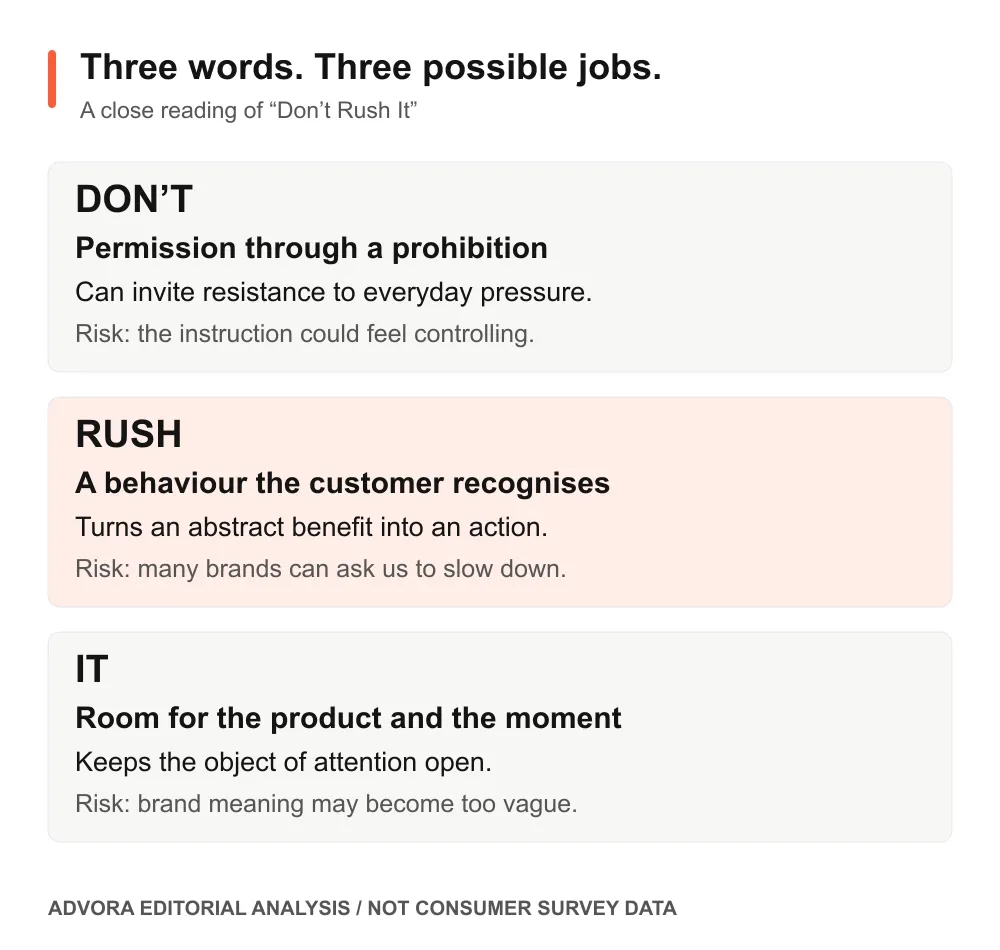
Language analysis of Don’t Rush It: permission through Don’t, recognisable behaviour through Rush and an open meaning through It, with limitations for each interpretation.
Advora editorial interpretation. Proposed meanings, not measured consumer responses. Credit: Advora Media

Word

Possible psychological role

Where the reading could fail

Don’t

An instruction that can feel like permission to resist pressure.

Without warmth or humour, a negative instruction can sound controlling.

Rush

Names an everyday behaviour that the viewer can recognise and change.

Slowing down is available to many brands, so the idea alone is not distinctive.

It

Can refer to the chocolate, the act of eating or the surrounding moment.

The openness may weaken brand attribution when the line appears without product cues.

“Don’t Rush It” does not require the customer to understand a technical ingredient story before understanding the instruction. That gives the line an accessible surface even when the product is positioned as sophisticated.

There is also a useful formal tension: a very short sentence asks for a longer experience. The wording reaches its point quickly; the consumption it proposes does not.

The psychology of the pause: from instruction to ritual

A ritual gives a familiar activity a repeatable form. In this context, that could mean setting aside a moment, breaking off a piece and attending to the experience.

The campaign itself does not prove that customers develop such a ritual. It supplies an invitation from which one might emerge.

A relevant 2013 study, Rituals Enhance Consumption, examined structured actions before eating and drinking. In its chocolate experiment, 52 students were assigned to a ritual or comparison condition. The ritual group reported higher enjoyment and willingness to pay. However, the reported differences in eating duration and flavour ratings did not meet the conventional 0.05 significance threshold.

This is useful background, not a Bournville effectiveness study. The participants performed instructed actions; watching an advertisement is a different intervention. A small laboratory result cannot establish that this campaign increased sales or that the effect transfers to Indian shoppers.

Our hypothesis is narrower: a brand that gives someone a simple way to engage with a product may make its promised experience easier to enact. That possibility is worth testing.
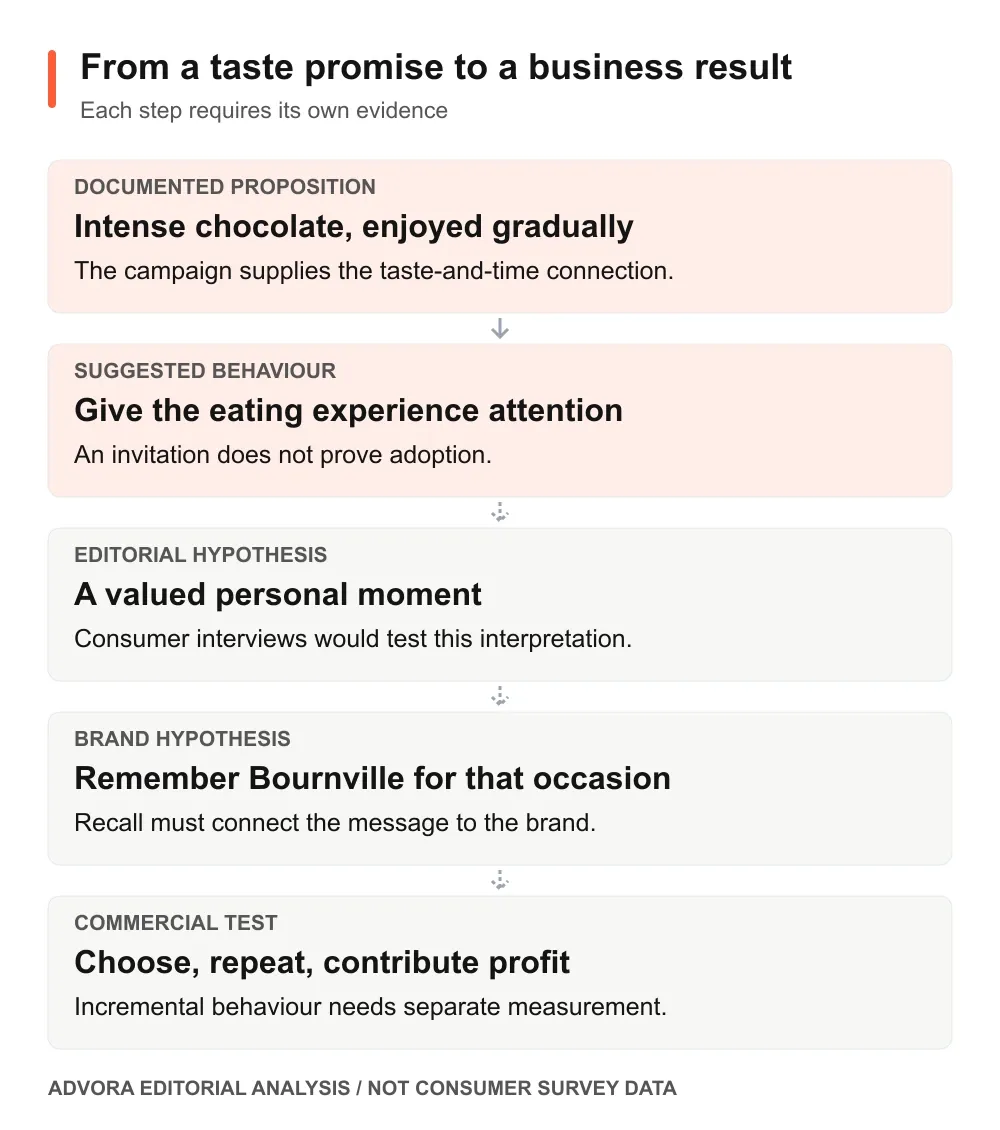
Five-step evidence chain: documented taste proposition, suggested eating behaviour, hypothetical personal meaning, hypothetical brand association and commercial outcomes requiring measurement.
The creative proposition is documented; the downstream effects remain hypotheses. Credit: Advora Media

What the heist contributes: the freedom to choose your pace

The setting creates an unusually strong contrast between expected behaviour and actual behaviour. The production entry explains that the film pairs an unrealistic stand-off with believable performances and restrained humour. Good Morning Films’ account identifies those as deliberate execution choices.

Our reading goes a step further. The character appears to reclaim control over time. A situation that should dictate his behaviour temporarily fails to do so.

For a viewer who feels constantly hurried, that may be emotionally attractive. The appeal could be the permission to enjoy something without immediately becoming available to the next demand.

But the simpler explanation deserves equal space: viewers may just enjoy an absurd joke. An analyst should not automatically convert every entertaining scene into a deep consumer truth.

Creative contrast

Strategic interpretation

What to check with viewers

Urgent situation, slow consumption

The product moment deserves protection.

Do viewers mention savouring without being prompted?

Others wait for the eater

Enjoyment receives social permission.

Do they interpret this as personal freedom, desire or simply comedy?

Serious genre, understated joke

Humour can coexist with premium presentation.

Does the film feel distinctive and appropriate for Bournville?

Bournville’s target audience: a motivation is not a media segment

The campaign appears to address people attracted to a deliberate chocolate indulgence. That interpretation describes a motivation. It does not tell us the exact age, income or targeting settings used in the media plan.

There is historical context. A 2015 campaign announcement identified urban affluent consumers aged 25–35 and associated Bournville with unwinding at the end of the day. Those are details of that earlier campaign, not verified demographics for “Don’t Rush It.” Read the archived announcement.

For planning purposes, we would distinguish three potential audience needs. These are editorial hypotheses:

The explorer

This person is curious about dark chocolate but may need a reason to try a different taste. Communication should explain the experience without implying that expertise is required.

The personal-reward buyer

This person wants a modest indulgence that feels chosen for themselves. The relevant benefit may be the occasion they create around it.

The existing dark-chocolate buyer

This person already understands the category. The harder task is to establish why Bournville deserves the choice over alternatives. A generic appeal to quality or slowing down may be insufficient.

These audiences could overlap. Their different barriers matter more than assigning them a fictional personality or an unsupported salary range.

Three positioning messages, three different customer questions

Bournville’s communication has used more than one route to desirability. A creative practitioner’s account of the Indian launch describes a challenge involving unfamiliar taste and a premium price. The earlier “earn it” proposition framed the chocolate as a reward. Sreejith Kodoth’s portfolio supplies that historical perspective.

Meanwhile, VCCP’s UK campaign, launched in August 2025, used “Made to be enjoyed, not endured.” It challenged intimidating dark-chocolate connoisseurship through comedy. This was a distinct market and creative platform. Read VCCP’s campaign account.

Message and context

Customer question it suggests

Potential barrier it addresses

Earlier Indian “earn it” positioning

Do I deserve this reward?

Justifying an indulgent purchase.

India: “Don’t Rush It”

Am I giving this experience time?

Establishing a meaningful way to consume the product.

UK: “Made to be enjoyed, not endured”

Why should enjoying chocolate feel difficult?

Category intimidation and excessive seriousness.

The questions and barriers are our interpretation. They do not establish a single, coordinated global strategy.

The comparison exposes a real tension for premium brands: make the experience feel special while keeping it approachable. Too little distinction makes the premium hard to justify. Too much ceremony can make enjoyment feel like work.

Mission, vision and campaign promise: keep them separate

The reviewed sources do not establish a standalone, formal Bournville mission and vision that can responsibly be reproduced as official statements.
Mondelez, its parent company, describes a corporate purpose centred on helping people snack right and connects that with suitable products, occasions and production practices. The company’s purpose explanation is corporate context, not a substitute for a Bournville mission statement.

At campaign level, the documented ambition is more specific: associate the chocolate with an unhurried experience. Our interpretation of the brand opportunity is to become a recognisable choice for a personal moment of enjoyment.

That distinction protects the analysis from a common mistake: inventing an inspiring mission and presenting it as something the business has actually declared.

How the strategy fits together, and what remains unknown

We cannot know every rejected slogan, research interview or formulation decision from the finished advertisement. We can assess whether the visible decisions support one another.

Decision

Logic visible in the work

Evidence still needed

Taste proposition

Intensity gives the invitation to savour a product connection.

Variant-specific sensory evidence and consumer preference.

Consumption behaviour

A gradual experience supplies a simple instruction.

Whether buyers adopt that behaviour outside the advertisement.

Emotional meaning

A protected personal moment could make the occasion appealing.

Unprompted consumer interpretation.

Creative execution

Urgency makes the interruption conspicuous.

Brand attribution and message comprehension.

Commercial objective

A valued occasion could support trial or repeat choice.

Incremental purchasing and contribution after marketing cost.

This is an analytical reconstruction of the public work. It is not the company’s internal brief.

The commercial paradox: slower consumption is not automatically growth

Slowing down sounds attractive in a brand presentation. For a business selling consumable goods, the commercial logic needs another step.

If people take longer over a bar, that alone does not establish higher revenue. The opportunity would come from more people choosing the brand, choosing it more consistently or accepting its price because the experience feels worthwhile.

Those outcomes have different implications. Trial without repeat purchase can produce a temporary spike. Higher sales accompanied by disproportionately higher media costs can weaken profitability. A campaign can also improve perceptions without changing behaviour immediately.

Therefore, the question is not simply whether people liked the advertisement. It is whether the advertising helped create profitable demand that would not otherwise have occurred.

This connects with a broader lesson in our Loop Earplugs marketing strategy case study: understanding the occasion in which a customer values a product can be more useful than endlessly adding adjectives to its description. The categories and business models differ; the comparison concerns how use occasions are articulated.

How we would test this interpretation

A useful study should allow the strategy to fail. These are proposed tests, not tests conducted by Advora or results disclosed by Bournville.

1. Separate entertainment from brand memory

Randomly assign suitable participants to the campaign or an appropriate comparison condition. After a consistent delay, ask what they remember before naming the brand. Record the story, the product and the brand separately.

If people recall the heist but cannot name the chocolate, entertainment has not reliably produced brand attribution.

2. Test meaning without teaching the answer

Ask participants to explain the message in their own words. Do not begin with “Did this make you want to slow down?” That question supplies the interpretation the study is supposed to discover.

Look for competing answers such as intensity, personal reward, freedom from urgency and simple humour. Unexpected answers are evidence, not inconvenience.

3. Separate the product from the expectation

A carefully designed tasting could compare equivalent samples under different exposure conditions. Keep the product, serving conditions and instructions controlled. Measure enjoyment and preference separately from reported price expectations.

Such a study needs appropriate participant consent and design. It should not be replaced by a marketer tasting one bar and declaring the consumer psychology proven.

4. Connect perception to incremental behaviour

Where feasible, use a planned holdout or comparable-market design with adequate sample size. Account for distribution, promotions, seasonality and competing activity. Examine repeat purchase over a suitable period rather than treating one short-term sales movement as causation.

The public sources reviewed here do not supply enough campaign-specific commercial evidence to establish that “Don’t Rush It” achieved those outcomes.

Advora’s editorial perspective: can the product keep the promise?

Our judgement is that the strongest strategic move is the connection between the eating instruction and the product. The campaign provides something a customer can do, rather than leaving premium quality as an abstract claim.

Its vulnerability is ownership. Coffee, hospitality and skincare brands can also invite people to slow down. Bournville needs the full combination of product, brand cues, execution and repeated association to make the idea recognisably its own.

For a smaller business, the useful question is whether the customer can experience the positioning without seeing the advertisement.

A restaurant promising an unhurried evening must make its service support that promise. A product promising craftsmanship must reward inspection. A chocolate inviting attention must provide an experience the customer wants to revisit.

Our Zudio business case study examines a different proposition, where the store experience forms part of the strategy. The shared lesson is operational: communication sets an expectation, and the business must make that expectation tangible.

“Don’t Rush It” gives Bournville an appealing invitation. Its lasting value depends on what the customer experiences after accepting it.

Frequently asked questions

What does Bournville’s “Don’t Rush It” tagline mean?

In the Indian campaign, it invites consumers to savour the chocolate gradually. Our analysis explores how that instruction can connect product intensity with a personal moment of enjoyment.

Who created the Bournville “Don’t Rush It” campaign?

The campaign credits identify Ogilvy India and Good Morning Films. The production account names Shashanka Chaturvedi as director.

Is Bournville’s tagline about chocolate not being bitter?

The Indian campaign centres on unhurried enjoyment, not a universal absence of bitterness. The separate UK “Made to be enjoyed, not endured” platform more directly challenges difficult or intimidating dark-chocolate experiences.

What is Bournville’s target audience?

The campaign supports an interpretation centred on people attracted to premium chocolate and deliberate indulgence. Exact audience settings for this campaign were not established by the reviewed sources. Historical age ranges should not be treated as current targeting data.

What is Bournville’s brand positioning?

For this Indian campaign, the documented position combines premium dark chocolate with a distinctive experience that should be savoured. Positioning varies by market and campaign, as the UK comparison illustrates.

Did “Don’t Rush It” increase Bournville sales?

The reviewed material does not provide sufficient campaign-specific incremental sales or profit evidence to conclude that it did. Creative strategy and commercial effectiveness should be evaluated separately.

What can small businesses learn from the campaign?

Identify a real product characteristic, connect it to a meaningful customer occasion and give the customer a simple way to experience the benefit. Then test whether people remember the brand and choose it again.

Evidence and editorial method

This analysis draws on the credited production team’s campaign entry, contemporary advertising coverage, a creative practitioner’s historical portfolio, VCCP’s UK campaign account, Mondelez’s corporate purpose explanation and the cited consumption-ritual research. Psychological interpretations and proposed tests are Advora’s. We did not conduct a tasting, interview campaign participants or obtain private sales data. The charts are conceptual explanations, not survey findings. The cover is an AI-assisted editorial composition based on a Cadbury Bournville Rich Cocoa 50% Dark product reference from Apollo Pharmacy. It is not an official campaign image.

Keep reading

More in Brands ↗

Brands

boAt Marketing Strategy: Case Study

boAt took a commodity category, earphones, and made it a fashion purchase for 20-year-olds, selling on Amazon and Flipkart first and spending close to ₹390 crore a year on cricketers, actors and a founder on Shark Tank. In FY26 it cut that spend, lost revenue and made more profit. This case study follows the spend, the ambassadors and the pivot ahead of its IPO.

Advora Editorial Team