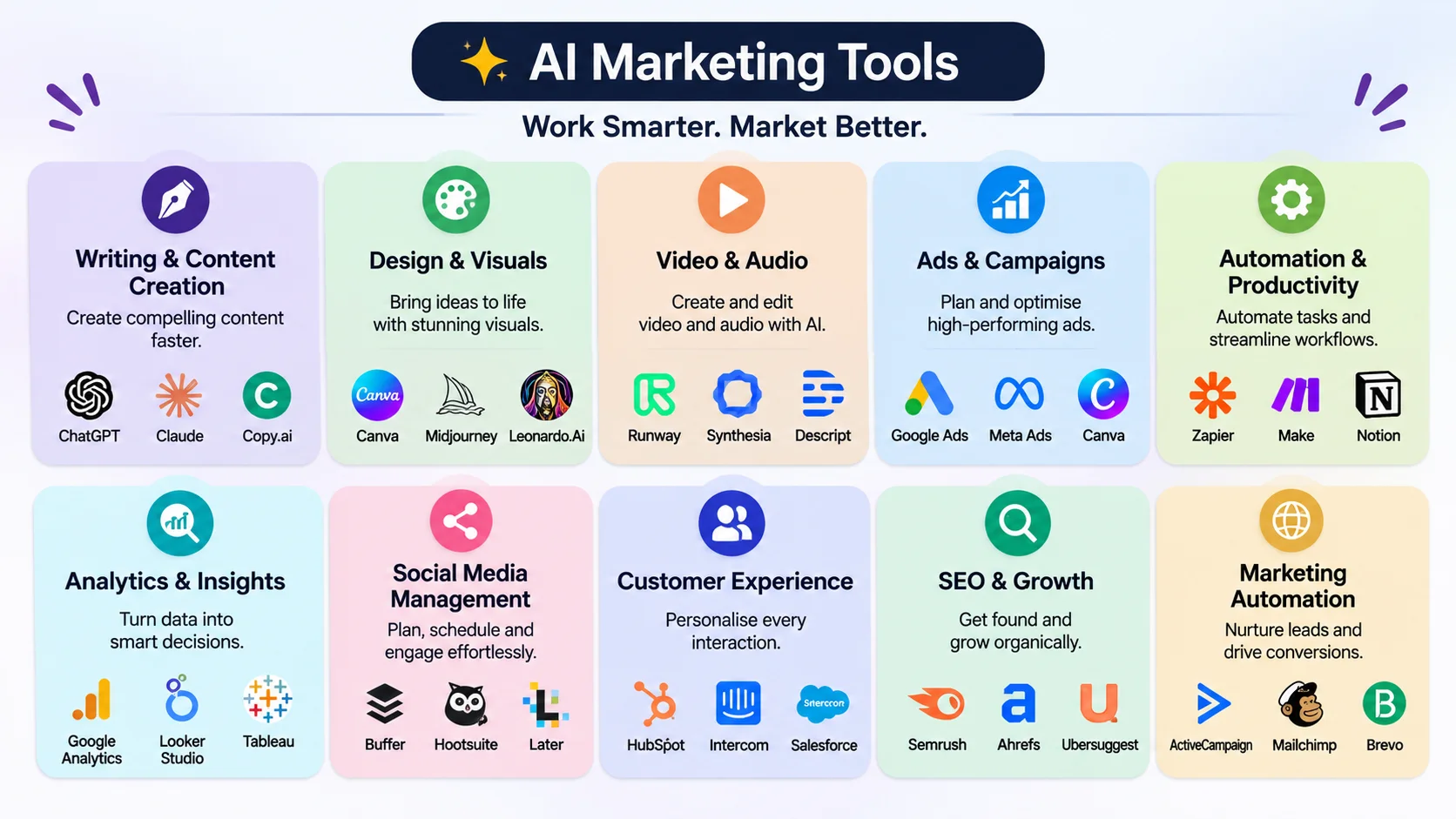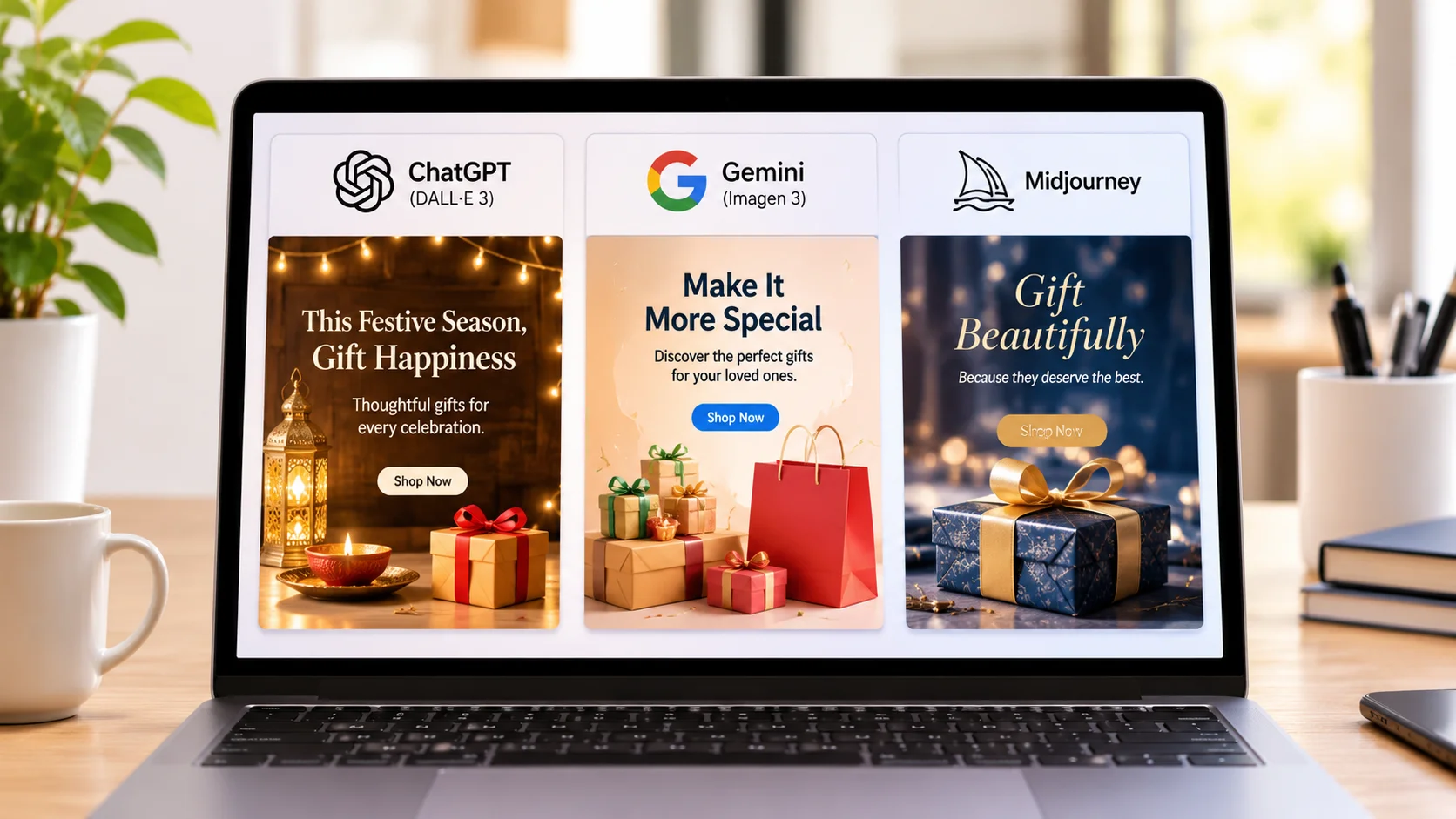
The best AI tools for digital marketing in 2026 depend on the job: ChatGPT, Claude and Gemini for writing and research; Canva, Midjourney, Ideogram and Google’s Nano Banana for design and images; Meta Advantage+ and Google AI Max for running ads; and Google Search Console for SEO data. Adoption is near universal, with Salesforce finding 87% of marketers use generative AI in at least one recurring workflow, but only 6% have AI fully embedded, according to Supermetrics. This guide sorts the leading tools by task, with Indian pricing, free options and the checks to run before AI work goes live.
Key points
- No single AI tool does everything well. Most effective teams use one assistant, one design tool and the AI already built into their ad platforms.
- ChatGPT, Claude and Gemini all offer free plans, and paid plans start around ₹399 a month in India.
- The biggest AI shift in 2026 is inside ad platforms: Meta’s AI creative tools and Google’s AI Max now automate much of campaign setup.
- Free tools such as Google Search Console, Canva’s free plan and assistant free tiers cover a surprising amount of work.
- AI output still needs human checks for facts, brand fit, claims and platform disclosure rules.
How widely are marketers using AI in 2026?
Use is close to universal. Salesforce’s survey found 87% of marketers use generative AI in at least one recurring workflow in Q1 2026, up from 51% in Q1 2024, and Jasper’s survey of 1,400 marketers put active use at 91%.
Depth is a different story. Supermetrics found only 6% of marketers have AI fully embedded in their workflows, and the largest group, 39%, are still experimenting.
That gap is the opportunity. The tools are widely available; the advantage comes from building them into repeatable processes.
Editor’s note: We judged tools on the jobs Indian marketing teams do every week: writing ad copy, briefs and blogs, making creatives, editing video, running Meta and Google campaigns, and reporting. A tool that is impressive in a demo but awkward in a weekly workflow ranked lower.
Which AI assistants are best for marketers?
General AI assistants handle the widest range of marketing work: drafting copy, summarising research, brainstorming campaign ideas, analysing data and writing briefs.
ChatGPT (OpenAI). The best-known assistant, with strong all-round writing, image generation and data analysis. In India it bills in rupees with UPI: Go costs ₹399 a month, Plus ₹1,999 and Pro ₹19,900. The Go plan may show ads; Plus and above remain ad-free.
Claude (Anthropic). Strong for long-form writing, editing, analysis of long documents and following detailed brand guidelines. Claude Pro costs US$20 a month before tax, billed in dollars. In Social Media Examiner’s 2026 survey, 42% of marketers named Claude their most important AI platform, narrowly ahead of ChatGPT at 39%.
Gemini (Google). Best for teams that live in Google Workspace, because it works inside Gmail, Docs and other Google apps. In India, Google AI Plus costs ₹399 a month (₹199 for the first six months at launch), AI Pro ₹1,950 and AI Ultra ₹24,500.
Perplexity. Useful for quick research with cited sources. Note that it could not yet bill recurring plans in rupees as of September 2026.
Editor’s note: Free offers come and go in India. Several free-year deals, including ChatGPT Go’s and Airtel’s Perplexity Pro offer, closed in January 2026. Jio users should check the MyJio app for Google AI Pro offers before paying.
Which AI tools are best for design and ad creative?
Canva. The most widely used design tool among Indian marketers, with AI features for text, images, resizing, background removal and translation. Canva Pro costs roughly ₹4,000 to ₹4,500 a year in India depending on billing, and the free plan includes basic AI features. Its India festival templates make it especially practical for local brands.
Midjourney. The strongest tool for striking lifestyle and mood visuals. Plans cost US10toUS120 a month, with no free plan, and companies earning over US$1 million a year must use Pro or Mega for commercial use.
Ideogram. The best for images with readable text, such as offers, prices and banners. Its 4.0 model, released in June 2026, is open-weight and design-focused, with a free plan and paid plans from US$20 a month.
Nano Banana (Google). The most practical tool for editing real product photos, swapping backgrounds and keeping products consistent across versions. It is available in the Gemini app and through Google’s API, and every image carries Google’s SynthID watermark.
We compare these three image tools in detail in our guide to the best AI image generator for ads.
Which AI tools are best for video and voice?
Video is where AI use is growing fastest, though fewer marketers use it than for text and images. Social Media Examiner found 67% of marketers use AI for images but only 37% for video and 21% for audio.
Google Flow and Gemini video. Google’s video generation is available in the Gemini app and its Flow tool, including on the Google AI Plus plan in India. It suits short concept videos, B-roll and social clips.
Meta’s built-in video tools. Meta’s ad platform can animate still images, extend videos to new aspect ratios, generate music and translate voiceovers, directly inside Ads Manager.
AI voice and avatar tools. Tools such as ElevenLabs for voiceovers and HeyGen for avatar videos help with explainer videos and translations. Check their language support and commercial terms before using them in ads.
A note on CapCut. CapCut, popular globally for short-form editing, is not available in India following the 2020 ban on several Chinese apps. Indian teams typically use alternatives such as Instagram’s Edits app, Canva’s video editor or desktop editors.
Editor’s note: AI video is excellent for backgrounds, transitions and quick variations, but real people still build trust. Most brands get better results combining AI editing with real UGC creator footage.
What AI is built into Meta and Google ads?
For performance marketers, the most important AI tools may be the ones already inside ad platforms.
Meta Advantage+ and AI creative tools. Advantage+ automates targeting, placements, budgets and creative combinations. Meta said in its Q1 2026 earnings that 8 million advertisers were using at least one of its AI creative tools, up from 4 million at the end of 2024.
Meta has said it aims to let advertisers create and run complete campaigns from a product image or URL and a budget by the end of 2026. Its creative tools already generate text variations, image backgrounds, video, music and translations.
Google AI Max for Search. AI Max is a set of automated features inside Search campaigns, covering search term matching, text customisation and landing page selection. It left beta on 15 April 2026 and Google says it is used by more than 500,000 advertisers.
Google says non-retail advertisers typically see 14% more conversions or conversion value at a similar cost per acquisition or ROAS. Independent tests are more mixed, so measure the results in your own account.
Performance Max. Google’s all-channel campaign type now has four million advertisers, according to Google, and campaigns can serve ads in AI Overviews and AI Mode.
The practical lesson is that platform AI rewards good inputs: accurate conversion tracking, strong creative and clear business goals. Our guide to Facebook ads cost in India covers what those campaigns cost.
Which AI tools help with SEO and analytics?
Google Search Console. Free, and the most important SEO data source for any existing website. It shows the real searches your site appears for, with impressions, clicks and positions.