

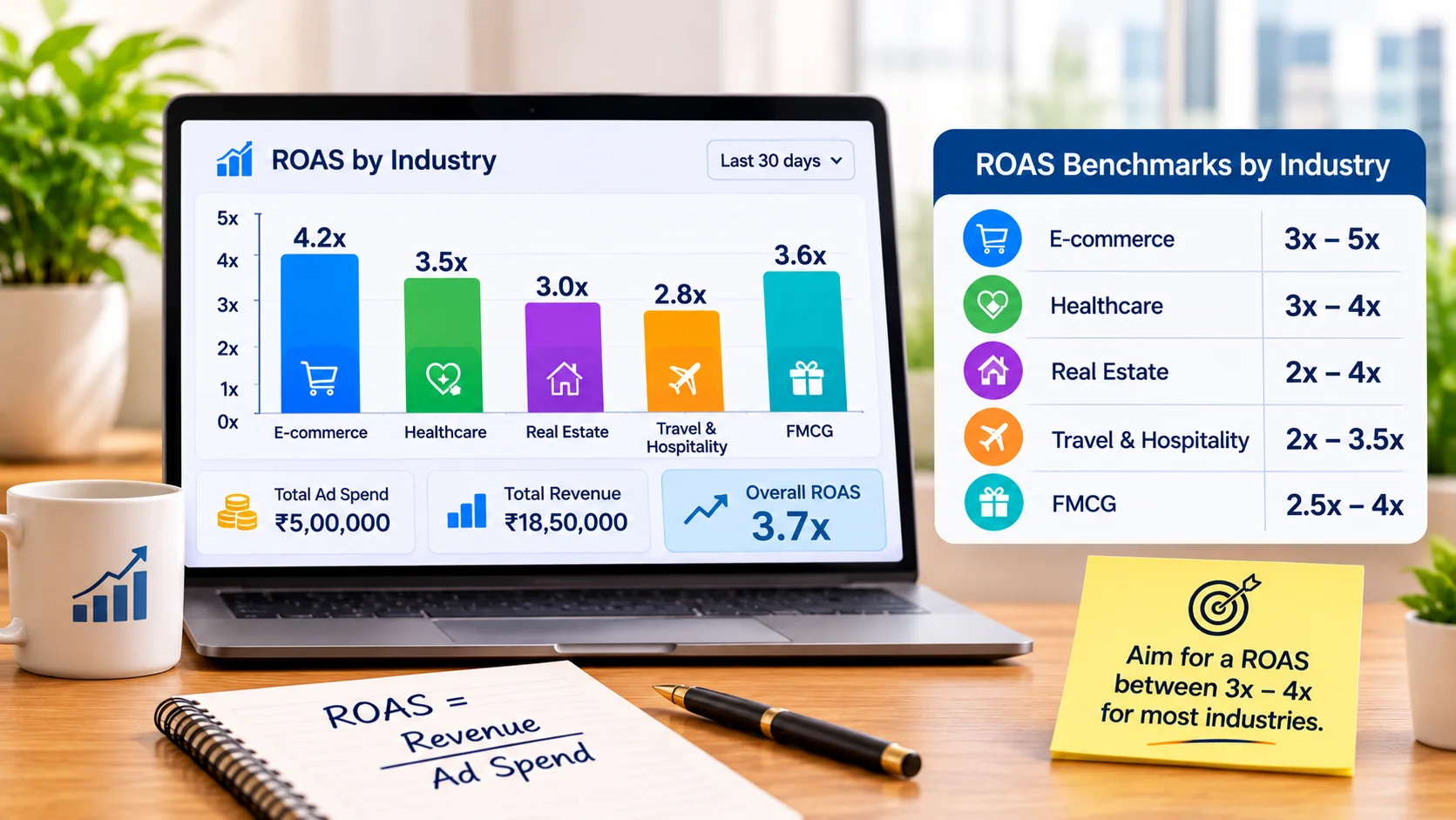
Calculate a target ROAS from contribution margin, order costs and the profit you need to retain. Use a consistent revenue definition when comparing campaigns.
Key points
- Define net revenue consistently before comparing return on ad spend.
- Use the contribution margin for the products the campaign actually sells.
- Use outside benchmarks as context when their sample, market and attribution window are comparable.
- Your real benchmark is break-even ROAS = 1 ÷ contribution margin. A 30% margin needs 3.3x to break even; a 20% margin needs 5x.
- For lead-generation businesses such as real estate, education and healthcare, ROAS is the wrong metric until leads are tied to revenue. Cost per qualified lead and CAC matter more.
What does a good ROAS mean?
ROAS, or return on ad spend, is revenue attributed to ads divided by ad spend. A 3x ROAS means ₹3 of revenue for every ₹1 spent. Our guide to calculating ROAS covers the formula and the common mistakes in detail.
“Good” depends entirely on what is left after the cost of the product, delivery, payment fees, returns and taxes. A jewellery brand keeping 60% of every sale can grow profitably at 2x. A grocery brand keeping 15% loses money at 4x.
So a good ROAS has three thresholds, not one. Break-even is where ad spend equals contribution. Target is break-even plus the profit you want per order. And a growth ROAS, sometimes below break-even, is acceptable when customers buy again often enough to recover the first-order loss.
Illustrative example: a campaign earning ₹4 lakh of net revenue on ₹1 lakh of ads reports 4x ROAS. At a 20% contribution margin, it generates ₹80,000 before ads and loses ₹20,000 after ads.
Before comparing channels, match the period, attribution window and revenue basis. For Indian ecommerce, reconcile platform orders with delivered orders, refunds and cash-on-delivery failures before calculating net revenue. Use the same revenue basis for contribution margin and ROAS.
How do you calculate your break-even ROAS?
Break-even ROAS is the point at which ad spend equals the contribution each order generates. The formula is:
Break-even ROAS = 1 ÷ contribution margin
Contribution margin is the share of reported revenue left after all variable costs: GST on the sale, product cost, shipping, packaging, payment fees, returns and COD failures, and any marketplace commission. Fixed costs like salaries and rent are left out.
The relationship is simple to read:
- 50% contribution margin → break-even ROAS 2x
- 40% → 2.5x
- 33% → 3x
- 25% → 4x
- 20% → 5x
To set a target, add the profit you want. If you want 10% of revenue left after ads, target ROAS = 1 ÷ (contribution margin − 0.10). With a 30% margin, that is 1 ÷ 0.20 = 5x.
Can a good ROAS still lose money?
Yes, in three common ways. The first is margin: a 4x ROAS loses money on any product with less than 25% contribution margin. The second is attribution: platforms take credit for sales that would have happened anyway, especially from retargeting and brand search, so platform ROAS overstates the real return.
The third is time. A campaign can show strong ROAS while acquiring customers who never buy again, or weak ROAS while acquiring customers who buy every month. First-order ROAS ignores what happens after the first purchase.
That is why ROAS should always be read alongside profit. A practitioner example shows a dashboard reporting 5x ROAS that fell to 3.6x once repeat buyers and refunds were removed. Still profitable, but not the number the business was planning on.
When is ROAS the wrong metric?
ROAS works best for ecommerce, where revenue appears in the same system as ad spend within days. For businesses that sell through a conversation, it often misleads.
Lead generation. Real estate, education, healthcare and B2B services generate leads, not purchases. Until leads are connected to closed revenue in a CRM, ROAS cannot be calculated honestly. Cost per qualified lead, cost per site visit or appointment, and CAC are better guides.
Long sales cycles. A villa project or a ₹5 lakh course may take weeks or months to close. A 7-day ROAS window misses most of the revenue.
Subscriptions and repeat purchase. A monthly consumable or a subscription brand can accept a first-order ROAS below break-even if lifetime value covers the gap. LTV to CAC is the better measure.
Awareness campaigns. Video and reach campaigns are not built for same-week purchases. Judge them on reach, cost per thousand and lift in branded search.


