

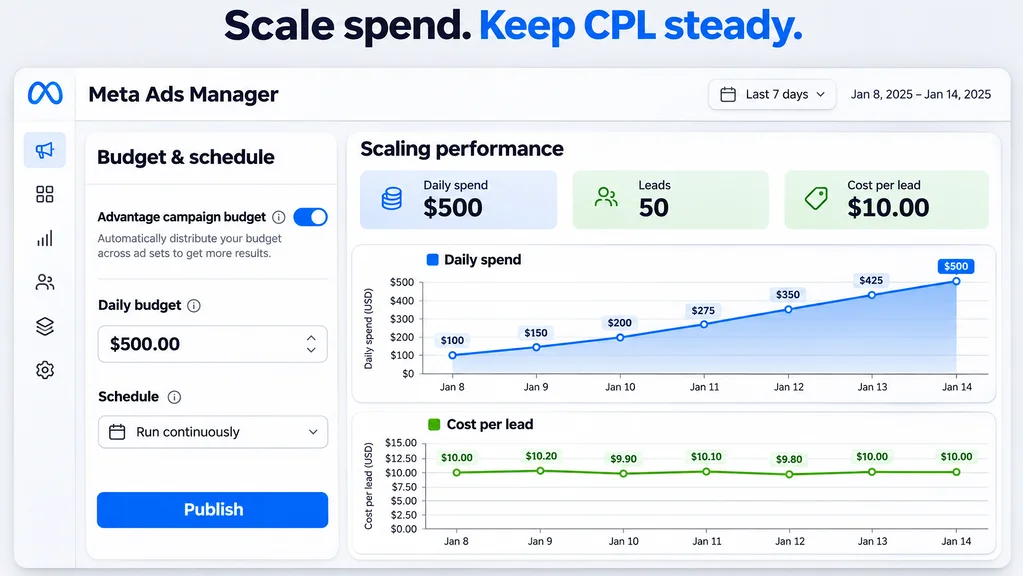
To scale Meta ads without killing your CPL, raise spend only on campaigns that are stable, raise budgets gradually, and add new creative and audiences as spend grows. Meta says ad sets with fewer than about 50 conversions a week ran around 28% more expensive per purchase in its analysis, so scale by consolidating into fewer, well-funded ad sets rather than spreading budget thin. Judge each increase on the cost of the extra leads it buys, not just your average CPL.
Key points
- Scale only after a campaign has exited learning and held a stable CPL for one to two weeks.
- Vertical scaling raises budget on what works; horizontal scaling adds new creative, audiences, cities, or placements. Most accounts need both.
- Meta’s own guidance: small budget changes are unlikely to restart learning, very large ones may. Many advertisers keep each increase to about 20%.
- Creative is the main limit on scale in 2026. Without new concepts, more budget means more frequency and higher costs.
- Track marginal CPL and cost per qualified lead. Your average CPL can look fine while each extra lead costs far more.
Why does CPL rise when you scale Meta ads?
Meta prices ads through an auction, and it shows your ads first to the people most likely to respond. When you add budget, it has to reach people who are slightly less likely to convert, or show ads to the same people more often.
A Two Six Tech test of identical Meta ads at different budgets found that roughly doubling the spend cut reach per dollar and clicks per dollar by about 16% to 17%. The higher-budget ads were being shown to the same people more often.
That is diminishing returns, and it applies to every advertiser. The goal of scaling is not to avoid it, but to keep the extra cost of each new lead within what you can afford.
Editor’s note: In this guide, “CPL” means cost per lead, but the same rules apply to cost per purchase, booking or app install. Swap in your own result.
When is a Meta campaign ready to scale?
Scale too early and you amplify noise. Before raising spend, check that four things are true:
- It has exited learning. Meta says ad sets usually exit learning after about 50 results in the week after their last significant edit.
- CPL has been stable for one to two weeks and sits at or below your target.
- Lead quality holds up. Check how many leads are reachable, qualified and converting, not just how many arrived.
- Frequency is not climbing fast. Rising frequency with falling click-through rate means the audience is already tiring.
Also check tracking. Meta reports that advertisers using the Conversions API for web events saw an average 17.8% lower cost per result, and scaling on incomplete data magnifies the gap. Our guide on how to reduce Facebook ads cost covers the fixes to make first.
What is the difference between vertical and horizontal scaling?
Vertical scaling means raising the budget on a campaign or ad set that already works. It is fast and keeps your existing learning, but each extra rupee reaches less-responsive people.
Horizontal scaling means expanding what you run: new creative concepts, new audiences, new cities or languages, new placements or new offers. It finds fresh demand but takes longer and needs testing.
The most reliable approach combines both. Raise budget on proven campaigns while adding new creative and markets, so the system has more to spend into.
How much can you increase a Meta ads budget at once?
Meta does not publish a fixed percentage. Its help centre example says a budget change from $100 to $101 is unlikely to restart learning, while a change from $100 to $1,000 may.
In practice, many advertisers keep each increase to around 20% and wait a few days before the next one. Meta also sometimes shows in-product recommendations naming how far a budget can rise without re-entering learning, so check Ads Manager before deciding.
Example: to take an ad set from ₹5,000 to ₹10,000 a day, raise it to about ₹6,000, wait three or four days, then ₹7,200, then ₹8,600, then ₹10,000. That takes about two weeks but keeps delivery stable.
What to avoid: sudden doubling, raising budgets mid-day after one good morning, and cutting budgets sharply after one bad day. Each large swing risks resetting learning and raising costs.
How many ad sets can your budget support?
In a peak-season guide published on 21 October 2026, Meta gave a simple formula: total weekly budget ÷ (cost per result × 50) = the most ad sets your budget can support. It added that most accounts run more than that.
Example: a ₹3,50,000 weekly budget at a ₹700 CPL supports 3,50,000 ÷ (700 × 50) = 10 ad sets. At a ₹1,400 CPL, the same budget supports only five.
Meta says ad sets under roughly 50 conversions a week ran about 28% more expensive per purchase in its analysis. Smaller ad sets may cost more for other reasons too, but the direction is clear: as you scale, consolidate first, then expand.
How do you scale with Advantage+?
Advantage+ campaigns let Meta manage audience, placements and budget allocation across ad sets. That makes them a natural place to add budget, because the system can move spend to wherever results are cheapest.
Meta says Advantage+ sales campaigns deliver an average 17% lower cost per acquisition and 32% higher return on ad spend than manual campaigns. For leads, it reports 14% lower cost per lead and 10% lower cost per qualified lead.
How to use it: run a proven Advantage+ campaign as your main scaling engine, feed it new creative regularly, and keep budget at campaign level. Use separate manual campaigns only for tests or for audiences Advantage+ cannot reach well.
Watch for: Advantage+ can find cheaper leads that convert less. Send qualified-lead and sale events back through the Conversions API so it optimises for outcomes, not form fills.
Why is creative the real limit on scale?
Meta’s delivery system now uses creative to decide who sees your ads. Each distinct concept can reach a different group of people, so more genuinely different ads means more room to spend.
Meta has advised advertisers to supply more creative variety, and to use fewer ads per ad set while keeping diverse creative assets in each. A widely cited Meta test found one ad set with 25 creatives delivered 17% more conversions at 16% lower cost than five ad sets with five creatives each.
What to do: plan creative volume before you plan budget. A useful rule is to add new concepts every time spend rises meaningfully, using different hooks, formats, people and problems. AI video tools and creator content help keep up.


