

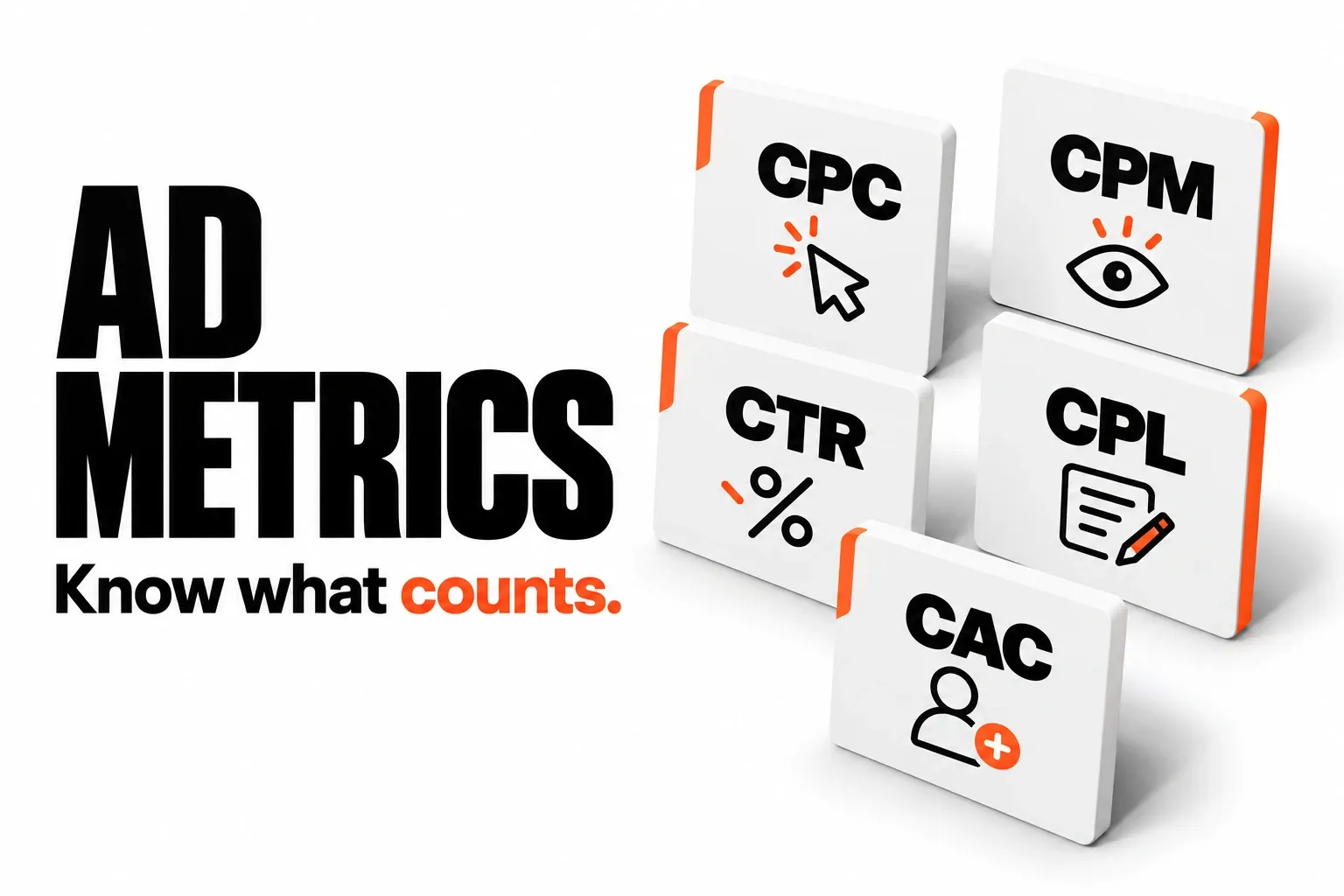
Every ad platform reports the same handful of metrics, and most arguments between clients and agencies come from reading them in the wrong order. A low CPC with a high CAC is a failing campaign, and a high CPC with a low CAC is a winning one. This guide explains what each metric measures, how it is calculated, and what a good number looks like in 2026.
Key points
- CPM measures the cost of attention, CPC the cost of interest, CTR the quality of the ad, CPL the cost of a prospect, and CAC the cost of a customer.
- The five metrics form a chain. Each one is the previous one divided by a rate, which is why fixing the wrong one changes nothing.
- Benchmarks differ by platform more than by industry. A 6% CTR is average on Google Search and impossible on Display.
- CAC is the only metric that tells you whether advertising is making money. The rest are diagnostics.
What is CPM?
CPM is cost per thousand impressions, the M being the Roman numeral for 1,000. An impression is counted every time your ad is served on a screen, whether or not anyone notices it. CPM is the pricing model for awareness formats such as display, video and most social placements.
The formula is total spend divided by impressions, multiplied by 1,000. If you spend ₹10,000 and your ad is shown 2,00,000 times, your CPM is ₹50. That is roughly where Google Display sits in India, with practitioner ranges of ₹20 to ₹150 depending on audience and placement.
Globally, Meta is the reference point for CPM. Across roughly 35,000 ecommerce brands, Meta’s 2026 median CPM reached $14.19, up about 20% year on year. Meta itself reported that average price per ad rose 12% year on year in both Q1 and Q2 2026, which is why your CPM climbs even when nothing in your account changed.
Editor’s note: CPM is the one metric that depends almost entirely on who you target rather than what you say. A tight audience of CFOs in Mumbai costs more per thousand than all adults in Telangana because more advertisers want that screen.
What is CPC?
CPC is cost per click, the amount you pay each time someone clicks your ad. It is the default pricing model for search and shopping, where a click signals active intent. You are not charged for impressions that produce no click.
The formula is total spend divided by clicks. ₹30,000 spent for 1,200 clicks is a ₹25 CPC. In India that is close to the commonly quoted 2026 Search average of ₹24, with the broader practitioner range running ₹20 to ₹200 and beyond for competitive commercial terms.
CPC is set by auction, not by rate card. Google charges the minimum amount needed to hold your position against the next advertiser, so your actual CPC is typically at or below your maximum bid. Better ad relevance and landing page experience clear that threshold more cheaply, which is why two advertisers bidding the same amount pay different prices.
For scale, WordStream by LocaliQ’s 2026 benchmarks across 13,474 US search campaigns put the average Search CPC at $5.42, up from $5.26 a year earlier. Meta traffic campaigns averaged $0.60 per click in the same report. Indian Meta CPCs typically run ₹5 to ₹40 against ₹20 to ₹200+ on Google Search.
CPC vs CPM, which should you choose?
The choice is really a choice of what you are buying. CPM buys reach and is the right model when the goal is to be seen by a defined audience. CPC buys visits and is the right model when the goal is to get the right people onto a page.
The two convert into each other through CTR. A ₹50 CPM at a 0.5% CTR means 1,000 impressions produce 5 clicks, so each click effectively costs ₹10. A ₹50 CPM at a 2% CTR produces 20 clicks, so each costs ₹2.50.
That maths explains a common mistake. Teams see ₹5 display clicks beside ₹60 search clicks and shift budget toward display. The display click is cheaper because it interrupts someone, while the search click answers someone, and the difference shows up three metrics later in CAC.
What is CTR?
CTR is click-through rate, the percentage of impressions that result in a click. It is the cleanest measure of whether your ad matches what the viewer was looking at or looking for. It is a quality signal, not a cost.
The formula is clicks divided by impressions, multiplied by 100. 1,200 clicks from 40,000 impressions is a 3% CTR. On Google Search that would be below average and on Display it would be exceptional.
Platform sets the benchmark. The 2026 LocaliQ all-industry average for Search is 6.64%. Compiled 2026 figures put Google Shopping near 0.86%, YouTube near 0.65% and Google Display around 0.46%, roughly seven times lower than Search because Display interrupts rather than answers.
On Meta, 2026 traffic campaigns averaged 1.93% CTR, and ecommerce brands saw a median of 2.19%. B2B and finance sit lower, around 0.7% to 1.2%, while beauty and fitness run above 2%.
Editor’s note: CTR is the metric clients most often over-read. A high CTR on a broad keyword can simply mean your ad is attractive to the wrong people, and the fix for that is negative keywords, not a new headline.
What does CPL mean?
CPL is cost per lead, the amount spent to acquire one prospect’s contact details. A lead is a form submission, a call, a WhatsApp enquiry or a booking request, depending on what you set up as a conversion. CPL is the primary metric for any business that sells through a conversation rather than a cart.
The formula is total spend divided by leads. ₹30,000 spent for 40 leads is a ₹750 CPL. CPL is also CPC divided by conversion rate, so a ₹25 click at a 3.3% landing page conversion rate lands at roughly the same ₹750.
Indian 2026 benchmarks from a 50-plus campaign study put Google Ads CPL at ₹200 to ₹600 for education, ₹600 to ₹1,200 for healthcare, ₹800 to ₹1,500 for real estate, ₹1,000 to ₹2,500 for financial services and ₹1,500 to ₹4,000 for SaaS. The US all-industry average on Search was $66.69 in 2026. Meta leads in India typically cost half to two-thirds of the Google figure, but qualify at a lower rate.
The qualification gap is the catch. A ₹400 Meta lead that converts to a customer 2% of the time costs ₹20,000 per customer. A ₹1,200 Google lead that converts 10% of the time costs ₹12,000.


