TV advertising cost in India is quoted per 10 seconds of airtime and ranges from about ₹5,000 on an off-peak regional channel to ₹1.5 lakh to ₹4 lakh for prime time on Star Plus, Sony, Zee TV or Colors, ₹8 lakh to ₹10 lakh for special programming, and ₹18 lakh for a live IPL spot. Most national channels also set minimum campaign spends in the lakhs. This guide sets out 2026 rates by channel category, what changed when BARC ratings were suspended in July 2026, and three worked campaign budgets.
Key points
- TV is priced per 10-second spot. A 30-second ad costs three times the 10-second rate for each airing.
- National Hindi GEC prime time (7 pm to 11 pm) runs about ₹1.5 lakh to ₹4 lakh per 10 seconds, off-peak ₹20,000 to ₹80,000. Regional prime time runs ₹25,000 to ₹1 lakh.
- Television remains India’s second-largest ad medium at ₹32,855 crore in 2025, but spend fell 5% and ad volumes fell 11% according to TAM.
- BARC’s weekly ratings were suspended from 2 July 2026 on a Ministry of Information and Broadcasting directive, and TV ad activity fell 8.6% year on year in July to September. Buyers now have more negotiating power and less data.
- Airtime is only part of the bill. Production, agency fees and 18% GST sit on top.
How is TV advertising priced in India?
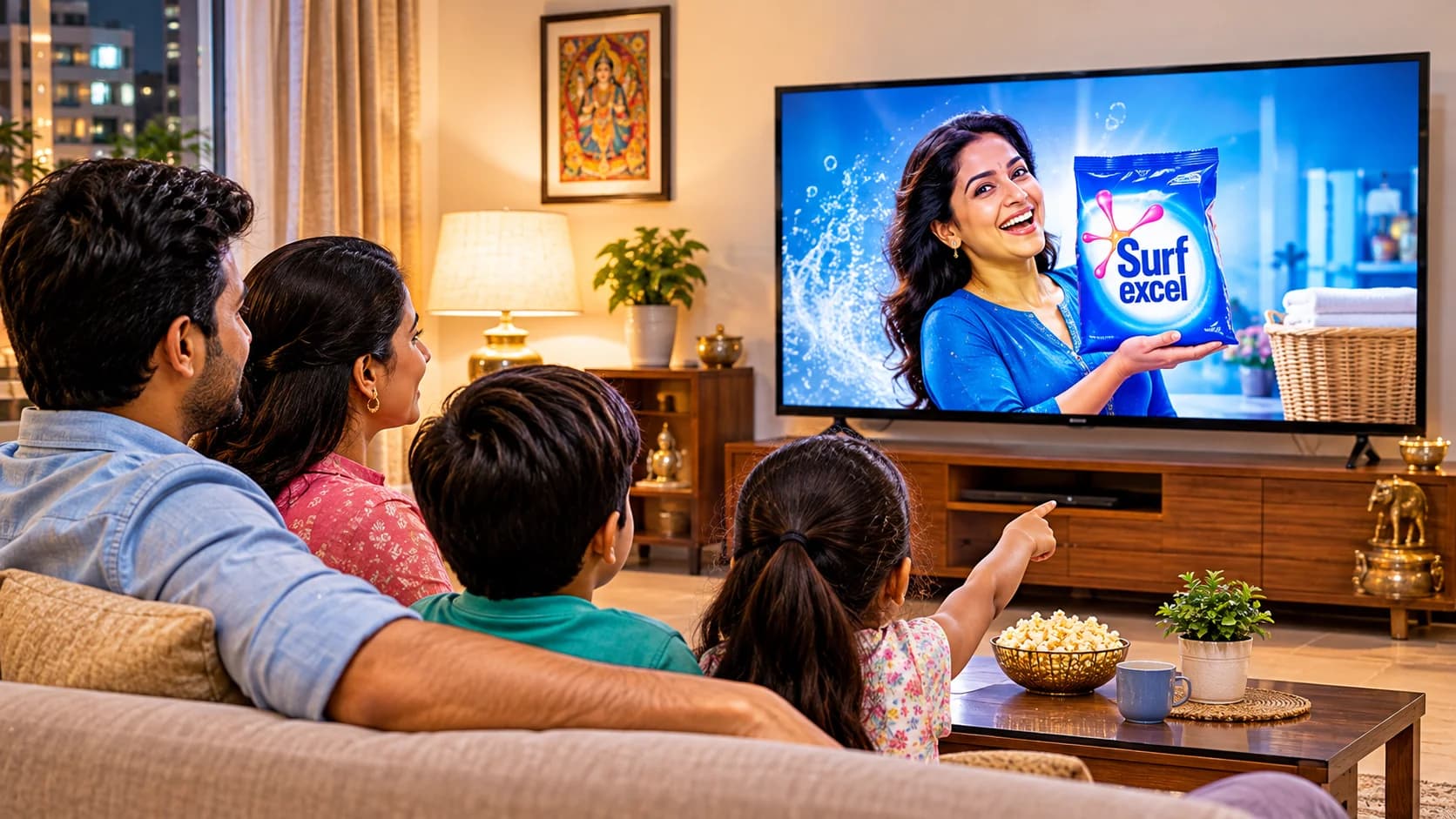
Indian television sells airtime in 10-second units, called FCT or free commercial time. The rate on a channel’s card is the price of one 10-second airing in a given time band. A 20-second ad costs double and a 30-second ad triple, per airing.
Rates depend on four things: the channel, the time band, the programme and the market. Prime time, roughly 7 pm to 11 pm, carries the highest price because that is when viewing peaks. A top-rated fiction show or a reality finale can carry a premium over the channel’s standard prime-time rate, and festive months raise prices across the board.
Channels also sell non-FCT formats on screen while programming runs. These include L-bands that wrap the picture, aston bands across the bottom, J-bands and scrolling tickers, mostly on news channels. They are cheaper per appearance than a spot and suit brands that want frequency more than storytelling.
Under India’s cable television rules, channels can carry at most 12 minutes of advertising per hour. That cap is why prime-time inventory on popular channels is finite and why the best slots sell out early in festive seasons.
Editor’s note: Treat every rate card as an opening position. In 2026, with ratings paused and TV ad volumes falling, broadcasters are negotiating harder than at any point in the last decade. A brand committing to a two- or three-week burst on one network should expect meaningful discounts off card, and should ask for bonus spots rather than accept the first quote.
How much does a 10-second ad cost on Star Plus, Sony, Zee and Colors?
The national Hindi general entertainment channels are the most expensive regular inventory on Indian TV. 2026 agency estimates put prime-time 10-second spots on Star Plus, Sony Entertainment Television, Zee TV and Colors at about ₹1.5 lakh to ₹4 lakh. Super prime-time and special programming, such as big reality finales or event premieres, reach ₹8 lakh to ₹10 lakh.
Off-peak inventory on the same channels is far cheaper, at about ₹20,000 to ₹80,000 per 10 seconds. Daytime and late-night slots reach smaller, more female and older audiences, which suits FMCG and household brands that do not need prime-time scale.
Minimum campaign spends set the real entry price. Media Ant lists minimum spends of about ₹10 lakh for Star Plus and Aaj Tak, ₹42.9 lakh for Sony Entertainment Television, and around ₹1.7 lakh for Zee TV. Below those thresholds, a national GEC will usually not take the booking.
For a 30-second spot in prime time, the arithmetic works out to roughly ₹4.5 lakh to ₹12 lakh per airing on a top Hindi GEC. That is why national TV campaigns are usually measured in crores, not lakhs.
What do news channels charge?
National Hindi and English news channels price below the big GECs for regular programming. 2026 estimates put prime-time news at about ₹50,000 to ₹2 lakh per 10 seconds on channels such as Aaj Tak, India TV, NDTV and Republic, with breaking news and election coverage rising to ₹1.5 lakh to ₹4 lakh.
Regular daytime news inventory is cheaper, in the ₹10,000 to ₹1 lakh range. Business news channels such as CNBC TV18, ET Now and Zee Business reach smaller but wealthier audiences, with minimum spends from about ₹11,000 to ₹1 lakh.
News is where non-FCT formats matter most. Media Ant lists L-band rates of roughly ₹966 to ₹10,120 and J-band rates of about ₹3,220 to ₹5,642 per appearance, and tickers are often sold by the day. Real estate, education and financial services brands use these heavily because they buy frequency at a fraction of spot prices.
How much do regional TV channels cost?
Regional channels offer the best value for brands focused on one state or language. 2026 estimates put prime-time regional GEC spots at about ₹25,000 to ₹1 lakh per 10 seconds on channels such as Star Vijay, Zee Bangla and Colors Marathi, with off-peak regional slots at ₹5,000 to ₹20,000.
The Telugu market is a good example for Hyderabad and Andhra Pradesh brands. Star Maa, Zee Telugu, ETV Telugu and Gemini TV dominate entertainment, and TV9 Telugu, NTV and ETV Andhra Pradesh lead news. Prime-time spots on the leading Telugu GECs sit toward the upper end of the regional range during fiction and reality shows, while news channels price lower.
Regional news is cheaper still. Media Ant lists TV9 Kannada with a minimum spend of about ₹55,000, and agency rate cards show regional news FCT at tens of rupees per second for off-peak bands. For a brand that only sells in one state, regional TV often delivers more relevant reach than a national channel at a tenth of the price.
Editor’s note: For Telugu-market clients, our default TV plan is a regional GEC prime-time burst paired with news tickers. The GEC builds reach in households that watch the evening serials, and the news L-bands and tickers build frequency among men aged 30 and above, who are often the decision-makers for real estate and education purchases.
How much does sports advertising on TV cost?
Live sport is the most expensive TV inventory per spot, and the IPL sets the ceiling. JioStar’s 2026 card priced a 10-second live IPL spot at ₹18 lakh on the combined SD and HD Star Sports feed, ₹15 lakh SD-only and ₹7.2 lakh HD-only, with the final at ₹50 lakh per 10 seconds.
India international cricket, ICC events and the Women’s Premier League follow at lower but still premium rates. Non-cricket sports such as kabaddi and football carry far smaller audiences and price accordingly.
Our IPL advertising cost guide covers the full sports rate card, including JioHotstar connected TV and sponsorship tiers. The short version is that sport is a reach and salience buy, not a frequency one.
How big is the Indian TV advertising market in 2026?
Television is still the second-largest ad medium in India after digital, but it is shrinking. The Pitch Madison Advertising Report 2026 put total TV AdEx at ₹32,855 crore in 2025, down 5% from ₹34,453 crore in 2024. TAM data showed TV ad volumes down 11% for the year.
FMCG remains the backbone, contributing ₹15,183 crore, or 46% of TV spend, in 2025, though it fell 4% and accounted for 42% of the total decline. E-commerce spent ₹5,125 crore on TV, down 4%, and real estate ₹1,471 crore, down 5%. Only a handful of categories grew.