Metro advertising cost in India starts at roughly ₹35,000 to ₹80,000 a month for a single station panel and rises to ₹8 lakh to ₹40 lakh a month for a full exterior train wrap, with Delhi the most expensive network and Hyderabad the cheapest of the four big cities. Station naming rights sit at the top of the market: Mumbai Metro Line 3 sold five station names for ₹216 crore over five years. This guide sets out 2026 rates by city and format, what drives the price, and three worked campaign budgets.
Key points
- Delhi Metro recorded 82.45 lakh passenger boardings in a single day in September 2026 and Namma Metro averaged 9.16 lakh a day in April 2026. Metro audiences are growing while radio and print audiences shrink, and rates follow.
- Format sets the price band. Station panels, pillars and gates run ₹25,000 to ₹3 lakh a month; interior train branding ₹65,000 to ₹10 lakh; full train wraps ₹8 lakh to ₹50 lakh; station domination ₹10 lakh to ₹1 crore or more.
- City sets the premium. Published ranges put Delhi roughly 30% to 60% above Hyderabad for the same format, with Mumbai and Bengaluru in between.
- Station tier matters more than city. An interchange such as Rajiv Chowk or Majestic prices far above a standard station on the same line.
- Production and installation are billed separately, typically ₹5 lakh to ₹10 lakh for a train wrap, and are the most common surprise in a first metro budget.
How much does metro advertising cost per format?
Metro inventory is sold by format and by month, and the formats fall into four price bands.
Station media. Entry and exit gate branding starts around ₹35,000 a month in Delhi, concourse branding around ₹40,000, and escalator or pillar branding from ₹25,000 to ₹50,000, rising to ₹2 lakh to ₹3 lakh at premium stations. Static platform and concourse panels run ₹45,000 to ₹3 lakh for a four-week cycle depending on city and tier. Digital screens at prime positions cost ₹80,000 to ₹5 lakh a month.
Interior train branding. Panels inside coaches near doors and windows start at ₹65,000 to ₹1 lakh a month per train in Delhi, and full interior branding of a train runs ₹2.5 lakh to ₹10 lakh depending on coach count and coverage. In-train audio jingles between stations are a separate line at ₹1.6 lakh to ₹1.8 lakh a month.
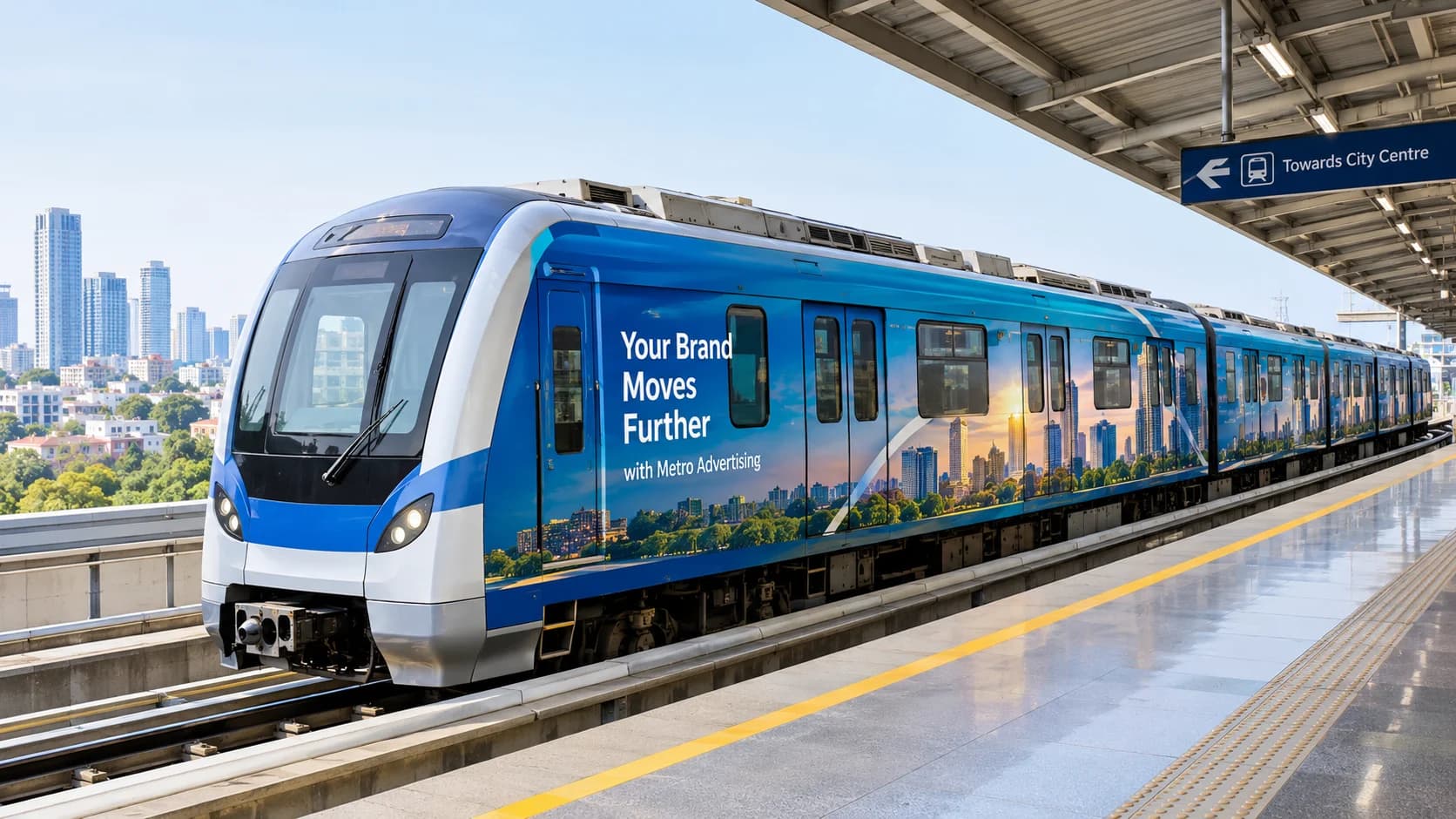
Exterior train wraps. A full exterior wrap is the signature metro format and the one most brands picture. Published 2026 ranges run ₹8 lakh to ₹25 lakh a month in Hyderabad, ₹10 lakh to ₹30 lakh in Bengaluru, ₹12 lakh to ₹35 lakh in Mumbai and ₹15 lakh to ₹40 lakh in Delhi. Combined interior and exterior branding of one Delhi train is quoted at ₹20 lakh to ₹24 lakh a month.
Station domination and naming. Taking every surface at a single station, called domination, runs ₹10 lakh to ₹1 crore or more a month depending on footfall. Naming rights, where a brand’s name becomes part of the station’s official name, are tendered by the metro corporation for multi-year terms and are priced in crores per station per year.
Editor’s note: Our rule for clients is that metro has two different products hiding under one name. Station media is a frequency buy aimed at the people who use that station every day, and it is priced like outdoor. A train wrap is a city-wide moving hoarding seen by people outside the metro as much as inside it, and it is priced like a brand launch. Deciding which one you are buying comes before deciding the city.
What are Delhi Metro advertising rates?
Delhi is the largest and most expensive network, with 82,44,903 passenger boardings on 17 September 2026, its highest ever, and daily averages above 60 lakh. Rates reflect that scale and a tiered station classification that puts interchanges such as Rajiv Chowk, Kashmere Gate and Hauz Khas in the top band.
Published Delhi Metro rates start at ₹35,000 a month for entry and exit gates, ₹40,000 for concourse branding, ₹50,000 for escalator branding and ₹50,000 for general station media. Static panels at a single station run ₹80,000 to ₹3 lakh for four weeks, and digital screens ₹1.5 lakh to ₹5 lakh.
Train formats are where Delhi prices pull away. Interior panels are ₹65,000 to ₹1 lakh a month per train, full interior branding from ₹2.5 lakh, exterior wraps ₹12 lakh to ₹15 lakh at the low end and up to ₹40 lakh for premium lines, and full train branding inside and out ₹20 lakh to ₹24 lakh. Metro jingles are ₹1.6 lakh to ₹1.8 lakh a month.
The Yellow Line between Samaypur Badli and HUDA City Centre and the Blue Line to Noida and Dwarka carry the highest ridership and the highest train rates. The Airport Express line is a separate, smaller inventory priced for a business-traveller audience.
What does Mumbai Metro advertising cost?
Mumbai’s metro is several networks under different operators, and rates vary by line. Line 1 between Versova and Ghatkopar, run by a private concessionaire, carries around 5 lakh passengers a day and has the longest-established ad inventory. Lines 2A and 7 under MMMOCL and the underground Line 3 Aqua Line under MMRC have added inventory since 2023.
Published Mumbai ranges put static station panels at ₹70,000 to ₹2.5 lakh for four weeks, digital screens at ₹1.2 lakh to ₹4 lakh, and full exterior train wraps at ₹12 lakh to ₹35 lakh a month. Mumbai trades slightly below Delhi on most formats because no single Mumbai line yet matches Delhi’s ridership.
Naming rights are where Mumbai leads. MMRC awarded names for five Line 3 stations for ₹216 crore over five years with 5% annual escalation, about ₹40 crore a year in total. Kotak Mahindra Bank took Bandra Kurla Complex and CSMT, ICICI Lombard took Siddhivinayak, and LIC took Churchgate and Hutatma Chowk, which works out to roughly ₹8 crore per station per year for the most valuable stops on the corridor.
How much does Hyderabad Metro advertising cost?
Hyderabad is the cheapest of the four big networks and, for a local brand, often the best value. The system carries about 5 lakh passengers a day across the Red, Blue and Green lines, with Ameerpet, Miyapur, LB Nagar and the Raidurg to Hitec City stretch as the highest-footfall points.
Published Hyderabad ranges put static station panels at ₹50,000 to ₹1.8 lakh for four weeks, digital screens at ₹90,000 to ₹3 lakh, and full exterior train wraps at ₹8 lakh to ₹25 lakh a month. That is about 30% to 40% below Delhi for the equivalent format.
Hyderabad also has a strong tradition of station co-branding, with sponsor names attached to stations across the network since the early years of operation. For brands in real estate, education and healthcare targeting the Hitec City, Gachibowli and Kukatpally corridors, a wrap on the Blue Line or domination at Ameerpet reaches the city’s professional commuter base at a fraction of Delhi or Mumbai prices.
Editor’s note: Watching the Hyderabad network for real estate clients, the Blue Line between Nagole and Raidurg is the inventory that sells out first, because it runs through the IT corridor where the buyers are. A station panel at Raidurg reaches a narrower audience than a Red Line wrap through Ameerpet, but it reaches the right one, and for a project launch that difference is the whole campaign.
What are Namma Metro advertising rates in Bengaluru?
Bengaluru has become the second-largest network in India by length at 96.1 km with 83 stations, and ridership jumped after the Yellow Line opened in August 2025. Namma Metro averaged 9,16,461 passengers a day in April 2026 and set a record of 11,19,815 on 10 August 2026. Majestic, the Purple and Green Line interchange, is the single most valuable station.
Published Bengaluru ranges put static station panels at ₹60,000 to ₹2 lakh for four weeks, digital screens at ₹1 lakh to ₹3.5 lakh, and full exterior train wraps at ₹10 lakh to ₹30 lakh a month. The Purple Line through MG Road, Indiranagar and Whitefield commands the premium, and the new Yellow Line to Electronic City is attracting tech and SaaS advertisers.
BMRCL is also expanding its own non-fare revenue, with a 5% annual fare increase from February 2026 and more aggressive commercial tendering. Expect Bengaluru rates to close the gap with Mumbai over the next two years as the network and ridership grow.