Advora.media
Language

Opens Google Translate in a new tab. Automatic translations may contain errors.

Offline & OOH/ Insights

Radio Advertising Cost in India 2026

A 10-second FM radio spot in India costs anywhere from ₹100 in a small town to ₹1,500 on Radio Mirchi Mumbai, and a two-week single-city campaign lands between ₹75,000 and ₹2.5 lakh before GST. Radio is the only mass medium in India whose rates fell in 2025. This guide gives the 2026 rate cards by city, what moves the price, and what a real campaign costs.

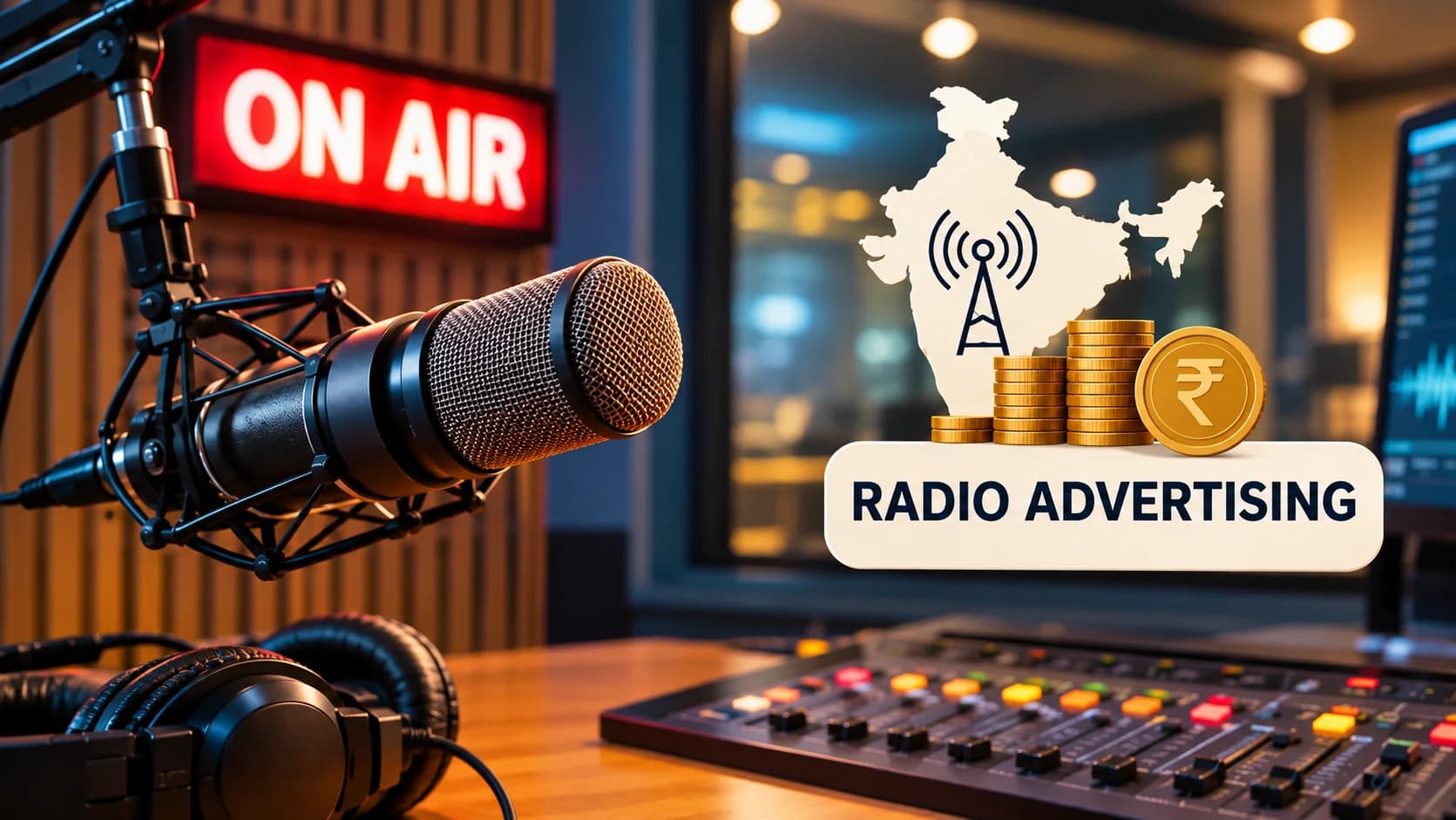
FM radio studio microphone and on-air sign, illustrating radio advertising cost in India

Radio advertising cost in India runs from about ₹100 to ₹1,500 per 10-second spot on private FM in 2026, with Radio Mirchi Mumbai and Delhi at the top at ₹110 to ₹152 a second and Tier 2 stations at ₹10 to ₹30 a second. A focused single-city campaign of two weeks costs ₹75,000 to ₹2.5 lakh before 18% GST, and national multi-station campaigns start near ₹25 lakh. This guide sets out the published rate cards, what the industry’s falling rates mean for buyers, and three worked campaign budgets.

Key points

  • Private FM stations quote in rupees per second, so a 10-second spot on Radio Mirchi Mumbai at ₹152 a second is ₹1,520 at list, while a Tier 3 station at ₹10 a second is ₹100. City, not station brand, is the biggest driver of price.
  • Radio is a ₹2,300 to ₹2,500 crore medium that is not growing. Pitch Madison put 2025 radio AdEx at ₹2,515 crore, up 2%, while FICCI-EY reported ad revenue down 7% and rates falling. Buyers have leverage.
  • There are 388 private FM stations in India and the count has not changed in two years, though networks such as MY FM are still adding Tier 2 and 3 frequencies in 2026. Metro inventory is finite; small-town inventory is expanding.
  • Real estate was radio’s largest advertiser category in 2025 at ₹393 crore, followed by auto at ₹299 crore. The medium works for local, time-bound, drive-time decisions.
  • The cheapest radio buy is rarely the cheapest spot. Frequency, time band and RJ integration decide whether ₹1 lakh produces recall or noise.

How much does radio advertising cost per 10 seconds?

Indian FM stations price airtime per second and sell it in 10-second units, so every rate card can be read as a per-second figure multiplied by ten. The spread between cities is wider than in any other medium. Media Ant, which aggregates station rate cards, puts the national range at ₹150 to ₹2,500 per 10-second spot, with Radio Mirchi stations at ₹500 to ₹3,000 at the top end.

Published per-second rates for Radio Mirchi make the pattern concrete. Mumbai lists at ₹152 a second and Delhi at ₹110, while Bengaluru, Chennai and Pune sit at ₹50 to ₹55. Patna is ₹30, Jaipur ₹18, Lucknow ₹16, and most smaller towns ₹10 to ₹13 a second, which means ₹100 to ₹130 per 10-second spot.

Competing networks sit a notch lower in the same cities. Red FM lists around ₹100 to ₹750 per 10 seconds depending on market, Radio City ₹100 to ₹700, Big FM ₹50 to ₹600 and Fever FM ₹100 to ₹600. In a city like Indore, minimum campaign spends across Red FM, Mirchi, Big FM and MY FM run ₹3,240 to ₹6,120, against ₹21,600 to ₹22,680 for Mirchi and Red FM in Delhi or Mumbai.

Editor’s note: The published rate is the opening position, and in 2026 it is a weak one. Radio ad revenue fell last year, stations have unsold inventory outside morning drive, and a buyer committing to two weeks at 10 spots a day should expect 20% to 40% off card in most markets. Treat the figures in this article as the ceiling.

What determines radio ad rates in India?

Five variables set the price, and only one of them is the station’s name.

City and station reach. A Mumbai or Delhi frequency reaches 20 lakh or more weekly listeners and prices accordingly; a Tier 3 station reaches a few lakh. Metro rates are ten to fifteen times small-town rates for the same 10 seconds.

Time band. Morning drive, roughly 7 am to 11 am, and evening drive, 5 pm to 9 pm, are the premium bands and typically carry a 20% to 30% surcharge over run-of-schedule. Late night and afternoon slots are where discounts live.

Language and format. In multilingual cities, the regional-language frequency often costs less than the Hindi one and reaches a more loyal audience. Radio Mirchi Bengaluru in Kannada lists at ₹50 a second against ₹48 for its Hindi feed, but the Kannada station claims nearly 50% more listeners.

Spot length and frequency. Stations bill per second, so a 20-second spot costs double a 10-second one. Most planners run 8 to 15 spots a day for at least 10 to 14 days, because radio works on repetition rather than reach.

Integration. A plain spot is the cheapest unit. RJ mentions, show sponsorships, contests and branded segments cost more per occurrence but carry the host’s credibility, and stations increasingly bundle them to protect yield.

What do Radio Mirchi, Red FM and Big FM charge?

Radio Mirchi, run by ENIL, is the network most advertisers ask about and the most expensive in most cities. ENIL’s FY25 revenue was ₹539.7 crore and its profit fell by half to ₹19 crore, with management saying radio advertising had weakened while its Gaana and events businesses grew. That context matters: the network is defending rates on paper while making deals in practice.

Mirchi’s per-second cards run ₹152 in Mumbai, ₹110 in Delhi, ₹50 to ₹55 in Bengaluru, Chennai and Pune, ₹30 in Patna and ₹16 to ₹18 in Jaipur and Lucknow. Media Ant’s aggregated range for the network is ₹500 to ₹3,000 per 10 seconds, with the ₹3,000 figure reflecting premium drive-time positions in Mumbai.

Red FM, owned by the Sun Group, is the strongest challenger in the south and in Delhi and prices just below Mirchi in most markets, with a published range of about ₹100 to ₹750 per 10 seconds. Big FM, under its new CEO Ashit Kukian since late 2025, runs ₹50 to ₹600 and is the most negotiable of the big networks. Radio City and Fever FM sit in similar bands, and regional networks such as MY FM, Suryan FM and Club FM are the value plays in their home states.

How much does a radio campaign cost in India?

Three worked budgets show how the per-second rate turns into a bill.

A south metro product launch. A real estate developer runs a 20-second spot 12 times a day for 10 days on one station at ₹55 a second. That is 10 × 12 × 20 × 55, or ₹1,32,000 at list, and ₹1,55,760 with GST. With a typical two-week negotiated discount, the cash cost lands near ₹1 lakh.

A Mumbai retail promotion. A chain runs a 10-second spot 10 times a day for 14 days on Radio Mirchi Mumbai at ₹152 a second. That is 14 × 10 × 10 × 152, or ₹2,12,800 at list and ₹2,51,104 with GST, for about 140 spots reaching the city’s largest FM audience.

A Tier 2 awareness campaign. A coaching institute in Jaipur runs a 20-second spot 15 times a day for 30 days at ₹18 a second. That is 30 × 15 × 20 × 18, or ₹1,62,000 at list and ₹1,91,160 with GST, for 450 spots over a month.

Agency packages confirm the scale. Published starter packages run ₹75,000 to ₹1.5 lakh for 20 spots a day on one station for a week, ₹2.5 to ₹5 lakh for a 10-day two-station metro campaign with RJ mentions, ₹6 to ₹12 lakh for 25 spots a day across five cities for two weeks, and ₹25 lakh upwards for a 30-day national blitz across 15 or more cities.

Editor’s note: Our planning rule for Hyderabad clients is that radio earns its place only when the message is local and time-bound. A site visit this weekend, an admissions deadline, a sale ending Sunday. For brand awareness with no date attached, the same ₹1.5 lakh buys more measurable reach on connected TV or Meta.
Is radio advertising in India growing or shrinking?

The numbers point the same way from every source, and the direction is down or flat. Pitch Madison reported radio AdEx at ₹2,515 crore in 2025, up just 2% from ₹2,462 crore, while FICCI-EY put total radio industry revenue at ₹2,300 crore and said advertising revenue fell 7% as rates, listenership and FM-enabled devices all declined.

The regulator’s data is similar. Private FM operators reported ad revenue of ₹1,818.71 crore to TRAI for FY25, up 2.4% after a 14.8% rise the year before, with the station count unchanged at 388 as of March 2025. TRAI’s reform recommendations for the sector had been pending for eight months as of May 2026.

The growth that exists is in small towns. MY FM launched seven new stations in March 2026 in markets such as Daman, Gandhidham and Alwar, and regional publishers including DB Corp, Malayala Manorama and Mathrubhumi are expanding in Tier 2 and 3 India where FM reach still outpaces cities. The categories still spending are local and transactional: real estate at ₹393 crore in 2025, auto at ₹299 crore and up 13%, retail, education and government.

For a buyer, a shrinking medium with fixed inventory in metros and growing inventory in small towns means two things. Metro drive-time remains scarce and priced to match, and everything else is negotiable.

How does radio advertising cost compare with other media?

Radio is cheap per spot and cheap per thousand, and that is the whole case for it. A ₹1,520 spot on Radio Mirchi Mumbai reaching a few lakh concurrent listeners works out to a CPM in the low single digits of rupees, well below television, print or any digital video format.

The trade-off is attention and measurement. Radio delivers no click, no view-through and no reliable audience number outside the RAM-measured metros, so the only way to attribute it is a dedicated phone number, a promo code or a lift in branded search. Brands that run radio without one of those have no way to know whether it worked.

The comparison most marketers should make is with hyperlocal digital. ₹1.5 lakh buys roughly 150 spots on a south metro FM station, or about 10 lakh impressions on Meta geo-targeted to the same city, or 6,000 Google Search clicks at India’s average CPC. Radio wins when the audience is in a car and the message is a date; the others win when the audience needs to act on a screen.

What to ignore in radio advertising cost advice

Ignore per-spot figures in the thousands. Some guides quote ₹5,000 to ₹32,000 for a single 10-second spot. Those numbers confuse a spot with a package or a day’s booking; published station cards top out near ₹1,500 to ₹3,000 even in Mumbai drive time.

Ignore the station’s list rate as the price. In a medium where ad revenue fell 7% last year, the card is a negotiating anchor. Ask for the effective rate on a two-week, 10-spots-a-day commitment.

Ignore reach claims without a source. Only the largest metros have RAM audience measurement, and most stations quote cumulative weekly listeners that cannot be verified. Buy on frequency and time band, not on a reach number.

Ignore “radio is dead” as a reason not to look. The medium is shrinking in metros and growing in Tier 2 and 3 towns, and it still carries ₹2,500 crore a year, led by real estate and auto. For a local business in a mid-sized city it remains one of the few affordable mass channels.

Ignore any rate quoted without GST. Every figure in this article is before 18% GST, which is how stations quote. Add it before you budget.

Advora editorial team insights

Buying radio for real estate and education clients across Hyderabad and the Andhra and Telangana districts, we have watched the medium split into two markets that behave nothing alike. Metro drive time on Mirchi or Red FM is scarce, priced firmly and sells; everything else is soft, and the station sales team knows it.

Our verdict for 2026 is to buy radio as a frequency medium with a deadline attached, never as awareness. Twelve spots a day for ten days with a site visit or a last date in the script, on a regional-language frequency in the morning band, is the configuration that has produced measurable call volume for our clients. Spreading the same budget across three stations at four spots a day has not.

The second insight is about the negotiation. With revenue down and TRAI reforms stalled, 2026 is the best buyer’s market radio has offered in a decade, and the discount a station will give on a committed fortnight is larger than any saving from picking the cheaper network. Pick the station the audience actually listens to, then negotiate the rate.

FAQs

How much does a 10-second radio ad cost in India?
From about ₹100 on a Tier 3 FM station to ₹1,100 on Radio Mirchi Delhi and ₹1,520 on Radio Mirchi Mumbai at list rates, before GST. Most metro stations outside Mumbai and Delhi list at ₹500 to ₹600.

What are Radio Mirchi ad rates?
Radio Mirchi lists ₹152 a second in Mumbai, ₹110 in Delhi, ₹50 to ₹55 in Bengaluru, Chennai and Pune, and ₹16 to ₹30 in cities such as Lucknow, Jaipur and Patna. That is roughly ₹500 to ₹3,000 per 10-second spot depending on city and time band.

What is the minimum budget for radio advertising?
Stations set minimum campaign spends from about ₹3,000 in Tier 2 cities to ₹21,600 or more on Mirchi and Red FM in Delhi and Mumbai. A meaningful single-city campaign starts near ₹75,000 for a week.

Is radio advertising effective in India?
For local, time-bound messages aimed at commuters, yes, and real estate and auto remain its largest categories. For national brand awareness, the medium’s shrinking reach and lack of measurement make it a weaker buy than television or digital video.

How much does Red FM advertising cost?
Published rates run roughly ₹100 to ₹750 per 10 seconds depending on city, generally a little below Radio Mirchi in the same market.

Do radio ad rates include GST?
No. Stations quote per second before tax, and 18% GST applies on top. A ₹1,00,000 campaign bills at ₹1,18,000.


Offline & OOH

TV Advertising Cost in India: 10-Second Rates by Channel

A 10-second prime-time spot on a national Hindi channel such as Star Plus costs ₹1.5 lakh to ₹4 lakh, a regional channel ₹25,000 to ₹1 lakh, and an IPL live spot ₹18 lakh. TV is still India’s second-largest ad medium at ₹32,855 crore, but it shrank 5% in 2025 and lost its ratings in July 2026. This guide gives the rates by channel and what a campaign costs.

Advora Editorial Team

Offline & OOH

DOOH's AI Shift Starts With Inventory Data, Not Creative

A DOOH media CEO argues AI's biggest impact on digital out-of-home will be behind the screen: smarter inventory data, faster planning and tighter links between direct and programmatic sales.

Advora Editorial Team