

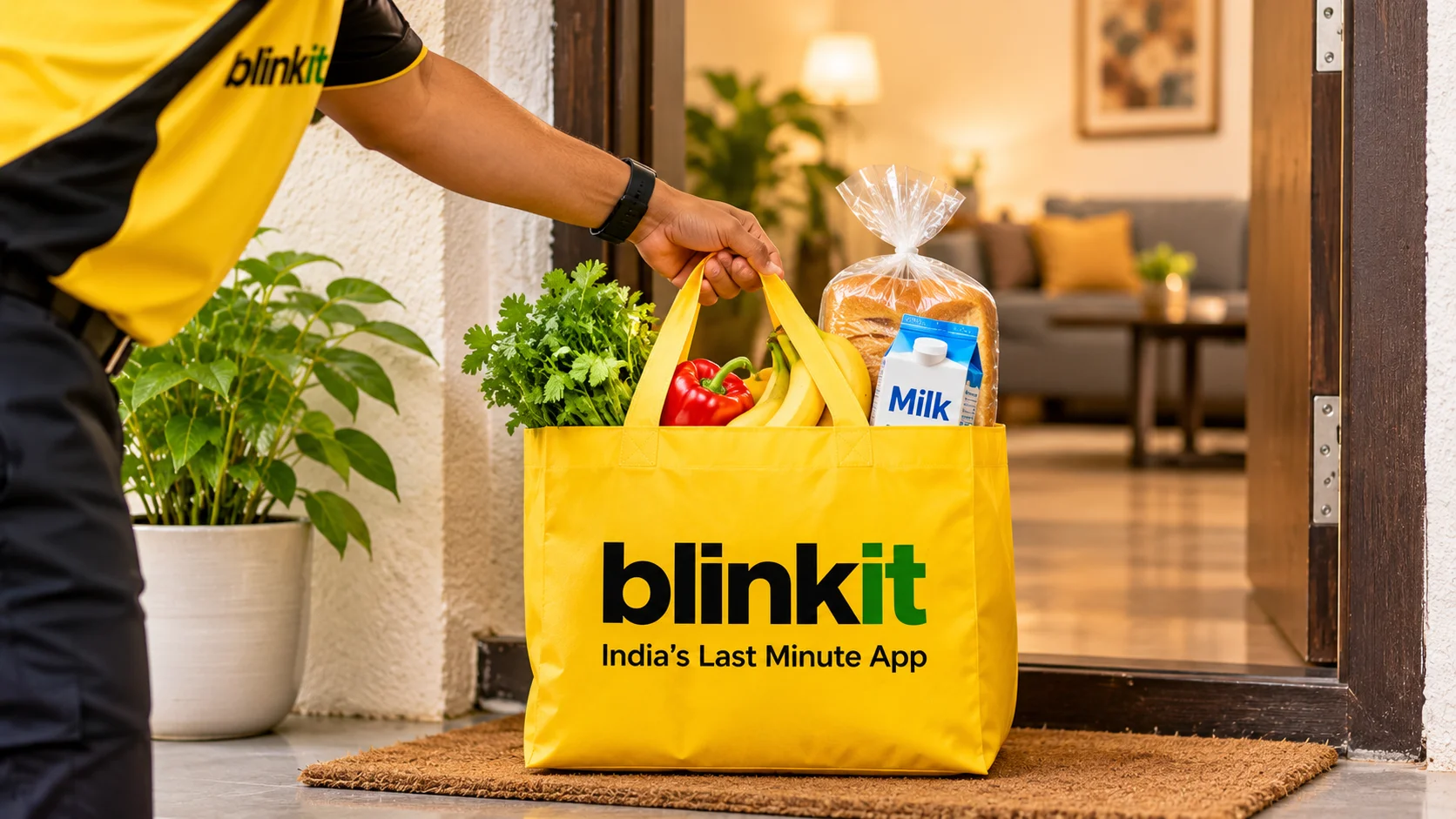
The Blinkit marketing strategy sold speed as a personality: a yellow brand, witty billboards, and a CEO who answers customer tweets in public and ships the fix within days. It made Blinkit India’s largest quick-commerce platform, with ₹19,152 crore of revenue and ₹184 crore of adjusted EBITDA in the July to September 2026 quarter. In January 2026, after a gig worker strike and government intervention, Blinkit dropped its “10-minute delivery” claim entirely. This case study follows how the brand was built, what changed, and why it grew faster after losing its slogan.
Key points
- Blinkit began as Grofers in 2013, rebranded and pivoted to quick commerce in December 2021, and was acquired by Zomato in 2022. Co-founder Albinder Dhindsa became Group CEO of Eternal, Zomato’s parent, on 1 February 2026.
- Moment marketing is the brand’s core channel. The free coriander feature, launched within days of a customer’s viral tweet in 2024, is still the most cited example of founder-led social response in Indian marketing.
- On 13 January 2026, Blinkit removed “10-minute delivery” from its branding after Labour Minister Mansukh Mandaviya met quick-commerce platforms. The tagline moved to “30,000+ products delivered at your doorstep”.
- Growth accelerated after the change. Q2 FY27 revenue rose 94%, orders reached 39.9 crore in the quarter, and adjusted EBITDA swung from a ₹156 crore loss a year earlier to a ₹184 crore profit.
- Blinkit had 2,751 dark stores at September 2026 and raised its March 2027 target to 3,500. Its own ad business sells that footprint back to brands.
What is the Blinkit marketing strategy built on?
Albinder Dhindsa and Saurabh Kumar launched Grofers in December 2013 as an online grocery platform with next-day delivery. It struggled against Amazon, Flipkart and BigBasket, which competed on assortment and price. In December 2021 the company rebranded as Blinkit and changed the promise from cheaper groceries to faster ones, built on dark stores placed within a few kilometres of customers.
The rebrand did three jobs at once. It replaced a generic name with one that meant speed. It introduced the yellow and green identity that now sits on riders, bags and billboards. And it gave the marketing team a single message, time saved rather than money saved, that every ad could repeat.
Zomato acquired Blinkit in an all-stock deal in 2022, giving it access to the parent’s delivery fleet, data and capital. Under Eternal, Blinkit has become the larger business: it contributed about 79% of the group’s Q2 FY27 operating revenue, and its founder now runs the whole company.
Editor’s note: This is the Advora verdict on Blinkit, and it reads differently after our Zepto case study. Both brands built their identity on speed and both had to drop the speed claim in January 2026. Blinkit came through it with a bigger business, which tells us the slogan was never the asset. The habit was.
How does Blinkit use moment marketing?
Blinkit’s social presence works like a friend who happens to sell groceries. The brand jumps on trends, films and cricket within hours, writes in the voice of a witty young Indian, and turns ordinary products into jokes. A 2023 billboard reworked a famous line from the film “Maa Tujhe Salaam” into “Doodh mangoge, doodh denge”, promising milk on demand, and the post crossed 5 lakh views.
The best example came from a customer, not the brand. In May 2024, a user named Ankit Sawant tweeted that his mother had to buy coriander separately after ordering vegetables on Blinkit. Dhindsa replied publicly, and within days Blinkit added free coriander to qualifying vegetable orders, posting “Everyone please thank Ankit’s mom” when it went live.
That one exchange became a lesson in what moment marketing can do when the product team is part of it. The feature cost Blinkit very little, generated national coverage and earned the brand credit for listening. Most brands can reply to a tweet; very few can change the product before the conversation goes cold.
How did the founder shape Blinkit’s branding?
Dhindsa’s public presence on X has been one of Blinkit’s most effective channels. He announces features, answers complaints, shares operating milestones and occasionally argues with critics, all in a tone that matches the brand’s. The coriander episode, the 2025 launch of Bistro for ten-minute snacks and meals, and in-terminal delivery at Mumbai Airport’s T2 in 2026 were all announced by him first.
That visibility carries risk as well as reach. Founder-led brands absorb public criticism personally, and quick commerce has faced plenty, over rider safety, pricing and dark stores in residential areas. When those debates peaked in late 2025 and early 2026, Eternal’s leadership was at the centre of them.
Dhindsa’s move to Eternal Group CEO in February 2026, with Deepinder Goyal shifting to non-executive vice chairman, confirmed that quick commerce now drives the group. It also means Blinkit’s founder voice now speaks for Zomato, District and Hyperpure as well.
Why did Blinkit drop its 10-minute delivery claim?
Gig workers across delivery platforms held a nationwide strike on 31 December 2025, protesting pay, working conditions and the pressure of ultra-fast delivery promises. The issue had already been raised in Parliament, and Rajya Sabha MP Raghav Chadha spent a day working as a Blinkit delivery partner to highlight rider conditions.
On 13 January 2026, after Labour Minister Mansukh Mandaviya met major platforms, Blinkit removed “10-minute delivery” from its branding across all platforms and advertising. Its app tagline changed from “10,000+ products delivered in 10 minutes” to “30,000+ products delivered at your doorstep”, and its marketing line shifted from “India’s 10-min delivery app” to “India’s last-min delivery app”. Zepto, Swiggy Instamart and Zomato agreed to follow.
Eternal said there was no change to the business model, and Goyal had argued earlier that riders are not shown a countdown timer. The change was to the claim, not the operation. But for a brand whose name and history were built on minutes, it was the most significant marketing change since the 2021 rebrand.
Editor’s note: For marketers, this is the clearest example this year of a brand claim becoming a public-policy issue. “Ten minutes” was a promise to customers that riders felt as a deadline. Brands making speed, safety or health claims should test how the claim reads to everyone who has to deliver it, not just to the people buying.
How did Blinkit’s marketing change after the rebrand?
The new positioning, “last-minute delivery”, moved the emphasis from the clock to the moment of need. Blinkit is now sold as the app you open when you have forgotten something, whether that is milk, a charger, a gift or party supplies. The promise is still speed, but expressed as convenience rather than a countdown.
Assortment became a bigger part of the story. The tagline’s jump from 10,000 to 30,000 products reflects Blinkit’s push into electronics, beauty, toys, gifting and festive categories, which carry larger baskets and higher margins than groceries. Seasonal campaigns around Diwali, Rakhi and Valentine’s Day now sell Blinkit as a last-minute gifting store as much as a grocery app.
The business model shifted too. Through FY26 Blinkit moved toward an inventory-led model, buying products from brands and selling them from its own dark stores, which raised reported revenue and gave it more control over pricing and availability. That control lets marketing promise things, such as specific products in stock, that a pure marketplace could not.
How much does Blinkit spend on marketing?
Eternal does not break out Blinkit’s advertising spend separately, but management has been open about the direction. In Q4 FY25 Blinkit’s adjusted EBITDA margin worsened because of higher marketing investment aimed at new customer acquisition. In October 2025, Dhindsa said Blinkit would keep spending heavily on marketing as long as growth continued.
Marketing sits alongside other acquisition costs. Discounts, free delivery thresholds and the cost of opening hundreds of dark stores a quarter are effectively customer acquisition spend. Blinkit added 308 net stores in Q2 FY27 alone, and each new store is both a capacity investment and a local brand launch.


