WhatsApp Business API pricing in India depends on the message category, recipient market and provider fees. Meta bills eligible messages on delivery and says service replies inside the customer service window are free. Use the current India rate card to confirm the pricing inputs in the examples below.
Key points
- Meta moved from per-conversation to per-message billing on 1 July 2025, and marketing rates in India rose about 10% in 2026, from ₹0.7846 to ₹0.8631. A marketing message now costs 7.5 times a utility message.
- Meta says service replies inside the 24-hour customer service window are free. Provider software or automation charges may still apply.
- GST adds 18% to every Meta charge, so the real marketing rate is about ₹1.02 and the real utility rate about ₹0.14.
- Providers add anywhere from 0% to 30% per message plus a platform fee of ₹1,500 to ₹10,000 a month. On 1 lakh messages, the gap between the cheapest and most expensive routes is over ₹12,000 a month.
- Meta’s Cloud API has no setup or licence fee. Everything above the rate card is a provider decision, not a WhatsApp one.
How does WhatsApp Business API pricing work in 2026?
Meta charges for messages a business sends, not for messages it receives. Since 1 July 2025, each delivered template message is billed individually by category, replacing the earlier model that charged once per 24-hour conversation. The price depends on the recipient’s country and the message type.
There are four categories. Marketing covers offers, broadcasts, product recommendations and re-engagement. Utility covers transactional updates such as order confirmations, delivery alerts, invoices and appointment reminders. Authentication covers OTPs and login codes, and Service covers free-form replies a business sends inside a customer-opened window.
The 24-hour customer service window still matters. When a customer messages first, the business can reply free-form for 24 hours, and utility templates sent inside that window are free. Marketing and authentication templates are charged whether the window is open or not.
Editor’s note: The single most expensive mistake we see in Indian accounts is tagging utility messages as marketing because the copy includes a soft upsell. Meta reclassifies templates it judges promotional, and the difference is ₹0.75 a message. On a 50,000-message order-update campaign, that is ₹37,000 of avoidable cost.
What are Meta’s WhatsApp API rates for India?
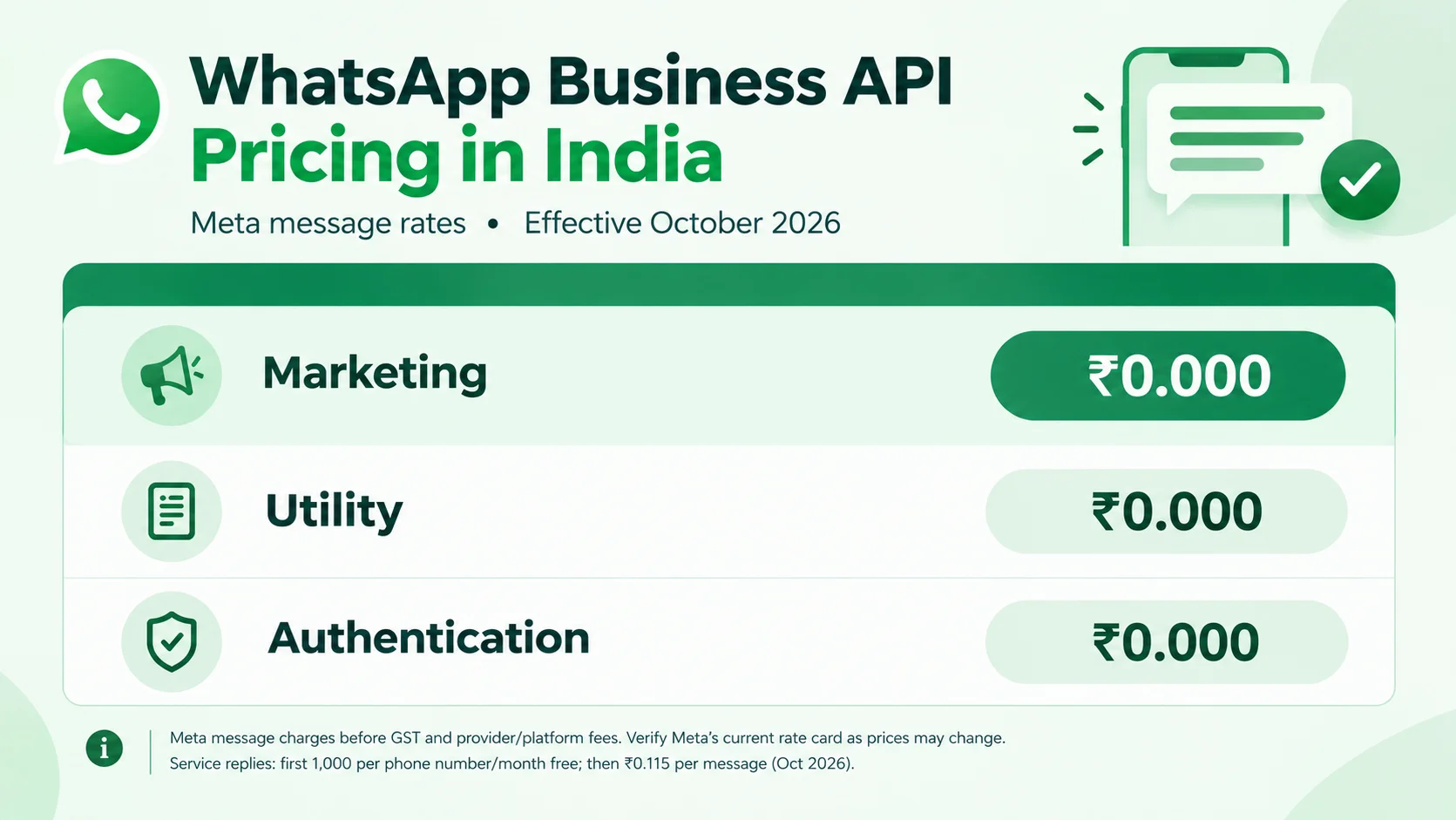
Meta’s rate card for messages delivered to Indian numbers, effective 1 July 2026 and unchanged on the 1 October 2026 card, is as follows. All figures are per delivered message and exclude GST.
- Marketing: ₹0.8631, or roughly $0.0118
- Utility: ₹0.1150, or roughly $0.0014
- Authentication: ₹0.1150
- Authentication-international: ₹2.4971, for OTPs sent to Indian numbers by businesses registered outside India
- Service: free until 30 September 2026; from 1 October, ₹0.1150 after 1,000 free messages per phone number per month
The 2026 marketing increase was about 10%, from ₹0.7846 to ₹0.8631, while utility and authentication stayed flat. Volume discounts exist only for utility and authentication. Utility stays at list rate up to 2.5 crore messages a month, and authentication discounts begin at 7.5 lakh messages a month, so most Indian SMBs will never see a tiered rate.
Add GST to get the number that lands on your bank statement. ₹0.8631 becomes about ₹1.02 per marketing message and ₹0.115 becomes about ₹0.14. GST-registered businesses can claim input credit, which brings the net cost back to the list rate.
Are WhatsApp customer service replies free?
Meta says businesses can send service replies at no charge during the 24-hour customer service window. An incoming message opens the window, and each new customer message resets it.
Source: Meta, WhatsApp Business Platform Pricing
A support operation handling 3,000 conversations with four in-window service replies each would send 12,000 service replies. Meta’s published rules put the message charge for those replies at zero. Check whether your provider bills separately for its support inbox or automation.
The second change is to utility behaviour inside the window. Utility templates sent in response to a customer message within the open window stay free, which rewards businesses that trigger order updates as replies rather than as cold sends. Marketing templates remain charged everywhere.
What do WhatsApp API providers in India charge on top?
Meta’s rate card is the wholesale price, and almost every Indian business buys through a Business Solution Provider, or BSP. Providers add value with inboxes, chatbots, CRM integrations and campaign tools, and they recover that cost in one of three ways: a flat monthly platform fee, a per-message markup over Meta’s rate, or both.
A July 2026 study of 15 providers selling in India found marketing markups ranging from 0% to about 30% over Meta’s ₹0.8631. The three largest SMB platforms by brand share were at the upper end, with Wati near +30% at about ₹1.12 a message, AiSensy at +26% at ₹1.09, and Interakt at around +20% at ₹1.04. Utility markups followed the same pattern, with AiSensy at ₹0.145 against Meta’s ₹0.115.
Platform fees vary just as widely. AiSensy’s published Indian plans run ₹1,500 to ₹3,200 a month, Interakt lists Growth at ₹2,799 and Advanced at ₹3,799 plus taxes, and Wati’s Growth plan is $59 a month, roughly ₹5,000, with a hard cap of three agents. Gupshup and Karix publish no pricing and quote enterprise deals. Wati, Zoko and some others bill Indian customers in dollars, which adds an effective 6% to 8% through forex spread and card fees.
A newer group of providers passes Meta’s rate through at zero markup and charges only a flat fee of ₹799 to ₹4,499 a month, including Gallabox and DoubleTick. Others run a ₹0 platform fee with a small fixed per-message charge. The right choice depends almost entirely on volume, which the worked examples below show.
Editor’s note: Most of these comparisons are published by providers themselves, including the one above, so treat the exact percentages as indicative and check live pricing pages before signing. The structure is reliable even if the decimals move: the bigger brands charge more per message, the newer ones charge a flat fee.
How much does WhatsApp marketing cost in India for a real business?
Three worked bills make the layers concrete. Each uses Meta’s India rates, adds 18% GST, and then shows what a typical BSP route adds.
A D2C brand sending 50,000 messages a month. Say 20,000 marketing broadcasts, 25,000 order and delivery updates and 5,000 OTPs. Meta’s charge is ₹17,262 for marketing, ₹2,875 for utility and ₹575 for authentication, a total of ₹20,712. With GST that is ₹24,440, and through a +25% markup provider with a ₹3,000 platform fee it rises to roughly ₹32,000.
A clinic sending 5,000 messages a month. Say 1,000 appointment reminders, 3,000 confirmations and follow-ups sent as replies inside the service window, and 1,000 marketing messages about a health camp. The 3,000 in-window utility messages are free, so Meta’s charge is ₹115 for reminders plus ₹863 for marketing, or ₹978 before GST. Here the platform fee dominates; a ₹2,799 plan is nearly three times the message cost, and a ₹0-fee usage-only provider wins by a wide margin.