

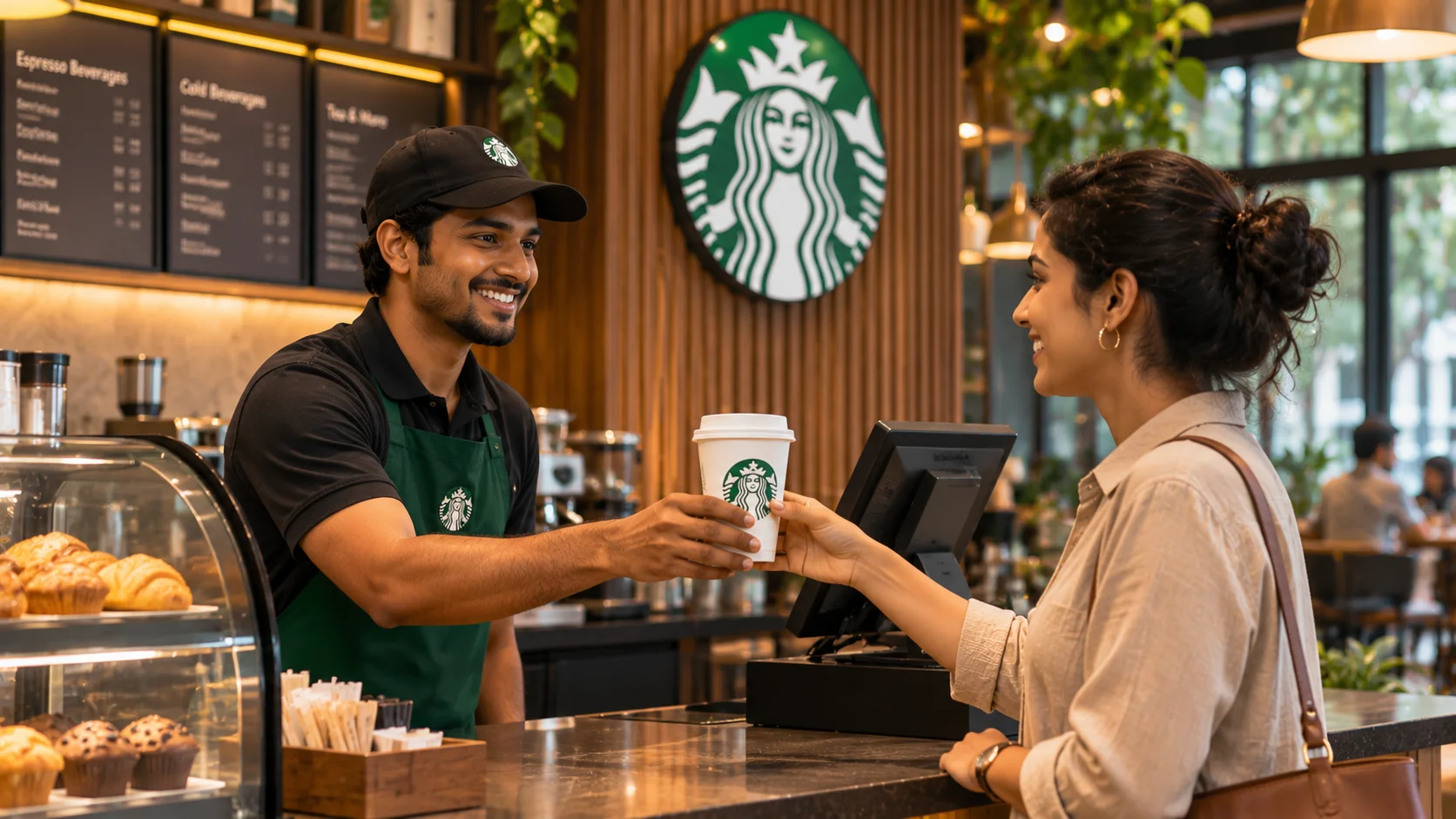
Starbucks’ marketing strategy is built on the store experience rather than heavy advertising. It positions itself as the “third place” between home and work, uses its stores, baristas and cups as its main media, and keeps customers coming back through the Starbucks Rewards loyalty programme and seasonal rituals such as Red Cups and the Pumpkin Spice Latte. After a slump, CEO Brian Niccol’s “Back to Starbucks” plan has restored growth: global comparable sales rose 7.2% in the fourth quarter of fiscal 2026.
Key points
- Starbucks positions itself as a premium “third place” for connection, not just a coffee seller.
- The store, barista and cup do most of the marketing; traditional advertising has played a smaller role.
- Starbucks Rewards had 35.5 million active US members in early 2026, and members drove nearly 60% of US company-operated revenue in fiscal 2025.
- Back to Starbucks refocused the brand on service, coffeehouse comfort and simpler menus.
- In India, Tata Starbucks crossed 500 stores and plans to add 50 to 100 stores a year.
How big is Starbucks in 2026?
Starbucks’ fiscal 2026 ended on 27 September 2026. Revenue rose 2% to $37.9 billion and global comparable coffeehouse sales grew 6.2% for the year.
The fourth quarter was stronger. Global comparable sales rose 7.2% and US comparable sales 7.7%, the company’s fifth straight quarter of growth.
Starbucks ended the year with 41,607 stores worldwide, 32% company-operated and 68% licensed. Revenue in the quarter was also affected by converting its China retail business into a licensed joint venture.
Editor’s note: Brian Niccol became Starbucks’ chairman and CEO in 2024 and launched the Back to Starbucks plan. “Back to Starbucks started as our turnaround plan. Now, it’s our growth plan,” he said in the fiscal 2026 results.
How is Starbucks positioned?
Starbucks positions itself as the “third place”: a welcoming space between home and work where people meet, work or pause. Former CEO Howard Schultz built this idea after visiting Italian espresso bars in the 1980s.
Three ideas define the brand:
- Premium coffee: quality beans, craft and choice.
- Human connection: baristas who know regulars, names on cups, a friendly greeting.
- An affordable luxury: a small daily treat that feels special.
Starbucks says its brand promise rests on exceptional coffee, human connection and a great customer experience.
How does Starbucks’ marketing mix work?
Product: coffee plus customisation
Starbucks sells espresso drinks, brewed coffee, tea, Refreshers, food and merchandise. Customisation is central: milk, syrups, sizes and toppings let customers make “their” drink.
Seasonal and limited-time products create urgency. In fiscal 2026, Matcha drinks, Refreshers and merchandise launches such as Peanuts and Pink collections helped lift average spend.
Price: premium, with loyalty value
Starbucks charges premium prices compared with mass-market coffee and positions each cup as an affordable indulgence. Rather than discounting broadly, it uses Rewards offers to deliver value to its best customers.
Place: stores, drive-thru and app
Starbucks reaches customers through company-operated and licensed stores, drive-thrus, mobile ordering and delivery, and packaged coffee in supermarkets.
Under Back to Starbucks, the company is refurbishing cafés with more comfortable seating. It has completed more than 1,700 “uplifts” in North America and plans more than 2,000 in fiscal 2027, while closing stores that could not deliver the experience.
Promotion: experience-led, digital-first
Starbucks has historically spent less on traditional advertising than most consumer brands of its size, relying on stores, word of mouth and social sharing. Its app, Rewards programme and seasonal launches now carry much of the promotion.
How does Starbucks Rewards drive marketing?
Starbucks Rewards is one of the most successful loyalty programmes in food and beverage. It reached an all-time high of 35.5 million 90-day active US members in the first quarter of fiscal 2026.
The programme drives a large share of sales. Starbucks says Rewards members accounted for nearly 60% of US company-operated revenue in fiscal 2025, more than $13 billion in spend.
The 2026 overhaul
On 10 March 2026, Starbucks launched a reimagined three-tier programme with Green, Gold and Reserve levels. Members earn Stars based on spend rather than payment method.
- Green: core perks, including birthday rewards and personalised offers.
- Gold: Stars earned 20% faster than Green, Stars that never expire, and Double Star Days.
- Reserve: for members earning 2,500 Stars a year, with faster earning, exclusive merchandise and experiences such as trips to coffee regions.
Starbucks also added a 60-Star redemption for $2 off any item, responding to members who wanted quicker rewards.
Why it matters: the app collects first-party data on what each member buys, which lets Starbucks personalise offers and measure marketing directly.
What are Starbucks’ most famous campaigns?
The name on the cup
Baristas writing customers’ names on cups turned every order into a small personal moment. Misspelled names became a running joke shared widely online, giving Starbucks free social content.
Red Cups (1997 onwards)
Starbucks introduced holiday cups in 1997, and the annual reveal of its red holiday cup has become a seasonal event. The launch signals the start of the festive season for many customers and generates widespread coverage each year.
Pumpkin Spice Latte (2003 onwards)
The Pumpkin Spice Latte, introduced in 2003, became one of Starbucks’ most famous seasonal drinks. Its yearly return turned autumn into a marketing moment and inspired copycats across the food industry.
Frappuccino and limited editions
Limited-edition drinks, such as colourful Frappuccino variations, were designed partly to be photographed and shared. They show how Starbucks builds products for social media as much as for taste.
Merchandise drops
Tumblers and cups have become collectible. In fiscal 2026, Starbucks said its Pink and Peanuts launches contributed to ticket growth, and it plans more merchandise drops.


