

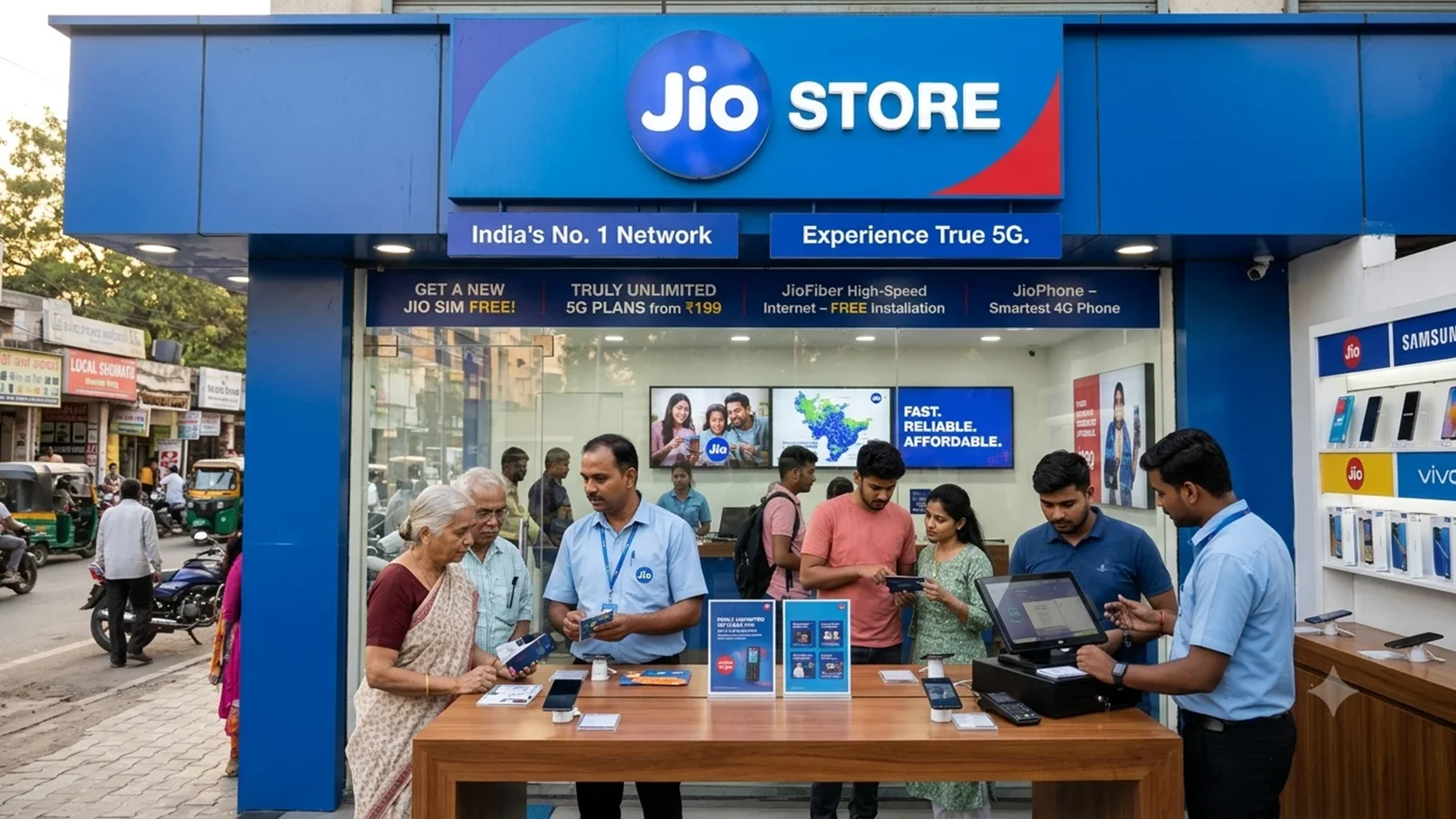
Jio’s marketing strategy was built on one idea: make data so cheap that every Indian with a phone would use it, then sell everything else on top. It launched in September 2016 with free voice calls and data, crossed 100 million subscribers in 170 days, and by September 2026 served 542.4 million subscribers, including 300 million 5G users. In October 2026, Jio Platforms listed on Indian stock exchanges after a ₹30,213 crore IPO, closing a decade-long shift from disruptive pricing to a digital platform business.
Key points
- Jio used free and near-free pricing as its main marketing tool, not just a promotion, to rewire how India used data.
- The JioPhone and later the JioBharat phone extended the strategy to feature-phone users who could not afford smartphones.
- A bundled app ecosystem, from JioTV to JioHotstar, made Jio a “Digital Life” brand rather than just a network.
- After winning scale, Jio shifted to raising prices, with average revenue per user rising to ₹218.80 a month in Q2 FY27.
- In 2020, Jio Platforms raised ₹1,52,056 crore from 13 global investors, including Meta and Google, before listing in 2026.
What was Jio’s marketing strategy at launch?
Jio’s launch strategy was price as the message. Mukesh Ambani announced the service at Reliance’s annual general meeting on 1 September 2016, and commercial services began on 5 September 2016.
The Welcome Offer gave users free voice calls, free 4G data, free SMS and free access to Jio’s apps until 31 December 2016. It was then extended as the “Happy New Year Offer” until 31 March 2017.
The results were immediate. Jio said it added 16 million subscribers in its first month, crossed 50 million in 83 days and 100 million in 170 days, among the fastest customer growth by any company worldwide.
Editor’s note: Free offers are usually tactics. Jio made “free” the strategy, because Reliance had already built a nationwide 4G network and needed to fill it fast. Most brands cannot copy this, but the lesson travels: remove the biggest barrier to trial, then earn the right to charge.
How did Jio position its brand?
Jio positioned itself as the brand that would bring India online, not as just another telecom operator. Its tagline, “Jio Digital Life”, sold an entire digital lifestyle rather than calls and data packs.
The positioning was simple and national. Jio framed cheap data as a route to opportunity, entertainment and access for ordinary Indians, using patriotic and aspirational messaging around Digital India.
The launch was also controversial. Print advertisements in September 2016 featured Prime Minister Narendra Modi’s photograph, drawing criticism over the use of his image in a private company’s advertising.
How did Jio use pricing as marketing?
After the free period, Jio kept prices well below incumbents and simplified plans. Free voice calls continued for life, so data became the only thing people paid for.
In February 2017, Jio introduced Jio Prime, a membership for existing users, rewarding early adopters while moving them onto paid plans. When the telecom regulator TRAI asked Jio to withdraw its “Summer Surprise” offer in April 2017, Jio replaced it with the “Dhan Dhana Dhan” offer.
Rivals were forced to cut prices, merge or exit. The industry consolidated sharply after 2016, leaving Jio, Bharti Airtel and Vodafone Idea as the main private players.
How did the JioPhone expand Jio’s market?
Jio’s next challenge was the hundreds of millions of Indians still using basic feature phones. In 2017, it launched the JioPhone, a 4G feature phone offered at an effective price of zero against a refundable ₹1,500 deposit.
The JioPhone ran popular apps on a basic handset, bringing people who could not afford smartphones onto Jio’s 4G network. In 2023, Jio followed with the JioBharat 4G phone priced at ₹999.
This was product marketing as distribution. Jio did not wait for customers to upgrade their phones; it made the phone itself part of the offer.
How did Jio build an ecosystem around the network?
Jio bundled a suite of apps with its connectivity: JioTV, JioCinema, JioSaavn, JioMart and others. The apps gave users more reasons to stay and made data consumption grow.
Entertainment became a major lever. JioCinema streamed IPL 2023 free, using cricket to drive app downloads and data use, and in February 2025 the merged Disney Star and Viacom18 business launched JioHotstar.
Partnerships extended the bundle further. By early 2026, Reliance highlighted JioHotstar and Google’s Gemini Pro as part of Jio’s consumer offering.
Editor’s note: Bundling worked because each app increased the value of Jio’s core product, data. For brands, the lesson is to add services that deepen use of what you already sell, not unrelated extras.
How did Jio raise money and partner with global tech companies?
In 2020, Jio Platforms raised ₹1,52,056 crore from 13 global investors, including Meta (then Facebook) and Google. The deals gave Jio capital, technology partnerships and international credibility.
The Meta partnership linked Jio with WhatsApp, India’s most-used messaging app, for commerce. The Google partnership supported affordable smartphones and Android work.
These partnerships turned Jio from a telecom challenger into a digital platform that global technology companies wanted to back.
How did Jio market 5G?
Jio branded its rollout as “True 5G”, positioning it as standalone 5G rather than an upgrade on existing 4G. It began a beta rollout in October 2022 and completed nationwide deployment by December 2023.
Jio offered unlimited 5G data to eligible users during the rollout, repeating its launch playbook of removing price as a barrier to trial. By Q2 FY27, Jio reported 300 million 5G users.
Home broadband became the next battleground. Jio launched JioAirFiber, a fixed wireless home service, and by September 2026 its fixed broadband connections had crossed 30 million homes.
When did Jio shift from low prices to higher revenue?
Once Jio had scale, its strategy moved from acquiring users to earning more from each one. In July 2024, Jio raised mobile tariffs by around 12% to 25%, alongside Airtel and Vodafone Idea.


