

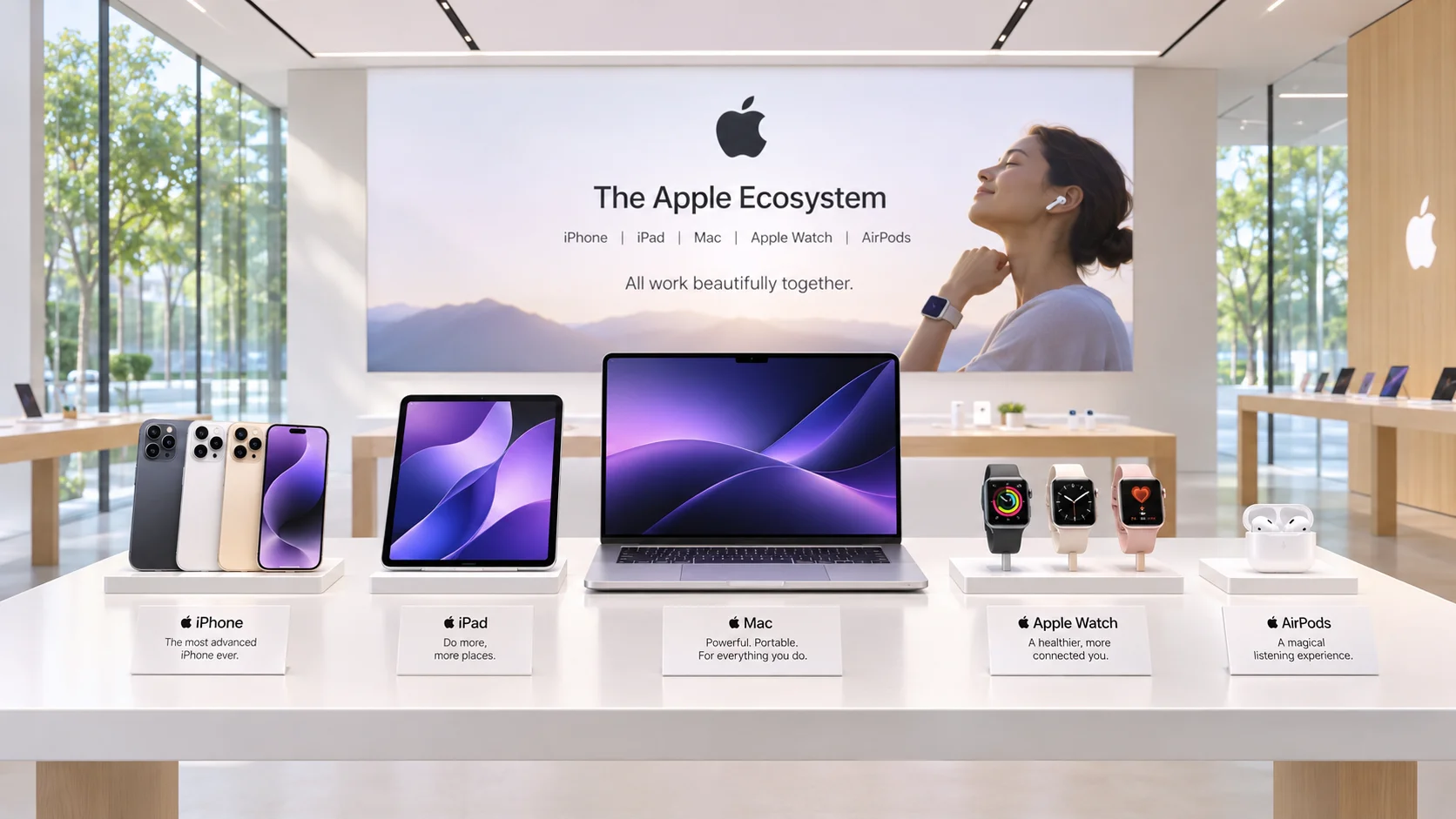
Apple’s marketing strategy rests on four choices: premium positioning built on design and simplicity, an ecosystem that keeps customers buying more Apple products and services, tight control over how and where products are sold, and advertising that shows what people do with the product rather than listing specifications. It works at scale. Apple reported record revenue of $478.8 billion for fiscal 2026, more than 2.5 billion active devices, and it remains the world’s most valuable brand in Interbrand’s 2026 ranking.
Key points
- Apple positions itself as premium and simple, and rarely competes on price or specifications.
- The ecosystem is the strategy: 2.5 billion active devices feed a services business worth $123.3 billion in fiscal 2026.
- Apple controls the retail experience through its own stores, online store and tightly managed resellers.
- Its best-known campaigns focus on people and use cases: 1984, Think Different, Get a Mac and Shot on iPhone.
- India is a growth priority, with annual sales above $10 billion and six Apple Stores.
How big is Apple’s business in 2026?
Apple’s fiscal 2026 ended on 26 September 2026. It reported record annual revenue of $478.8 billion, up 15.1% from $416.2 billion, and net income of $132.2 billion.
The iPhone remains the core business, with fiscal 2026 revenue of $254.1 billion. Services, which include the App Store, iCloud, Apple Music, Apple Pay and AppleCare, reached $123.3 billion for the year.
Apple says its installed base passed 2.5 billion active devices in January 2026, up from 2.35 billion a year earlier. Mobile World Live reports more than 1.5 billion paid subscriptions across Apple’s services.
Editor’s note: Leadership changed this year. John Ternus, formerly head of hardware engineering, became Apple’s CEO on 1 September 2026, and Tim Cook became executive chairman. The strategy described here was largely built under Steve Jobs and Cook.
How is Apple positioned?
Apple positions itself as the premium, easy-to-use choice. Its products promise that things “just work” together, look good and protect your privacy.
Three ideas run through almost everything Apple says:
- Simplicity: clean design, few product choices and plain language.
- Creativity: Apple products as tools for photography, music, art and work.
- Trust: privacy and security presented as product features.
Apple rarely compares specifications with rivals. It sells outcomes, such as better photos, longer battery life or less hassle, and lets the brand do the rest.
How does Apple’s marketing mix work?
Product: an ecosystem, not a device
Apple’s strongest marketing asset is how its products work together. AirDrop, iMessage, Handoff, iCloud, Apple Watch health features and AirPods switching make each extra Apple device more useful.
This raises switching costs. Customers who own several Apple devices and pay for services have more reasons to stay.
Apple also keeps its range relatively small. Fewer models make choosing easier and let marketing focus on a few hero products each year.
Price: premium, with ways in
Apple prices at the top of most categories and avoids frequent discounting. That protects margins and supports the premium image.
It widens access without cutting list prices. Trade-in programmes, instalment plans and older models kept on sale at lower prices bring more buyers in.
In India, sales growth has been supported by trade-ins and instalment plans that reduce the upfront cost of an iPhone, according to reports on Apple’s India results.
Place: controlled retail
Apple sells through its own stores, its online store, carriers and authorised resellers, while keeping tight control over presentation and pricing.
Apple Stores act as marketing as much as sales outlets. Free Today at Apple sessions teach photography, music, art and coding, which builds familiarity and community.
Promotion: launches, films and earned media
Apple’s product launch events, keynote presentations and carefully timed product pages generate huge earned media every year.
Its paid advertising usually shows the product in use, often with little copy. Apple also benefits from reviews, creator content and customers showing their devices in daily life.
What are Apple’s most famous campaigns?
1984 (1984)
Apple introduced the Macintosh with a television ad directed by Ridley Scott and aired during the Super Bowl. It positioned Apple as the rebel against conformity.
The ad is still cited as one of the most influential commercials ever made, and it set the tone for Apple as a challenger brand.
Think Different (1997)
After Steve Jobs returned to a struggling Apple, the company launched Think Different. It featured people such as Albert Einstein and Martin Luther King Jr., rather than products.
The campaign rebuilt Apple’s identity around creativity and independent thinking before the company had new hit products to sell.
iPod silhouettes (2003)
The iPod ads showed dancing silhouettes against bright colour backgrounds, with the white earphones as the only product detail.
They made the white earphones a visible status symbol, so every user on the street became an advertisement.
Get a Mac (2006 to 2009)
The “I’m a Mac, I’m a PC” ads personified the two platforms. The Mac was relaxed and modern; the PC was stuffy and plagued by problems.
The campaign is a textbook example of comparison advertising that never mentions specifications.
Shot on iPhone (2015 onwards)
Launched with the iPhone 6, Shot on iPhone put ordinary users’ photos on billboards and in print and digital ads. Apple has used the format for every camera upgrade since.
It turns customers into proof. Each new iPhone generation gets fresh evidence of camera quality without a new creative concept.
The platform also travels well locally. In 2019 Apple released “Our Game”, a Shot on iPhone film about India’s passion for cricket.
Privacy. That’s iPhone. (2019 onwards)
Apple turned privacy into a marketing message, with campaigns about data tracking and app permissions. This differentiated iPhone from rivals whose business models rely more on advertising.


